


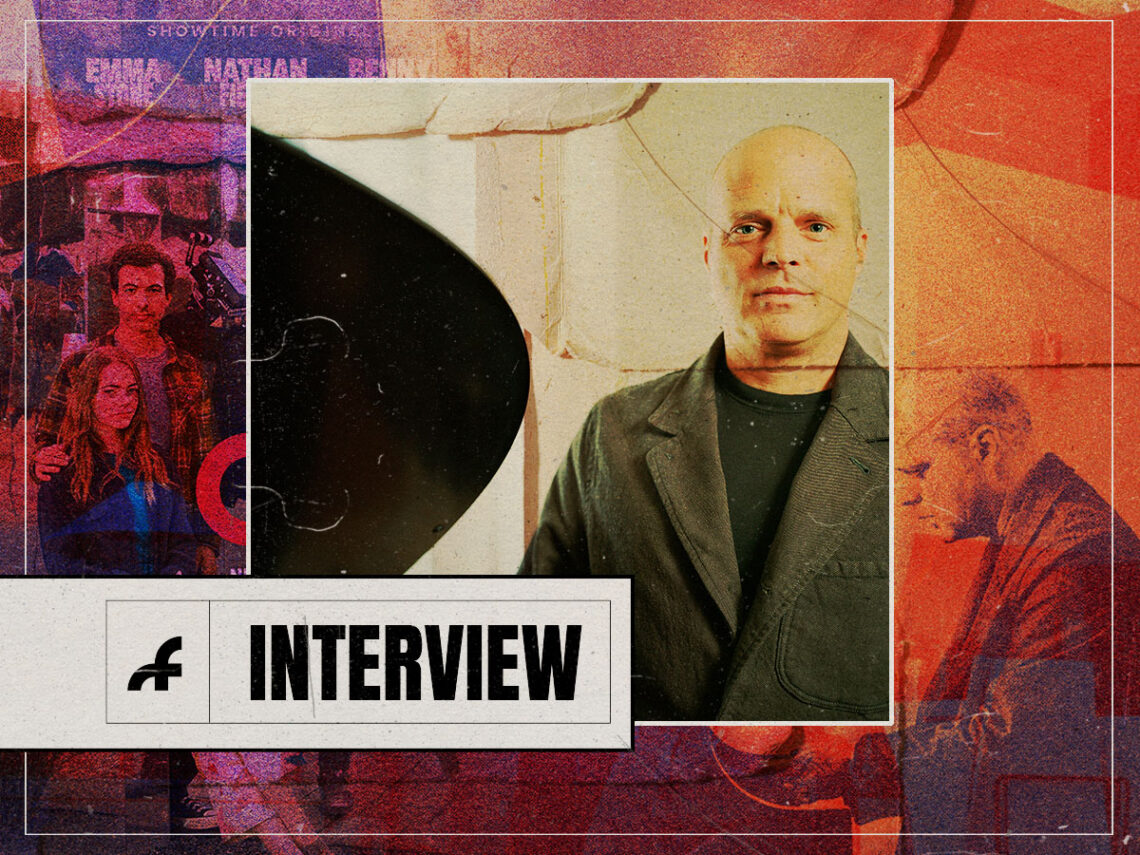
Synths and surrealism: Scoring ‘The Curse’ with John Medeski

“What we have here is a frictionless show,” Benny Safdie’s Dougie declares in the sixth episode of HBO’s The Curse, “There’s no conflict, there’s no drama. And that’s not something people wanna watch.” He’s talking about Fliplanthropy, the fictional eco-friendly home renovation show fronted by the less-than-loved Siegels, but his words could just as easily be applied to the real show it exists within. No one does meta quite like Nathan Fielder.
Much like the mirrored houses the Siegels populate Española with, The Curse is passive. It’s far more concerned with creating and maintaining tension than it is with any real conflict or resolution. The titular curse looms over the entire show, over every social blunder and every shift in Whitney and Asher’s relationship, but it hardly ever comes to the forefront.
It’s not that Fielder and Safdie had any shortage of ideas to tackle when it came to writing. Somewhere in between that uncanny atmosphere, they take on everything from gentrification to cultural appropriation, but they never stay in one place for too long. The show flits between themes with abandon and passivity. It never tells you how to feel as a viewer, leaving you to marinate in anxiety and embarrassment.
It’s a feeling that is built into Fielder’s storytelling, but it’s also one that’s entirely elevated by the production of the show. We watch Asher and Whitney through doors and windows and, at times, through our fingers, the camera always making us feel like we’re watching something we shouldn’t. But perhaps the most off-putting element comes in the form of the mystical score, which almost becomes an entirely new character or theme of its own.
This was integral to the creative duo’s vision for the show, an idea they presented to Safdie’s long-term collaborator, Daniel Lopatin, who pointed them in the direction of John Medeski. An avant-garde jazz composer by craft, he also fulfilled their other sonic muse: the music of Alice Coltrane.
“I think that’s probably why they asked me,” Medeski explains to me when he joins our call from New York, “That’s the sort of realm that I work in all the time.” Safdie approached the composer using Coltrane’s ‘Jagadishwar’ as a reference point, hoping to capture a similar spirituality without bias, an impartial yet contemplative sound, but the project itself would push them both far outside of the jazz sphere.
Rather than taking from the sounds and instrumentation of the inspiration track, ‘Jagadishwar’, Medeski took on the feeling of it. “There’s something about that track that was just deep and contemplative and beautiful,” he enthused, “And enlightened. Not happy, not sad, both. That ambiguous place between idea and emotion is, to me, the ultimate music gold place.”
Just as the show itself evolved from ambiguity on-set, incorporating real people as characters and leaning into the shooting location, the music grew into something completely unforeseen. Rather than solely creating spiritual jazz in the image of Coltrane, Medeski found himself jumping between cosmic synths and haunting chimes as the music became just as self-evolving as the show it served.
“The original inspiration was Alice Coltrane,” Medeski explained, “her playing this organ and singing. So a lot of the original things I did were with these weird organs, but it evolved into this whole synthesiser universe.” Working closely with the “masters of discomfort” behind the show, he found that allowing for improvisation and experimentation served the score best, the flow and removal of ego allowing him to harness the strangeness of the project.
“You’re almost giving over to something greater by allowing the music to happen,” he added. The music that did happen may exist in an entirely different sphere of instrumentation and genre than once planned, but it certainly maintained that unbiased spirituality of Coltrane, as well as that position as another character. It forces you into the role of an observer, Medeski noted, feeding into those off-kilter camera placements and cringe-worthy moments.

“They didn’t want the music to follow the scenes, to lead the viewer into feeling anything,” the composer explained, “They wanted it to be a different perspective, like an outside observer with this other opinion on what’s going on.”
He received dailies from Fielder and Safdie and found that the show evoked a certain feeling despite rarely returning to the same themes. “For me, each episode, it just keeps evolving, and it doesn’t really return,” he observed, “You go deeper and deeper and deeper into their psyches and into their functions and dysfunctions, and it gets more uncomfortable, and so the music needed to keep moving forward like that too.”
Like Fielder’s writing, Medeski’s aim was never to focus on those particular psyches or dysfunctions. Sometimes, he didn’t even focus on scenes, and sometimes, the music he created for certain scenes matched up with others. He hadn’t created a soundtrack in the traditional sense of the term, a strict accompaniment for narrative and visuals, but rather a sonic “pairing” for the show.
This way of working only changed when the creators reached the season’s finale. After nine episodes’ worth of unrelieved discomfort, the show quite literally releases Fielder’s character from his failing marriage and apparent curse. As Whitney gives birth to their child, gravity begins to fail Asher, and he ends the series floating in the outer depths of the universe.
The surrealism of the final entry into the series inspired Medeski to take a different approach to sonic accompaniment, making it one of the few scenes that he created to picture. “We had to follow,” he explained, “We had to get inside it and follow it all, from when he wakes up until the baby’s born, and then also to somehow keep the thread to everything else in the show.”
It seems absurd that the most subjective scene in the show required the most objective musical accompaniment, but this was exactly Medeski’s intent. “The observer thing is just built into the scene already,” he noted, “There weren’t too many perspectives to have on that other than, ‘It’s happening.’”
Unlike the show’s viewership, who immediately jumped to social media to interpret the meaning of the final episode, Medeski couldn’t form an opinion on Asher’s demise. Instead, he was forced to take a realistic approach to the surrealism, depicting it faithfully to allow audiences to entirely embody that observer’s standpoint.
Luckily, this subjectivity is something Medeski was particularly passionate about creating. “That’s my favourite thing, period,” he declared, “I guess that’s why I felt so aligned to work with these guys in this way. I like art that can have a lot of perspectives.” It’s no surprise, then, that Medeski is more than willing to work with the cast and crew again and is already brewing up ideas for a record with Lopatin.
The composer is full of praise for his collaborators and their infectious creative energy, something which shines through all the cringe and discomfort in the final cut of the show. “I think it’s one of the best things to happen in a long time,” Medeski concludes. I’m inclined to agree.
