


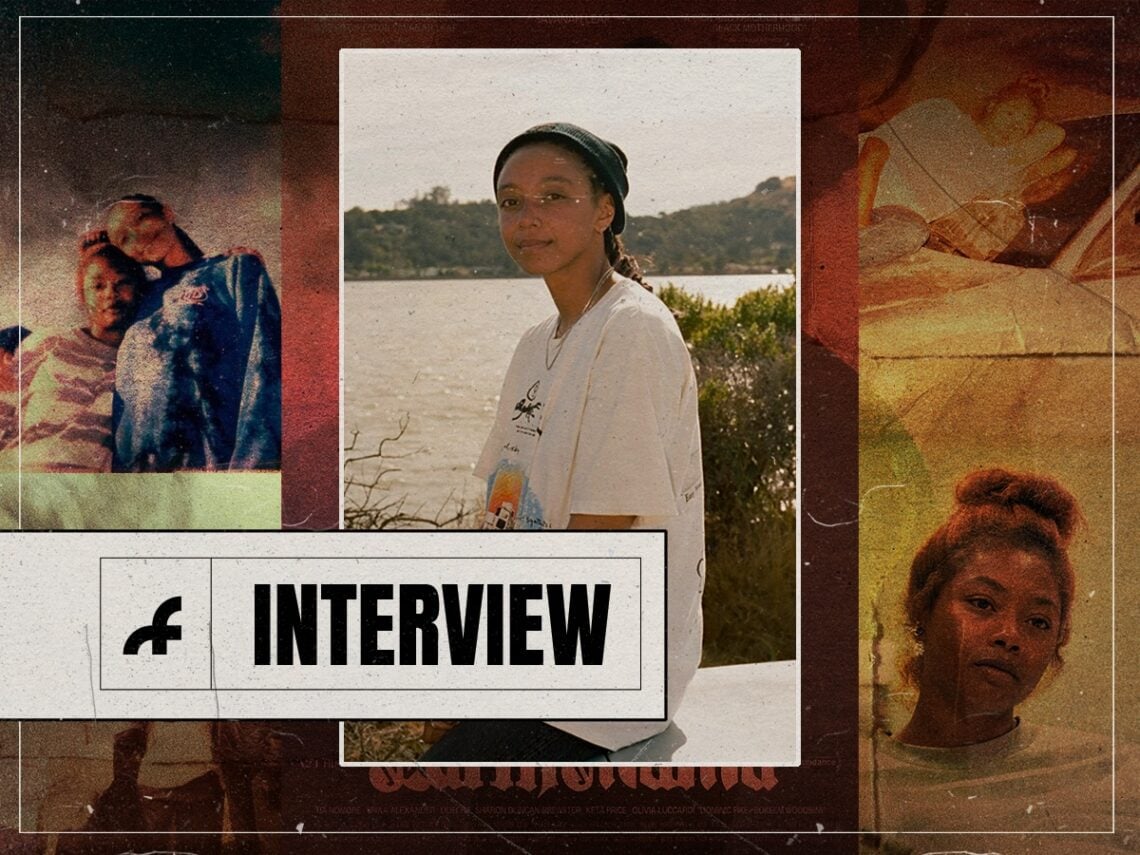
‘Earth Mama’ director Savanah Leaf discusses bringing visibility and truth to the big screen

Savanah Leaf might have started her career as an Olympian, becoming the youngest member of Team GB’s volleyball squad at the 2012 event, but now she’s proving her multi-disciplinary talents as a filmmaker, too. Following her 2020 short documentary The Heart Still Hums, which she co-directed with Taylor Russell, Leaf released her stunning debut feature, Earth Mama, in 2023.
Earth Mama is a truly extraordinary film. We follow Gia, a young single mother whose two children live in foster care due to her past struggles with drug abuse. Barely afforded the right to see her kids, Gia does all she can to fight, all while dealing with another pregnancy. She decides to explore adoption, hopeful to give her new baby a happy, uncomplicated life. Leaf beautifully explores the nuances of motherhood, pregnancy, adoption, class, community, race, identity, and family, exploring the full complexity of each issue.
Leaf’s movie is never didactic; rather, she offers us a snapshot of a character whose struggles are very much grounded in the real lives of many women across the world. Talking to Far Out via Zoom, Leaf revealed why she chose to tell a story as poignant as Earth Mama. “I wanted to centre a story around a mother – a black mother – who is fighting to get her children back, giving multiple perspectives and trying to pull away some of the initial judgments,” she said. Leaf hopes that “we can start to gain a bit more understanding and maybe empathise a little bit more” by watching films that tell stories about underrepresented and typically misunderstood characters.
Bringing “visibility” to women like Gia – who are continually failed by the systems that are supposedly put in place to provide help – is of utmost importance to Leaf. She doesn’t “pose a solution” to the issues Earth Mama depicts. Instead, “I try to show many sides to the story so that it really just brings about questions and conversations, and maybe makes people feel a little less alone with what they’re going through.”
Stories about pregnancy, honestly exploring the effects of how it feels to grow a human inside of you, to come to terms with your own body and relationship to the rest of the world, are hard to come by. Leaf gives visibility to the pregnant belly in Earth Mama by framing Gia’s naked body in an unsexualised manner. It is so rare to see scenes like these on the big screen. “That’s why it was so important to show her naked body with the belly,” Leaf told me, emphasising that pregnancy is “a wild thing”.
She added, “Motherhood just encompasses so much. It goes beyond the physical.” Thus, the director wanted to explore questions such as, “How does she relate to her own body?”
Leaf highlighted films such as Ladybird Ladybird by Ken Loach, Nénette and Boni by Claire Denis, Ossos by Pedro Costa, and The Son by the Dardenne brothers as significantly impacting her approach to exploring themes such as pregnancy and/or family. She admires these films for their “grounded” nature and the “subtlety” of the actors’ performances.

However, she also absorbed certain paintings and songs while writing the film, which “seeped” in, such as artworks by Tracey Emin and Kara Walker. Additionally, Leaf noted the influence of the album Promises by Floating Points, Pharoah Sanders and the London Symphony Orchestra, illuminating how the blend of “new age jazz with soulful, older remnants” shaped the direction she wanted to take the film.
Speaking of music, viewers might recognise several musicians in Earth Mama, including Tia Nomore and Doechii. Leaf revealed that while she didn’t actively seek out musicians, she looked for “people with a lot of experience in performance because this is a really tough script.” She also wanted to cast people from the Bay Area (where the movie is set) who “related” to the story, such as “young mothers,” with Nomore fitting the bill.
In fact, Earth Mama was Nomore’s first acting gig, with Leaf suggesting that she brought plenty of real-life experience (the star became a mother a year before shooting) to the film. Leaf and Nomore were able to “build something together,” with the director adding, “We both had expertise in different spaces and were able to lean on each other for different elements of the character.”
The influence of real stories and people’s experiences moulded Earth Mama, with Leaf’s previous experience working as a documentary filmmaker evident within the movie. Its opening sequence – which includes a character directly addressing an audience which we cannot see, making it feel as though she is talking directly to us – establishes this documentary influence from the very beginning.
Asked how she found the transition from documentary to fictional feature-making, Leaf explained that she felt as though she could potentially portray reality more honestly through fiction. “There’s a fictionalised element of documentary filmmaking because people don’t want to reveal too much about themselves,” she argued. “My favourite fictionalised features have so much truth in them that it doesn’t feel like it’s that far of a division between fiction and documentary.”
With an overwhelmingly positive response to her debut feature under her belt, Leaf will no doubt continue to create movies – whether documentary or fiction – that explore stories which need to be told. “I think the most important thing for me is to find honesty and truth in whatever I’m creating,” Leaf concluded.
Watch the trailer for Earth Mama below.
