


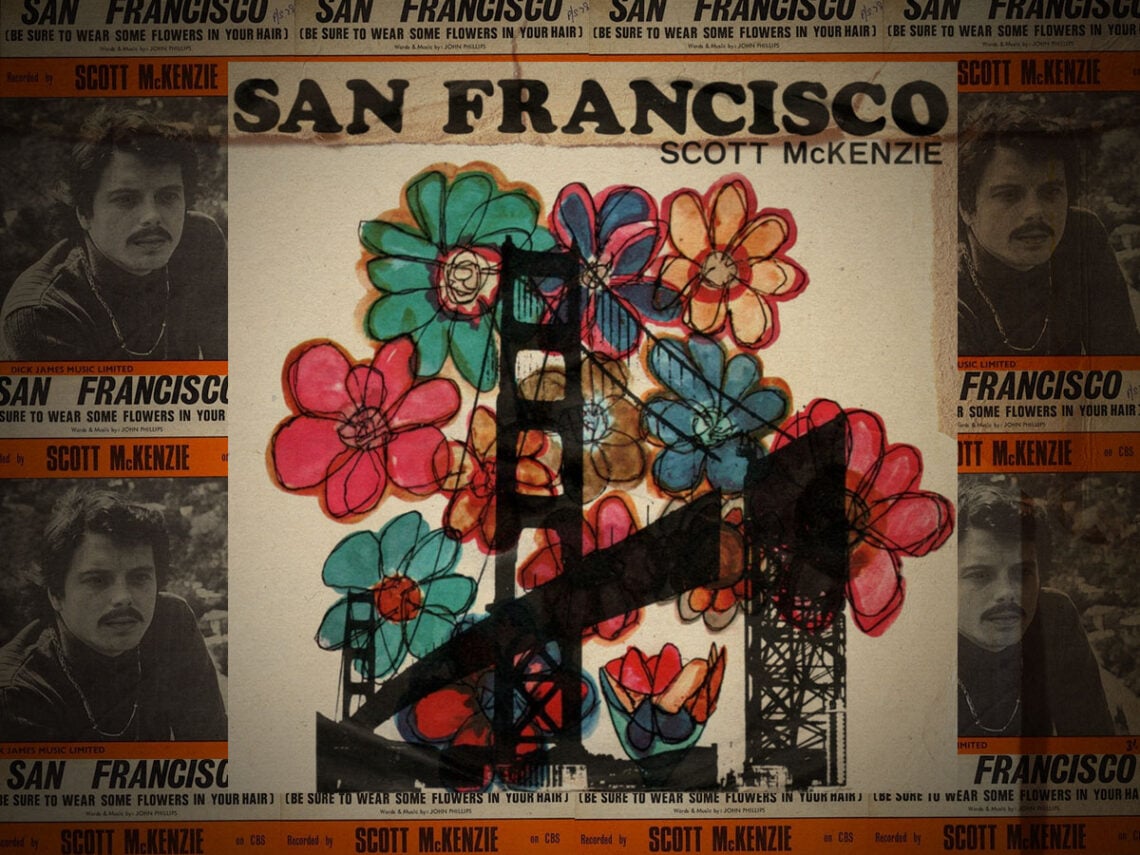
‘San Francisco (Be Sure to Wear Flowers In Your Hair)’: How a terrified town led to the definitive hippie anthem

“I used to be with ‘it’, but then they changed what ‘it’ was. Now what I’m with isn’t ‘it’ anymore, and what’s ‘it’ seems weird and scary. It’ll happen to you,” once decried Grandpa Simpson in one of the greatest pieces of social commentary in any long-running animated sitcom, and it certainly rings true when looking at social attitudes towards the blossoming hippie subculture back in the 1960s.
Born from the foundations of the Beat Generation, free-spirited hippies infected the youth culture of America back in the mid-1960s, but their political consciousness, anti-war stance, and penchant for mind-expanding drugs quickly made them the ire of mainstream society. After all, America was (and, to an extent, still is) a pretty conservative society, with ideals of nuclear families and white-picket fences forming the bulk of ‘the American dream’ for most families.
When that same society is content to send its youth halfway around the world to die in a jungle for a seemingly ambiguous cause, rebellion is something of an inevitability. For the first time in modern history, America’s youth were willing to fight back against the authority of the morally corrupt state, pushing back not just against the war in Vietnam but also the continued racist discrimination of American society. Inevitably, then, the American mainstream – who were quite happy with their warmongering government – viewed the emergence of the hippie with nothing short of pale-faced fear.
Admittedly, the media of the time were quite adept at presenting hippies as being a danger to society, particularly in the wake of the Chicago riots of 1968, during which the police had ruthlessly beaten hundreds of peaceful protesters outside the Democratic National Convention. Even before that fateful convention, though, the towns and cities of the United States weren’t overly receptive to the growing numbers of hippies infiltrating their youth, particularly in the case of San Francisco.
If any one city encapsulated the spirit, sound, and defiance of the counterculture age, it was San Francisco, what with its LSD-fueled psychedelic scene of Jefferson Airplane, Big Brother, and the Grateful Dead. Back in 1967, its hippie stronghold reputation was forever cemented when the city played host to the Monterey Pop Festival – the arguably defining event of the hippie era. However, the ordinary people living in Monterey didn’t quite see the revolutionary potential of the festival.
“The town of Monterey, 26,000 people, were absolutely terrified by this rush of youth coming across the country,” once recalled John Phillips, of The Mama’s and The Papa’s fame. So, in an effort to quell those worries, Phillips wrote a lush, peace-soaked anthem to reflect the peace and love manifesto of the hippie generation, entitled ‘San Francisco (Be Sure To Wear Flowers In Your Hair)’.
“It was the beginning of the flower power movement and all that kind of thing,” the songwriter reflected, adding: “I fell asleep in the studio and Scott [McKenzie] recorded it.”
With that landmark recording, McKenzie broke into the top five of the US singles charts, cementing the cultural command of the hippie movement and also helping to alter the public perception of hippies themselves.
All of a sudden, hippies weren’t riot-hungry communists looking to dismantle the fabric of American society, and were instead peace-loving young people trying to make their futures a brighter place. While the flower power anthem’s downplaying of the political aims of hippiedom did something of a disservice to its vital anti-war activism, and it is not clear whether it did actually ease the minds of Monterey’s residents, it did at least give an enduring anthem to the hippie movement.
