


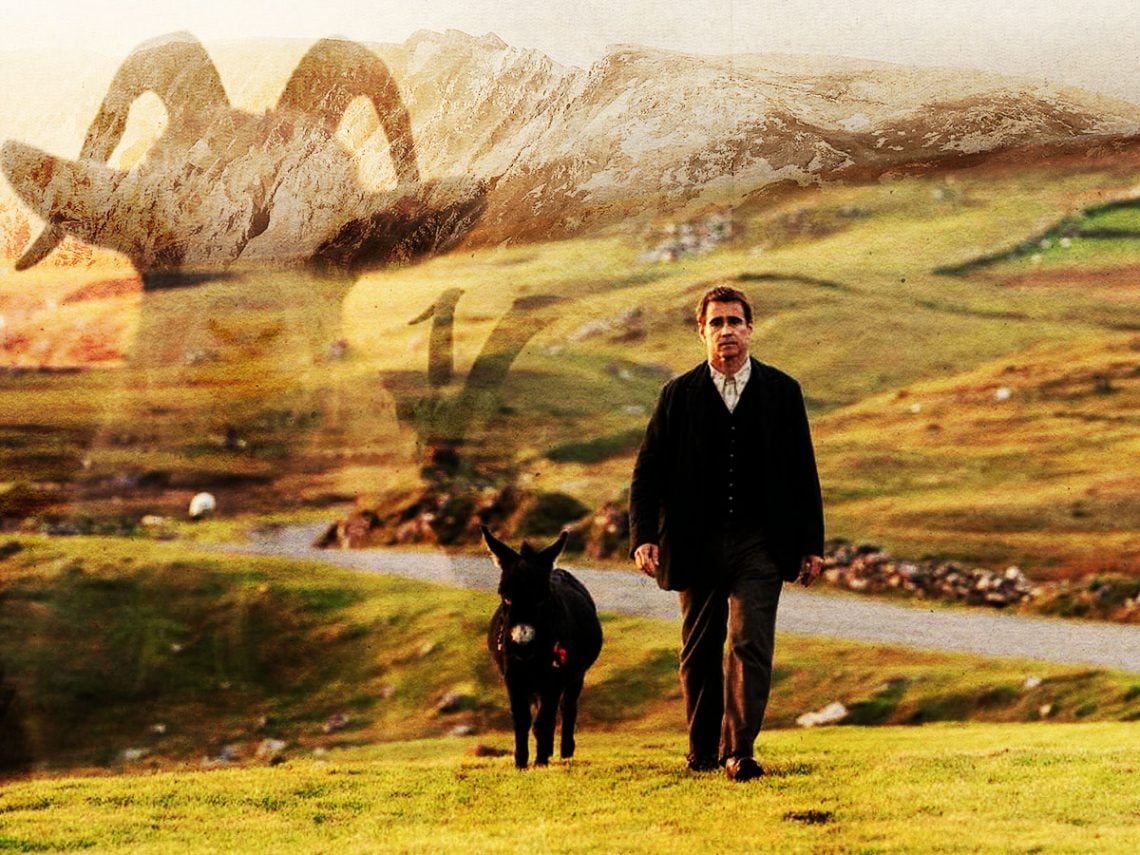
The tragicomic influence of Samuel Beckett in Martin McDonagh’s ‘The Banshees of Inisherin’

When looking at a selection of the most influential Irish writers, the first names that crop up are usually Oscar Wilde and James Joyce. Another with profound significance, however, is the great Samuel Beckett. In many ways, the famous Irish playwright shares much in common with one of today’s most respected writers, Martin McDonagh, who was born to Irish parents.
Interestingly, in light of the comparison with Beckett, McDonagh’s writing career had also begun in the theatre, and in 1994, aged 24, he wrote an impressive seven plays in just ten months. By the time McDonagh was 27, he was the first person since William Shakespeare to have four plays running simultaneously in London.
When McDonagh made the intentional move into cinema in 2004 with the short film Six Shooter (for which he won an Oscar), the early theatrical influence would remain with him until now. Notably, the most significant influence on his work does indeed seem to be Samuel Beckett, as McDonagh’s dialogue and themes are as sparse and absurd as the Irish literary icon’s.
McDonagh’s most recent film, The Banshees of Inisherin, actually started as a play – an attempt to complete the Aran Islands trilogy alongside The Cripple of Inishmaan and The Lieutenant. However, McDonagh felt that the story didn’t work as well in the theatre and he set about rewriting it for the screen whilst slightly adjusting the title from The Banshees of Inisheer (Inisheer is a real island, while Inisherin is fictional).
Beckett’s influence on Banshees is evident, even if McDonagh has not gone on record to explicitly state it – a clearly confident writer in his own right. As such, he is unlikely to delimit his own work by claiming that he had indeed had Beckett in mind when writing it (especially so given his Irish heritage and not wanting to state the bleeding obvious).
Beckett’s works are often defined as tragicomedies, which fuse the traditional elements of tragedy and comedy to create a profoundly serious mood through the delivery of underlying humour. Beckett’s plays are hilariously funny whilst simultaneously touching on the deep sadness that human beings experience as a result of the absurd lack of meaning in their lives.
To see Beckett’s influence on Banshees, we should look no further than his notorious play Waiting for Godot, which sees two relatively featureless characters (giving the sense that they could be any of us) ponder the deep questions about the meaning of life, whilst waiting for someone called Godot to arrive – although he never does.
The general feel of the play (and the meaning of Godot themselves) is that we wait around for whatever it is we desire to arrive in our lives, and, by doing so, we miss out on the things that should matter to us: morality, the existence of God, the pursuit of good, friendship and philosophical enquiry. It is because Godot does not arrive that the two characters, Vladimir and Estragon, are afforded the opportunity to toy with those notions – although whether or not they end up truly appreciating them or still allowing them to pass them by remains open to interpretation.

While McDonagh’s film is more explicit in the way in which its main characters, Colm (Brendan Gleeson) and Padraic (Colin Farrell), explore what will bring value to their lives, the way the dialogue is delivered (deeply serious and simultaneously deadpan funny), as well as the reason behind there being a story concerning them in the first place, is undeniable Beckettian in its approach.
The central premise of Banshees is that Colm has simply decided that he does not wish to be friends with Padraic any longer. Nothing more, nothing less. This, of course, is an overtly banal way to begin a story, yet it is that very banality that gives rise to the film’s pertinence.
Padraic is in shock when he discovers Colm’s intention to end their friendship and is not given a single reason for his change of heart – at the very beginning, at least. Eventually, we learn that Colm is concerned about his life passing by him and does not want to spend his limited days listening to Padraic prattle on about what he considers meaningless shit.
Through this simple intention, we are afforded the chance to discover what is most important to both men. For Colm, it’s evident that he admires music, reading, philosophy, the cosmos, and all the other lofty pursuits that have been celebrated since the ancient civilisations. Fair enough. As for Padraic, through his shock and hurt at being cast aside by Colm, we learn that he values friendship above all, even if he does not pursue the same high-minded passions as his friend.
The seemingly mundane (the barren fictional island, for example), the banal (spending all your days in the pub gossiping) and the absurdity of life (the fact that two fully grown men have fallen out because one thinks another is boring) are all toyed with, but not merely for a simple narrative value, but rather to illuminate the real meaning of life.
Discussing his tragi-comic impulses, McDonagh once said (via Industrial Scripts): “I suppose I walk that line between comedy and cruelty because I think one illuminates the other. We’re all cruel, aren’t we? We are all extreme in one way or another at times, and that’s what drama, since the Greeks, has dealt with.”
He added, “There have to be moments when you glimpse something decent, something life-affirming even in the most twisted character. That’s where the real art lies. See, I always suspect characters who are painted as lovely, decent human beings. I would always question where the darkness lies.”
In that light, Beckett’s influence on McDonagh is evident. McDonagh’s characters may be ambiguous in their morality – Colm is willing to hurt his friend in pursuit of what he considers worth his time, while the two hitmen in In Bruges are both seemingly good people despite committing awful crimes – but that is precisely how they reveal what they consider “life-affirming”.
In Beckett, that ambiguity is one of his central themes: the lack of setting and the lack of biographical details surrounding Vladimir and Estragon, for example, not to mention who or what Godot actually is. So perhaps McDonagh, having been born to Irish parents and starting his career in the theatre, felt that to acknowledge Beckett may have been too obvious. Still, Beckett’s influence is there for all to see, should you begin to peel the layers away.
