


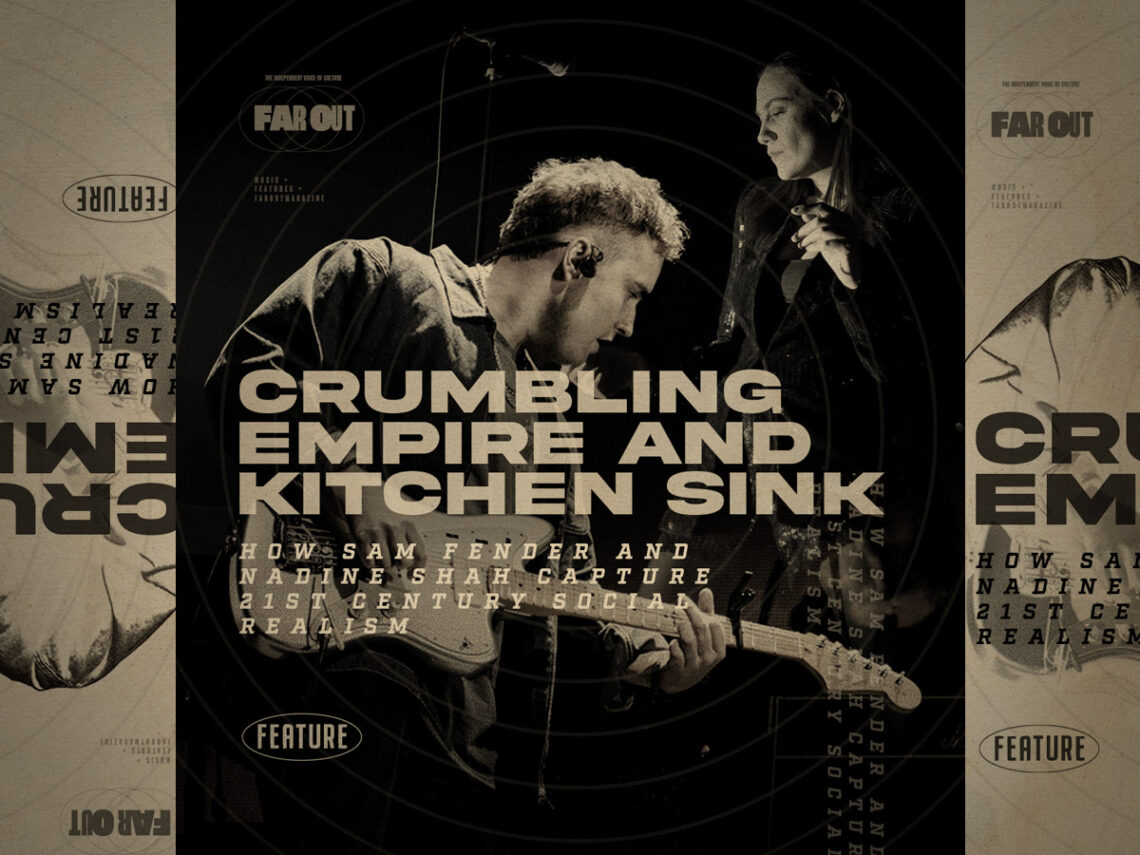
‘Crumbling Empire’ and ‘Kitchen Sink’: How Sam Fender and Nadine Shah capture 21st century social realism

The concept of social realism seems to have become pretty distorted in a 21st-century version of reality where we never truly know if anything is real. It’s artists like Sam Fender who are providing a reckoning to that.
It’s almost like Fender has swooped onto the scene within the past five years or so, like a Geordie working-class knight in shining armour – or so many of the critics like to think. His recent moment of coming up roses with the Mercury Prize is the strongest testament to that, but it’s mainly because he’s seen as the main beacon of whatever social realism is meant to mean these days. Digging deeper, however, he’s just one single cog as part of a much larger machine.
Take the likes of Nadine Shah as the prime example, whose song ‘Kitchen Sink’, taken from the 2020 album of the same name, offers up just as much of a stark commentary as anything Fender might have to say. In a lot of ways, his track ‘Crumbling Empire’ is the perfect companion; real lives under the weight of an oppressive world, a little bleak, but always truthful, and incessantly sharp through the wave of melancholy which can often surround them.
To take Shah’s song in the first instance, the notion of the ‘Kitchen Sink’ in itself is something both uniquely British and equally true to building the world of social realism. Consider so-called kitchen sink dramas of the postwar era, seeking to portray a decidedly unromantic version of life, the warts-and-all edition. Among all the tropes that came with this was often the idea of the slightly insular woman, also reflected by Shah as she sings: “Don’t you worry what the neighbors think/ They’re characters from kitchen sink/ Forget about the curtain twitchers/ Gossiping boring bunch of bitches/ And I just let them pass me by.”
Shah’s view of social realism, in this case, is the insidiousness that still manages to creep behind seemingly closed doors, even if the notions cultivated by the original kitchen sink are now more than outdated. Conversely, from his point of view in ‘Crumbling Empire’, Fender is out stalking the streets of his town. “Following suit in the Atlantic mirror/ Under the Byker Bridge, they shiver/ It’s one for me, and one for the dead/ And one for my crumbling empire,” he sings, all at once forming a vision of both the ghosts left behind and the soulless bodies left in their wake to carry on whatever semblance of legacy is left.
All in all, it’s easy to cast both songs off as a bleak picture exercise and nothing more. But whether tucked away in the home or out on the empty streets, there’s a feeling of total and utter invisibility within the throngs of the forgotten pockets of this 21st century world. On one hand, Shah says “all they see is just a strange face/ Whose heritage they cannot trace,” while Fender laments: “I’m not preaching, I’m just talking/ I don’t wear the shoes I used to walk in.”
While it stems from different eyes, the message is essentially the same: no matter what outfit you wear or the guise you put on, social realism of the 21st century is the cloak that the rest of the world simply looks through as if it is never there.
Of course, amid a political landscape becoming ever stauncher and more extreme in its views, leaving behind what really matters in favour of the most inflamed rhetoric, it’s songs like ‘Crumbling Empire’, ‘Kitchen Sink’, and a litany of others which have the greatest chance of shifting the dial. This is not because they seem helpless or desperate, but because they communicate a truth that many others would rather be left unsaid. And, with every word of reality they deliver, maybe the plight of the 21st-century working classes becomes a little less invisible, more and more.
