


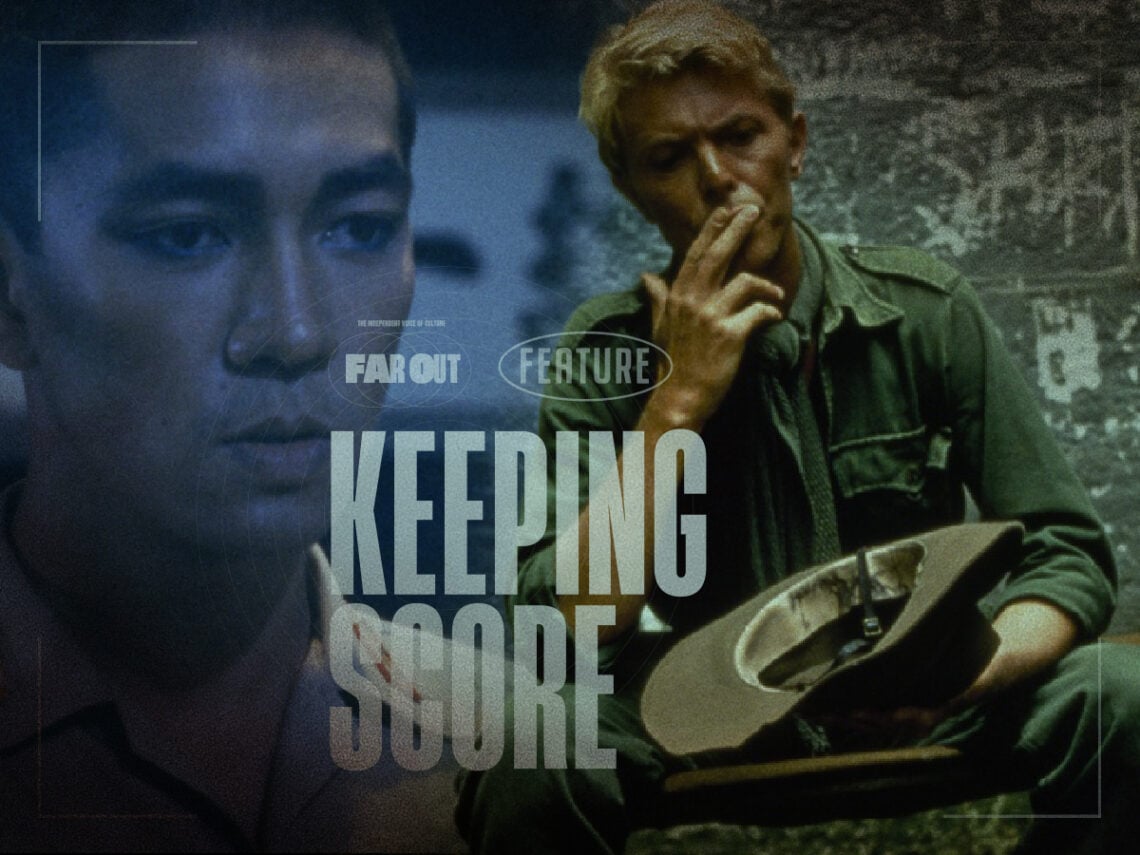
Keeping Score: Ryuichi Sakamoto’s haunting take on a ‘Merry Christmas’

At Christmas time, nothing brings people together quite like movies and music.
Every year, we find ourselves returning to the classics, the songs and films that remind us of the good old days, spark memories of yuletide joy, and that get grandma to shut up for five minutes about what she read in the Daily Mail the other day. This article could have been about one of the many great scores that accompany our festive favourites, but instead, it’s about a really depressing war movie that just so happens to have the word Christmas in its title.
Released in 1983, Merry Christmas, Mr Lawrence is a Japanese film from director Nagisa Ōshima that’s set during World War II, following the titular British prisoner of war played by Tom Conti, as he finds himself caught between cultures and loyalties to his fellow countryman, David Bowie’s Jack Celliers, and the camp’s Draconian commander, Yanoi. This character was played by the late, great Ryuichi Sakamoto, who also provided the film’s most memorable element: its score.
Having first found success as part of the band Yellow Magic Orchestra (YMO), Sakamoto was thrown in at the deep end of movie composing, and with this being his first ever film score, he was forced to split his time between acting and writing music. Luckily for all involved, he took to it like a natural.
The most memorable element of his Bafta-winning work is the film’s title track, an ethereal piece comprised mostly of synthesisers, where the theme is instantly recognisable through its simple five-note scale, which ascends and descends throughout.
Having pioneered electronic music with YMO, Sakamoto found it funny that the genre had become full of what he called “Orientalist clichés”, so while writing the music for his first-ever film job, he wanted to honour his country’s place in the narrative without falling into this same trap.
“I was careful not to use any real Japanese elements, or a Japanese scale,” he told Wire magazine in 2000, “The pentatonic scale is all over the world, it’s not Japanese at all. I wanted to write music which would be Oriental to anybody, to [the] West or [the] East, but not particularly coming from Japanese culture. Somewhere, but nowhere.”
While the original version of the theme has no words, David Sylvian, frontman of the band Japan (no obvious connection to the country) quickly filled that niche, lending his distinctive voice to a vocal version called ‘Forbidden Colours’, where Sakamoto and his chemistry is on remarkable display. The song was an instant hit in multiple countries, and even though Sakamoto wished he could have recruited Bowie for it, the track became their calling card.
As both a chart musician and a film scorer, Sakamoto always matched the brief perfectly while never losing his individual flair, and while his score for The Last Emperor might have landed him an Oscar, it was his work on Merry Christmas, Mr Lawrence, in many ways, remains his creative peak, even after his tragic passing in 2023.
