


Who is on the cover of Rush’s album ‘Power Windows’?

The only thing rivalling the intrigue left behind by Power Windows was its album artwork. Continuing the exploration of synth and other electronic facets that Rush established throughout Grace Under Pressure, they evoked more considered efforts to enhance the progression with structures that seemed deceivingly simple. Fronting this new chapter was the cover, which captured their balance between intricacy and control.
Recording the material under the guidance of a new producer, Peter Collins, and engineer, James Barton, Power Windows started to take shape with a whole new approach and attitude, with the band members being encouraged to view songs or song snippets as parts of a whole. This naturally created a far more relaxed environment than what they had experienced on Grace Under Pressure, knowing that any ideas they brought to the table were better if they were in their earliest stages.
This also ensured that the record itself was the primary focus from the get-go, with Geddy Lee saying that the push to “not to hold anything back” made them do the one thing they never did: think about how the songs would fair on stage later. While this inexplicably fed into the album’s broader themes of power and control, they would likely have explored this in some format, given their longstanding interest in complex themes and the newfound desire to pivot their sound into something more relevant to the times.
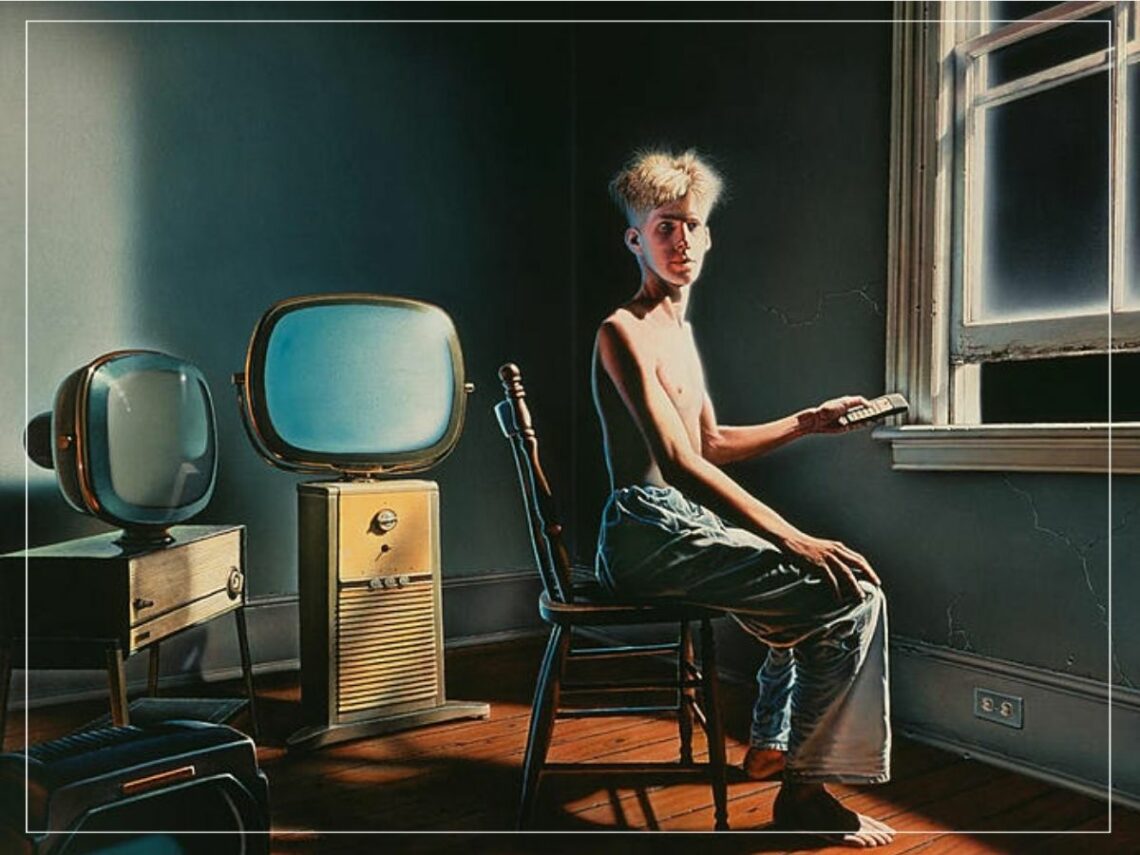
The artwork provided an additional visual asset to this idea, with an image designed by longtime collaborator Hugh Syme depicting a teenager, Neill Cunningham, gazing at the lens in a moment of control while surrounded by television sets. It’s a striking image, and one that reflected the broader themes of the material with an added layer of ambiguity that could be enlightening or unsettling depending on the interpretation.
So, who is on the cover of Power Windows?
Cunningham, who was selected to adorn the sleeve, points a remote control at a window with his back against the televisions in a bedroom in Toronto. Shot by photographer Dimo Safari, the image tackles power with reality and the media, utilising contrasting elements, like a seemingly vintage chair in a minimalist setting, glossed with a sheen that comments on modern-day technological advancements.
For the cover, Syme had wanted “a skinny blonde” guy to bring the image to life, to which Cunningham was suggested by a friend who had been working with Safari at the time. Interestingly, however, Cunningham wasn’t a massive fan of Rush then but said yes to the opportunity because it still seemed exciting to be involved with. Moreover, as a music lover without many inroads, it was a no-brainer.
When he arrived on set, however, Cunningham was already aware that Rush’s music hinged on the conceptual and understood the vision they were trying to conceive. Although his path hadn’t crossed with much of their material, knowing his position in the broader artistic scope made him feel more involved from the get-go, allowing himself to fall into the idea they wanted to capture.
As he explained to Vice: “The thing with Rush is their music’s really involved, their lyrics are generally really conceptual. It’s almost high art. It’s like prog rock, where they’re giving you story. […] They don’t do love songs, they don’t do songs about girlfriends… not a lot of love songs, but a lot of high concept, a lot of politics, a lot of futurism, control—this [image] was really all about control. There’s a lot of imagery going on there.”
