


Rupert Goold’s ‘American Psycho’ camp musical can’t quite land the kill

Anyone who’s seen American Psycho will tell you this: Patrick Bateman is not real, or rather, what he does isn’t real, because the power he’s afforded through Wall Street’s hedonistic heyday is upheld by gimmicky, intangible structures, like capitalism and masculinity.
Heck, we’ve started on the wrong foot: whether or not Patrick Bateman is real, Rupert Goold’s revisited camp musical at London’s Almeida Theatre certainly is, and therein lies its issue. The camp whimsy, the kitschy effects, the dreary synth soundtrack, and the gory bodies fight awkwardly for dominance, resulting in a play too aware of itself to be legendary, landing heavily at our feet with a thud.
Despite some great scenes, what we’re left with is more a feeble fable than a flamboyant fairytale, and in a story as deliciously mind-melting and confusing as Bret Easton Ellis’s 1999 novel masterpiece, followed up by Mary Harron’s 2000 film adaptation, any other adaptation must find, and stick to, one spear-headed conceit to distinguish the forest from the trees.
Goold’s been here before. The play was first staged by the director when he took over the Almeida Theatre in 2012, and that production, which starred Matt Smith in the lead role, made it all the way to Broadway and became a cult classic, and this time, he is taking one last bow with the play’s revival as he hangs up his hat as artistic director.
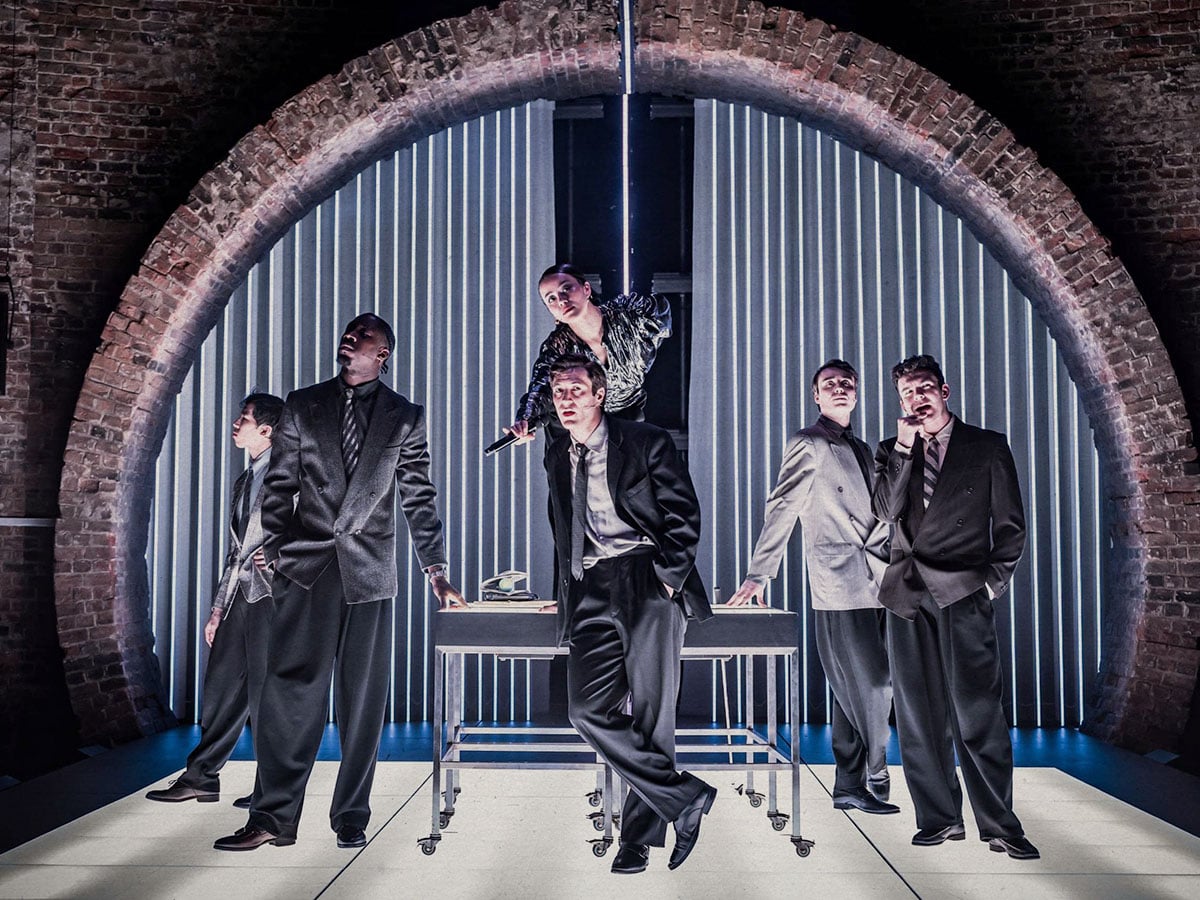
Actor Arty Froushan is an impressive Bateman, nailing the preppy intonation which slips insidiously into blood-curdling mania over the course of the two-and-a-half-hour production. The larger ensemble is artfully kitted out in swanky suits, 1980s-core mini dresses, and ripped fishnets, as well as, in one laugh-out-loud scene, neon aerobic outfits.
In this way, the production begins with much promise, which is upheld most of the way through the first act. The infamous business card meeting, which sees Bateman and his colleagues obsessively compare business cards, is delightfully obnoxious, breaking out into an original song and a dance number which embodies 1980s corporate narcissism, cutting new figures from the same boxy suits.
However, in the second half, the slick, stylised nature of the project becomes clunky and heavy, where characters must wait for a fellow actor to shuffle off-stage before delivering their line. The communicative mismatch between Bateman and his fiancée, Evelyn, played by Emily Barber, once rollicking, becomes frustrating, and a scene in the Hamptons, where the stage is awash with a painful neon blue, is stagnant and uninspired.
By the end of the overwrought play, the thread is all but lost. In what appears to carry the weight of the final scene, the ensemble runs on, scrubbed of their wigs and extra trimmings, to follow a clever light show across the floor of the stage, in reaction to Bateman’s confession to the policeman working the case of Paul Allen’s disappearance.
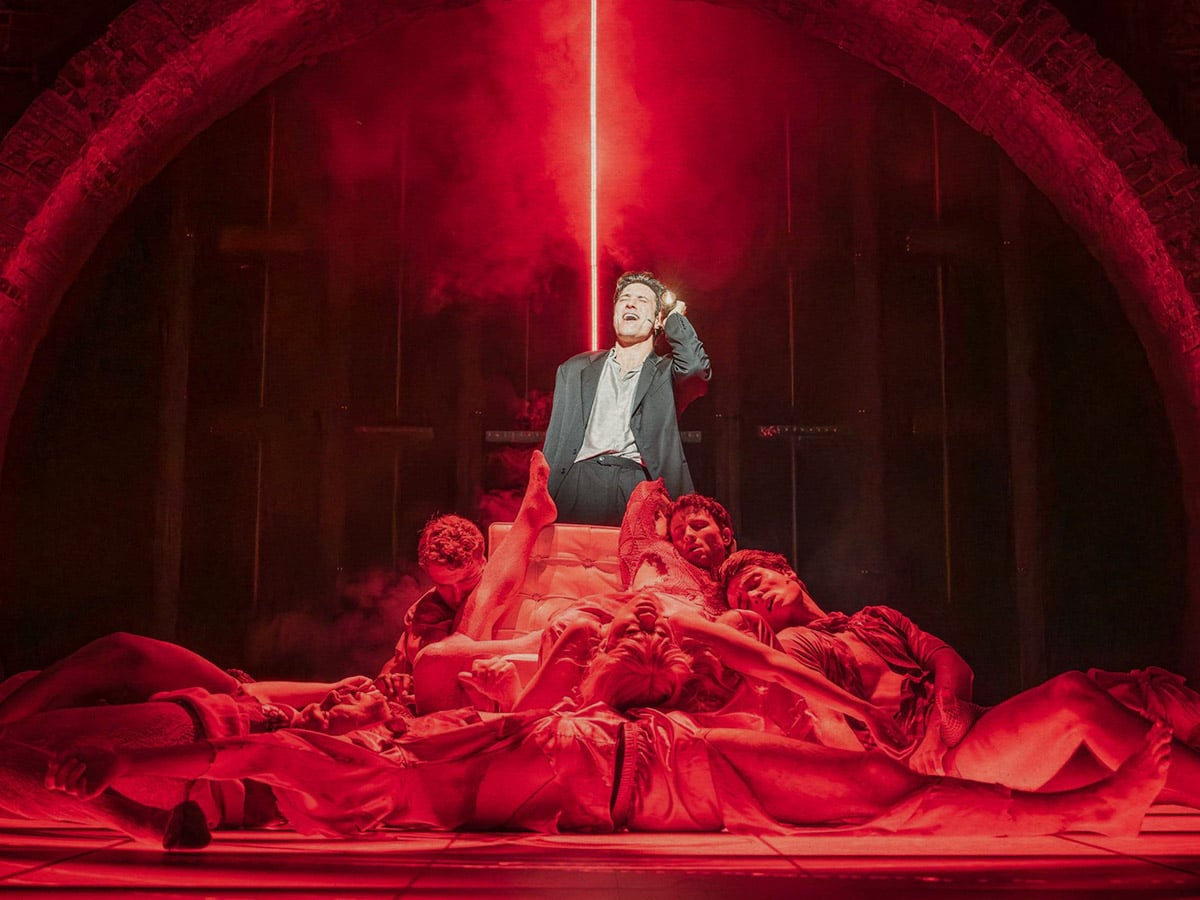
But nope, that wasn’t it at all, as the play jerkily picks up once more, in a pseudo-resurrection of one of the corpses in the choreographed and admittedly impressive mass-killing numbers. Instead, we have Bateman monosyllabically mincing a formulaic rendering of the most famous lines from the novel, and ones the theatre has chosen for the official tag line: “There is an idea of a Patrick Bateman, some kind of abstraction, but there is no real me, only an entity, something illusory”.
Some of the most provocative lines are spun into a spoken-word over-explanation of what the viewer had just seen play out, as if refusing to trust the audience’s media literacy. “Maybe this schism is just a symptom of late capitalism,” Bateman muses, only somewhat better from an earlier killing-spree scene when he sings, “Hey, I know a great spot, it’s called the abyss!” I love camp as much as the next guy, but despite Froushan’s fierce commitment, not even he can make the lines sound right.
Goold has at least attempted to zap new life into the cult classic, with the highly capable Oli Higginson delivering an outstanding mockery of Donald Trump, whom our Bateman is obsessed with. A nod to Jeffrey Epstein’s island comes early on, and discussion of the “death of Downtown” drips eerily into gentrification disputes taking place across all parts of the capital.
Is it enough? Not quite. Is it too much? Not even. The murdering of sex workers and the homeless might make for heavy thematics, but Goold brandishes them expertly through the high-energy action moments. Instead, the story is let down in the slower moments, such that ultimately, I left the theatre with one long nod and, in place of a shriek, a yawn.
