


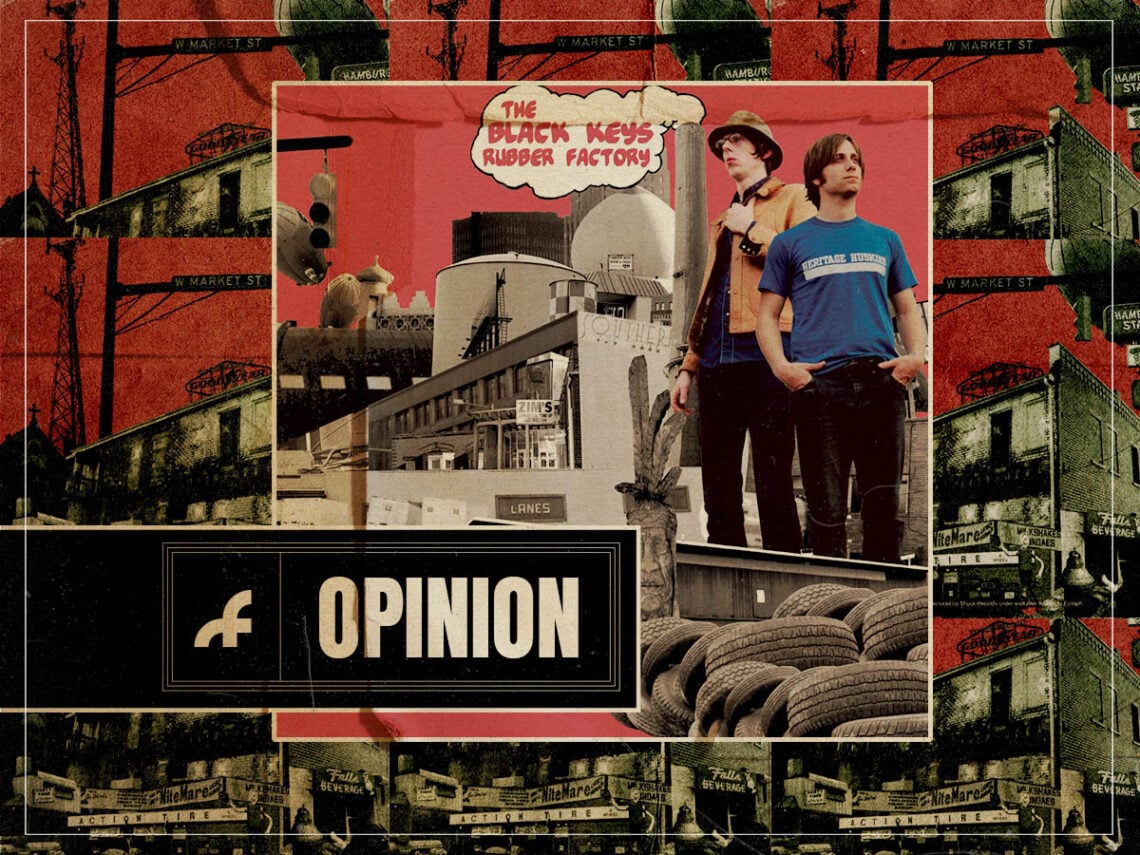
Hear Me Out: ‘Rubber Factory’ is still The Black Keys’ best album

Blues-rock survivalists The Black Keys have now released 12 full-length studio albums in total since their 2002 debut, and while nobody tends to organise those records into specific eras, a la Taylor Swift, doing so is actually surprisingly easy.
The first era of the Keys could be called the ‘Basement Years’ (2001-2007), referring to the four LPs recorded in Dan Auerbach and Patrick Carney’s shared hometown of Akron, Ohio, with a consistent minimalist DIY ethos and a necessary low budget. Era Two, the ‘Danger Mouse Days’ (2008-2015), saw the band grab the brass ring, so to speak, leaving Akron for Nashville, partnering with an adventurous new producer, and parlaying their growing critical favour into bonafide commercial success, with several smash radio hits and a surprisingly large pile of Grammy awards.
The third and final era, which may have no clear end in sight, is the ‘Elder Statesmen’ period, launched with 2019’s Let’s Rock and loosely defined by a solid sameness—if not in the sound of the records, then at least in the responses from journalists: “Nothing groundbreaking here,” they write after each new release, “But Dan and Patrick know what they’re doing.”
The Elder Statesmen era also saw one of the more embarrassing chapters of the Keys’ run, as they were forced to completely abandon an ambitious 2024 arena tour planned behind the release of their latest record, Ohio Players. Disappointing sales of both the album and concert tickets led to the cancellation of those dates and the unceremonious firing of the band’s management team. In the aftermath, it was hard not to surmise that The Black Keys had, after 20 years, plateaued a bit in the public consciousness and that their internal assessment of their own seat-filling capacity had gone sadly askew.
Is Ohio Players, then, the “big comedown” to bookend their 2002 debut record, The Big Come Up? I wouldn’t go that far. But then again, I also have a slightly different opinion on when The Black Keys were actually at the peak of their original ascent.

If we’re talking about trophies, record sales, TV appearances, and cultural relevance, the nominees for the “best Black Keys album” would certainly come from the Danger Mouse era. Both 2010’s Brothers and 2011’s El Camino were monsters, each going platinum in America twice, with the latter also earning platinum status in the UK. The band headlined more than 100 shows worldwide in 2012, playing mostly the hits from both albums (‘Tighten Up’, ‘Gold on the Ceiling’, ‘Lonely Boy’) and basking in almost universally positive reviews.
For this reason, it might sound counterintuitive to argue that the boys’ best album had quietly come out almost a decade earlier. If you were listening in 2004, though, you might agree.
Rubber Factory, the third Black Keys studio album, hails from the Basement Era but is also somewhat of an outlier. Whereas the two records before it and the one after it were literally recorded in Patrick Carney’s basement, Rubber Factory was recorded, again quite literally, in an old abandoned rubber factory (there is actually no shortage of such buildings in Akron, Ohio, the former tyre manufacturing capital of the world). As such, the album still has the band’s early raw production sound but adapted for a bigger room, almost in expectation of arenas to come.
It’s booming, loose, never self-conscious, and establishes more of a signature sound for the Keys—free from their old blues idols as well as the comparison points that had plagued them in the early 2000s (namely, the White Stripes). When future critics would describe albums like Ohio Players, Let’s Rock, or 2022’s Dropout Boogie as “a return to form” or “a call back to The Black Keys’ roots,” they were essentially identifying noble efforts to recreate the alchemy of Rubber Factory, a record that could only be made by two minimally ambitious Midwestern guys jamming out in a hollowed-out tyre plant.
I would happily put ‘10 AM Automatic’, the second track on Rubber Factory, head to head with any of the hit singles from the Danger Mouse Days. It’s certainly not as slick or perhaps as sonically “interesting”, but it’s a kick-ass, three-minute audio blast furnace that would burn up any frills someone attempted to attach to it.
Prefer something more akin to drinking a Pabst Blue Ribbon by a campfire with an acoustic guitar and the ghost of your lost love as your only company? ‘The Lengths’ is the ballad for you. Want to follow that up with a straight-up ZZ Top meets RL Burnside blues jam played through a quivering amp with a half-blown fuse? ‘Keep Me’ is your choice.
Rubber Factory is The Black Keys, which is still in small-town mode; it is a proud “Ohio Players” in reality and not just in name. If it’s not their best album by every measure of creativity and quality, it’s still the best manifestation of what Auerbach and Carney were first aiming for when they dropped out of college and gave the music thing a shot.
