


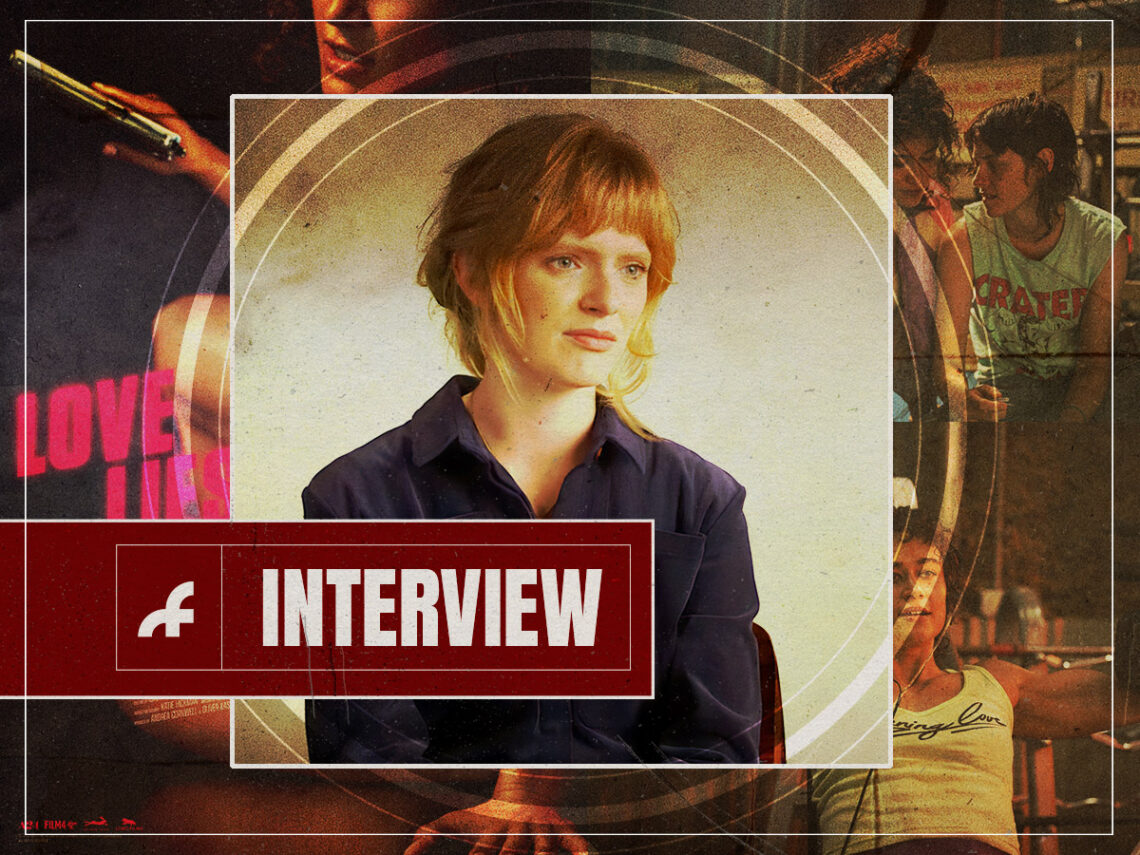
Rose Glass on ‘Love Lies Bleeding’, mullets, and defying convention

She may only have two features to her name as a director, but Rose Glass is already regarded as one of the most dynamic and exciting rising filmmakers in the business, with her second film marking a drastic departure from the first.
Bursting onto the scene with atmospheric and nerve-wracking psychological horror Saint Maud, Glass subsequently took her talents to the United States to partner up with powerhouse production company A24 for romantically-inclined crime thriller Love Lies Bleeding.
When Katy O’Brian’s ambitious and determined bodybuilder Jackie shows up in a dusty New Mexico town, Kristen Stewart’s introverted gym manager Lou is instantly smitten with the mysterious newcomer. What follows is an intense and passionate romance that quickly becomes complicated by the violence that begets them at every turn.
Lou’s father Lou Sr. (Ed Harris) owns the local gun range where Jackie finds a job, Dave Franco’s J.J. works for the long-haired patriarch and convinces Jackie to sleep with him to get the job in the first place, while he’s also married to Lou’s sister Beth (Jena Malone), and Anna Baryshnikov’s Daisy has an obsessive fascination of Lou that means she’s instantly suspicious and distrustful of her new lover.
Those individual stories intersect and combine to create an intoxicating whole, with Love Lies Bleeding effortlessly weaving between elements of the crime thriller, neo-Western, family drama, film noir, pitch-black comedy, and the occasional burst of full-fledged fantasy, often in the space of a single scene. For Glass, though, walking that tonal tightrope came naturally.
“I guess it was kind of a constant balancing act,” she admitted. “At every stage you’re making every decision as you’re writing it, shooting it, casting it, designing it, you’re constantly weighing up this tonal tightrope. So that was, one the one hand, a challenge. But on the other, I think this is what comes naturally to me as well. It’s following what I liked.”
It’s a drastic departure from Saint Maud in almost every way, but Love Lies Bleeding does trade in several of the same themes. The concept of loneliness and a desire to belong are intrinsic to both Morfydd Clark’s title character in the former and both Jackie and Lou in the latter, a connection that wasn’t lost on Glass.

“It must seem to happen to quite naturally,” she mused on the similar undertones. “I mean, it’s only my second film, but even in my short films, they were usually either isolated characters or people struggling or finding weird ways to connect. I supposed both Maud and Jackie particularly are people who feel maybe isolated or overlooked, trying to make themselves feel powerful and visible and transform themselves in an obsessive, ill-advised kind of way.”
Love Lies Bleeding unfolds in 1989, and while the time period is perfectly suited to the narrative, the script wasn’t always written with a specific year in mind. Although “it was always a period piece” according to Glass, the very first idea placed it in the 1960s, which for her was important because it was an era “before female competitive bodybuilding really came up and became a proper sport.”
“I think we floated back and forth between the 1970s and the 1990s and then eventually settled on the 1980s,” Glass offered of trying to nail down the timeline. “Which felt like a culturally, politically, thematically appropriate decade to have as a backdrop of this story, which in some ways is very much about ego and ambition, and individualism.”
Glass has been open in saying the production set up shop in New Mexico for financial and budgetary reasons, but it’s incredibly fitting. It’s the UFO capital of the United States, and in a way, Lou and Jackie are outsiders who get wrapped up in what could reasonably be called a star-crossed cosmic love story. And yet, those connections completely went over the director’s head at first.
“It’s so weird. I was an idiot, I didn’t even think of the whole UFO sighting stuff until well into the shoot! And then I think at one point I was looking at a gift shop and I was like, ‘Why are there so many alien themed magnets here?’ I overlooked that, but I think it must have been meant to be.” Seizing the opportunity from that point on, the alien references made their way into Love Lies Bleeding eventually.
“There must have been something in the water that made me think of it. The location that we’d found for the place where there’s this big giant crack in the earth that the characters have to go and hide a body, the place that we shot that does just look like the surface of the Moon, it’s this weird like gypsum mine,” Glass continued, but that was far from the end of the cosmic connections.
“When I was coming up with the name for the gun range, we called it Louville because Lou’s dad is called Lou and he’s a narcissist, but then I googled it, and Louville apparently is the name of a crater on the Moon. So then we call the town Crater.” Having picked up the baton and started running with it, Glass decided to carry on the newfound interstellar attachment into post-production.
“Once we got into post, some of the music that we chosen had this kind of weird, twinkly, synthy sci-fi kind of feel,” which then carried through into the visual effects. “So then because of that, we found ourselves finding any opportunity to put lots of digital stars in the sky whenever there was an empty shot of the black sky, which did then seem to thematically fit quite nicely with the idea of Lou and Jackie, as you say, being these kind of lonely outsiders, I think.”
Somewhere between coincidence and fate, then, the stars certainly aligned for Love Lies Bleeding in more ways than one to further its otherworldly aspects. “We had a music consultant who was doing a lot of work during prep, kind of setting the kind of musical tone for the film,” Glass said. “He’d done all these playlists, and one of them was just called ‘Cosmic Love’, I think. And that’s where all these twinkly, sci- fi feeling sort of cues came in. So it all kind of fed into each other.”
If there’s one thing as important to Love Lies Bleeding as its central love stories, then it’s the mullets. Lou Sr has a luscious mane that doesn’t consider touching the top of his head to signal he’s the man in charge, whereas J.J. has a shorter version to illustrate his status as an underling. Lou, meanwhile, has a rougher and more homemade-looking mullet, while outsider and interloper Jackie gets a luscious perm.
Did Glass intentionally use mullets as a means to convey symbolism, or were we reading far too deeply into the hairdos? “No, that’s pretty right to me, the haircuts do tell a story” the filmmaker confirmed, saving the hassle of an awkward moment of being told ‘nope, it’s just hair’, before outlining why those decisions were made for reasons that weren’t entirely aesthetic.
“Once Ed had got himself these glorious extensions, that definitely influenced how we then styled Dave, who plays J.J. And yeah, we thought that exactly, he’s one of the underlings of Lou Sr. Perhaps he aspires to be like him one day, and so he’s in the early baby mullet stage, not full-blown villain just yet. And Lou? Yeah, she’s definitely got a bit more in common with her dad than she’d like to admit, maybe manifesting subconsciously in her choice of hairstyle.”

Love Lies Bleeding is an intense ride from start to finish, though there are several jarringly graphic scenes featuring extreme violence, it’s also surprisingly hilarious. Not that Glass had any interest in penning zingers and one-liners for the sake of it, with the multitude of funny moments feeling completely situational and organic, with the co-writer and director naming a couple of unexpected touchstones as required viewing for the cast to get a handle on the tone.
“I told both Katie and Kristen to watch Showgirls, which is maybe an unintentionally funny film, but still, there’s obviously a playfulness to it.” Stewart didn’t take the advice on board at first, but when she did, she completely understood the assignment. “Kristen didn’t watch it until like halfway through the shoot, and she came out of her trailer one day having watched it like, ‘Oh, OK, now I get why you keep telling me to like go bigger.'”
Glass gave her assessment on how to derive comedy from some seriously dark moments, and they’re played to perfection both stylistically and performatively on-screen. “It’s literally as simple as that when you’re shooting something, you can say it’s OK for people to laugh at the scene, actors can calibrate their performances to or against that kind of thing,” she said. “And from the from the outset, I’d always wanted it to have quite a lot of dark comedy. When me and Weronika [Tofilska] – my co-writer – when we were coming up with a story, a lot of the time, we were just like trying to make each other laugh. And I guess we’ve both got quite sinister senses of humour. So again, that sort of came naturally. Encouraging the cast to be aware of how the scene is going to come across, it sort of gives them permission to go a bit further.”
A potential downside was that it went against the instincts of the two leads, but again, Glass gave them the room and freedom to find the best way to approach their performances: “Kristen and Katy, naturally, they’re both quite understated performers, which is good at balancing out some of the more ludicrous elements of the film.” To strike the ideal tonal balance, Glass would often encourage them to try it from a multitude of angles. “But, it meant that a lot of the time basically being like, ‘OK, again. Big, more, let’s try the comedy version. Now let’s play it straight’. It’s getting them to try it every which way. And they’re just really, really funny. I think she [Stewart] should do more comedies.”
That being said, Glass doesn’t “want it to feel like I’m just getting them to do it over and over again, each time trying to refine it to get this one perfect thing.” Instead, she found it more beneficial to “play around with it and try out a lot of different things when you’re shooting, and then you can sculpt stuff a lot when you’re editing,” and the versatility of the performers is also key: “I think it loosens the actors up as well, Glass said of the process. “If there’s less pressure on, ‘OK, get it right’, it’s like, ‘Cool, we’re just trying stuff out’. And if they’re more relaxed, I think that helps hugely, particularly the comedy stuff.”
Beyond Paul Verhoeven’s notorious Showgirls acting as inspiration, Saturday Night Fever was another title bandied about, which summed up the eclectic markers Glass laid down ahead of Love Lies Bleeding. “Also Crash, the Cronenberg film,” another movie on the list that illuminated the esoteric nature of what Love Lies Bleeding became. “All of them in have in common the fact they take place in their own slightly warped universes, which have a foot in reality and a foot somewhere else. And it’s a mixture of sort of like grittiness and heightened, fantastical-ness.”
To tick the box Glass dubbed as “dark eroticism with weird power dynamics,” Stewart and O’Brian were pointed in the direction of Shinya Tsukamoto’s 2002 cyberpunk erotic thriller A Snake in June and Liliana Cavani’s psychological war drama The Night Porter with Charlotte Rampling and Dirk Bogarde, largely because they “explore quite messed-up sexual relationships in a very intimate, extreme kind of way,” which she thought “maybe they’d be useful ones for them to get a flavour of.”

Without diving headlong into spoiler territory, the ending of Love Lies Bleeding fully embraces the fantastical elements Glass discussed. It’s a fitting way to put an exclamation point on the story’s thematic driving forces, but it wasn’t a decision settled on without some internal discussion.
“It felt instinctually to me and Weronika the most natural combination, but then we did get cold feet at one moment, and both started to think, ‘Can we get away with that?'” They certainly could, but despite attempts at “writing the more grounded, sensible version where essentially the same dynamics play out in the same way,” both Glass and Tofilska “missed the terribly fantastical elements.”
It plays into the relationship between Lou and Jackie, too, as Glass explained; “Between those two characters there’s a heady romanticism to it, it was more important to capture that kind of feeling, perhaps in a non-literal way. So we switched back, and we’re very glad we did.”
The love affair between the two protagonists is every bit as intense as it is passionate, but does Glass think Lou and Jackie have what it takes to make it as a couple? “I’m not sure I hold out too much hope for their long-term prospects, but I think they’re going to have a pretty exciting few months ahead,” she admits. “I think they suspect it’s going to be one of those relationships they both look back on and go, ‘What the hell was that?’ They’ll probably be pivotal in both of their lives, but I think reality might catch up with them eventually.”
It definitely wasn’t the case nor the intention, but theories have already emerged from Love Lies Bleeding that operate under the assumption Jackie isn’t even real, but a figment of Lou’s imagination. Glass never thought about it that way, but she’s nonetheless happy to accept multiple different readings of her film.
“I welcome it, I find it really interesting,” she said of the interpretation. “They’re almost like two parts of the one psyche in a way. Figuratively, there are ways in which Jackie does come along and break Lou out of these patterns of behaviour that she’s got stuck in, so yes, she does kind of play that role. But I don’t think that means she’s not real. If anything, I’d say that because Jackie is a real person, that’s a little more trouble for her because she does these things for Lou, but in the process maybe loses a part of herself or gets derailed from her own dreams. So it’s a slightly parasitic relationship, where Lou’s kind of feeding off her in a way.”
Having gone from rural British horror to a sun-baked American thriller for her first two features, Glass is hopeful of carrying on her eclectic career path with whatever her next film turns out to be. “I kind of like the idea of flitting from genre to genre,” she conceded. “Now having done one in England and one in America, I’m a little torn between continents, so it’s been fun problems to solve, what to do next.”
There’s always the prospect of television, a medium that’s roped in some of the best and brightest filmmakers in the business to tell longer-form stories, but Glass self-effacingly believes she doesn’t quite have the levels of patience and stamina required to bring her gifts to the small screen.
“I feel a bit intimidated by the world of TV, and to be honest, it’s hard enough to make a two-hour film, although both of my films are pretty comfortably under two hours, so I think the idea of doing four hours of television or whatever it is, that sounds exhausting.” Her Love Lies Bleeding co-writer is of a different mind, though, and recently directed one of Netflix’s most talked-about shows.
“Weronika, she’s the main director from Baby Reindeer, which she was prepping and shooting while I was doing Love Lies Bleeding. So seeing it, it’s a pretty mammoth undertaking. I think I’ve got too short an attention span, maybe, to commit to one project for that long. I think if I did anything that wasn’t features, I’d be more interested in looking at… I don’t know, I’d rather do some weird art installations, or live visuals, and stuff like that,” she confessed. “Shorter, rather than longer, is the key.”
While Glass isn’t likely to be lured into the “double-edged sword” of big-budget productions, one thing is clear: her vision is as wide, encompassing and forever-stretching as the night’s sky above.
