


How a chunk of classic rock’s greatest albums have The Rolling Stones’ truck to thank

Some classic rock aficionados will be aware that Deep Purple’s 1972 classic ‘Smoke on the Water’, known better for its legendary riff than the lyrics, was inspired by a fire that broke out during a Frank Zappa show at the Montreux Casino in Switzerland.
While no one was seriously injured, the blaze did destroy the building, and the flames made their way to the edge of Lake Geneva as the guys in Deep Purple watched with terror from their hotel rooms.
What might be slightly more obscure information is that the band were actually in Montreux to record what would ultimately become their best-selling album Machine Head; only they weren’t booked into any studios in the city. As explained in the lyrics to the song, they already had a studio that went wherever they went, a studio on wheels.
“We all came out to Montreux,” the first verse begins, “On the Lake Geneva shoreline / To make records with a mobile / We didn’t have much time”. The “mobile,” as singer Ian Gillan later clarifies in the song, is the “Rolling-truck-Stones thing” parked just outside the casino, a portable music studio that the band had on loan from the ‘Glimmer Twins‘ themselves.
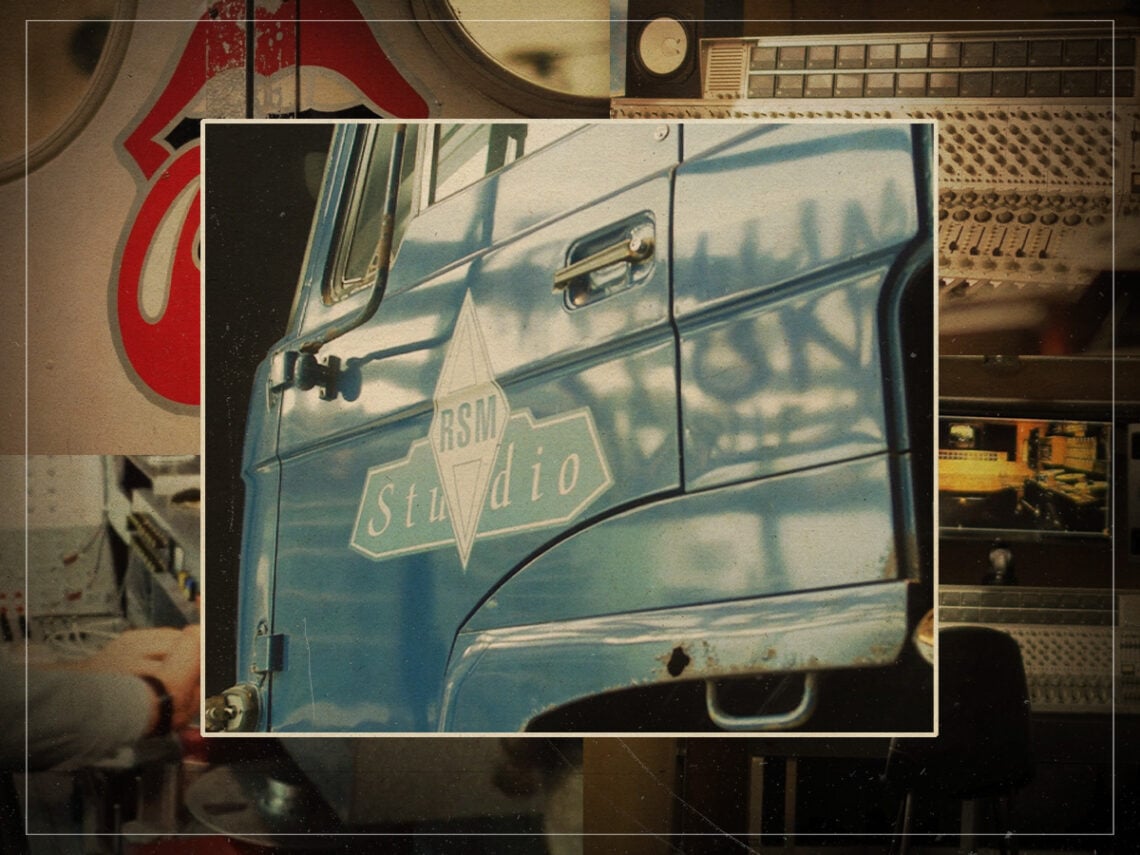
Officially known as The Rolling Stones Mobile Studio or RSM Studio, the truck was born out of necessity as by the late 1960s, The Stones had grown tired of the rigid schedules, union rules, and creative constraints of traditional studios, and recording at odd hours in borrowed mansions or remote country houses suited their nocturnal habits far better. To make that possible, they commissioned a custom-built mobile unit in 1968, produced by the crack team at the Helios Electronics company and outfitted it with cutting-edge gear for the time.
Inside the nondescript-looking truck was a surprisingly powerful setup, wherein the early iterations of the RSM involved an eight-track recorder, which was later upgraded to a 16-track Helios console, paired with high-end outboard equipment like Pultec equalisers, UREI compressors, EMT plate reverbs, and a carefully curated mic locker heavy on Neumanns. The control room was compact but professional, and long multicore cables allowed bands to record in castles, barns, theatres, or hotels while the truck sat safely outside, akin to a sort of television truck outside a sporting event.
However, Deep Purple were far from the only beneficiaries; in fact, the RSM quietly became one of the most important ‘recording studios’ of the early 1970s: The Stones themselves used it extensively, including on large portions of Sticky Fingers and Exile on Main St, the latter recorded primarily in the humid basement of Keith Richards’ Villa Nellcôte in the South of France, Led Zeppelin tracked parts of Led Zeppelin III and IV with the mobile too, capturing the thunderous drum sound of ‘When the Levee Breaks’ in the stairwell of Headley Grange, and The Who used it to record parts of Who’s Next.
The truck was literally hosting a who’s who of classic rock royalty, such that other artists followed suit in the form of Fleetwood Mac, Santana, Bad Company, Wishbone Ash, and even Bob Marley. In many cases, the mobile studio didn’t just offer convenience, but it helped define the sound of the records, with the raw, roomy ambience and slightly rough-around-the-edges fidelity becoming synonymous with the era’s most beloved rock albums.
The Rolling Stones continued to own the truck up into the mid-1980s, when they sold it to their own bassist, Bill Wyman, to use as part of his Ambition Invention Motivation Success (AIMS) programme, giving recording opportunities to young, up-and-coming musicians. It was still occasionally borrowed by major bands, however, with Iron Maiden gearing up the “Rolling-truck-Stones thing” as late as 1990 for their album No Prayer for the Dying.
