


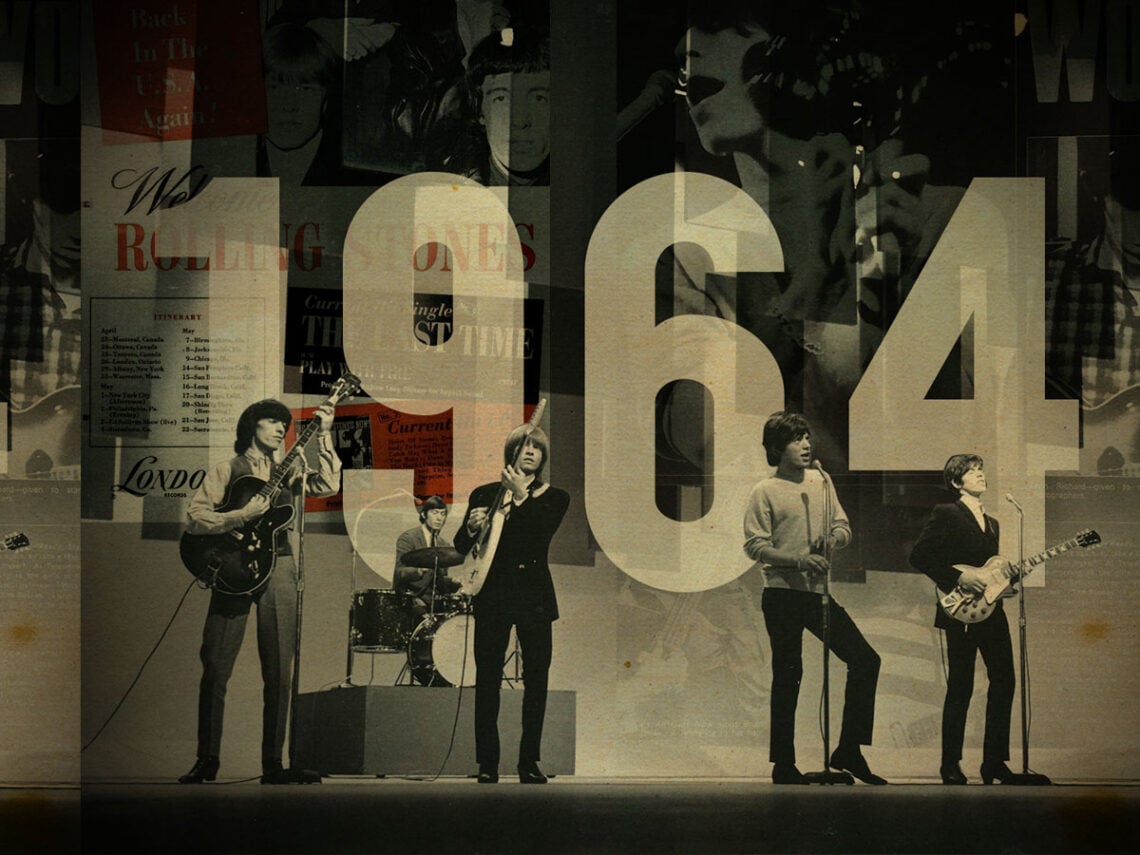
So, what about The Rolling Stones’ debut on ‘The Ed Sullivan Show’ in 1964?

On July 11th, 1962, The Rolling Stones played their first ever show. It was at the Marquee Club in London, and their only intent was to have a good time, and maybe one day, they’d be the finest blues covers band in London. Only 837 days later, they’d be the new rebels on The Ed Sullivan Show.
It was a manic ride. When the Stones arrived in America in the autumn of 1964, things had turned a bit crazy for the band. Following their disappointing arrival earlier in the year, they headed back to Blighty well and truly overshadowed by the towering Beatles and the buzz of Beatlemania. Yet, they were too young and eager to be deterred.
So, they knuckled down and honed their attitude as the hardened alternative to the happy-clappy Fab Four. A run of rougher chart hits later, the group had ensured that they were the talk of the town when they returned to the States a few months further down the line.
They were met at JFK by a horde of fans screaming “we want The Stones” following their return trip across the pond. It was enough to confirm them as the new saviours of rock ‘n’ roll and the progenitors of its dark new edge. As the Melody Maker headline from March, ‘64 encapsulated, ‘Group Parents Hate Makes Big Hit’.
Shortly after touching down, they sold out two nights in New York and were being asked to appear on countless television shows. One such appearance was for the illustrious Ed Sullivan Show and things were never going to be sane again. It was the kind of mania that had previously been reserved for the Fab Four alone.
But now, the Stones saw their opportunity across the pond and were not about to let it run through their fingers. It was clear that, unlike the solo days of Elvis Presley, a whole movement was afoot. Myriad manias were being whipped up. As the most high-wire act amid the rock ‘n’ roll hubbub, the German publication, Die Zeit, was even moved to ask, “Are the Beatles passé?”
There was now a window of opportunity for the Stones to hammer that home on the very show that launched them.


So, how did The Rolling Stones play out on Ed Sullivan?
The Stones’ manager responsible for booking them on the show, Andrew Loog Oldham, had cut his teeth as a publicist for The Beatles and clearly understood the power of The Ed Sullivan Show and the impact The Rolling Stones appearing on it could have on record and ticket sales. The Stones were in good hands and were poised, ready to capitalise on the opportunity.
On the evening of October 25th, 1964, Mick Jagger, Keith Richards, Brian Jones, Bill Wyman and Charlie Watts all sat backstage anxiously awaiting their call time to go on air in front of the majority of Americans. It may sound an over-estimation but in a time with limited entertainment, Sullivan represented a must-watch moment for the entire family.
The Beatles had summoned roughly 38% of the entire American population to tune-in with their debut performance. That was the benchmark that the Stones had been set. And it didn’t help with the nerves. While they waited they were treated to an eclectic bunch of acts. That also didn’t help with the nerves.
The Ed Sullivan Show was a variety performance after all so the boys were treated to the husband and wife comedy duo of Stiller and Meara as well as an incredible nineteen-year-old Israeli violinist called Itzhak Perlman. Despite the quality of these acts, it was clear that the audience was getting impatient. It was apparent by this point, that variety shows were mere fodder. The real event was the rock ‘n’ roll music.
Soon enough the call came and The Rolling Stones took their spots under the spotlight in front of a highly-charged studio. The show was full to the brim with screaming fans all desperate to catch a glimpse of one of the hottest bands on the planet. The curtain raised to reveal a fresh-faced Mick, Keith, Brian, Bill and Charlie staring back at their adoring crowd.
The Rolling Stones had arrived in America and they weren’t ever going to leave again. In fact, they may well be the greatest American band ever to be born and raised in Britain. As Mick Jagger said when that every point was put to him years down the line, “We’re probably going to gloss over the achievements of some good American bands of the time, but maybe it’s because British bands had a good overall history of the thing – blues, country, rock, black music, jazz, whatever.”
That “synthesis” of American music that the Stones had assimilated was about to set the States alight.
Dutifully, the band performed the Chuck Berry classic ‘Around & Around’ with Jagger doing his usual swashbuckling best, flanked by Richards and Jones to deliver a memorable performance. As soon as the last notes of the song landed, the curtain dropped unceremoniously on the band. Shrieks of horror ensued from the crowd in front of them and at home.
The producers had taken the band away from their fans too soon, and the audience wasn’t afraid of telling them. They didn’t stop screaming either. As the next act got ready to come onto the stage, the crowd were still screaming so loudly that it had become intolerable for the older heads in the production team.
In fact, Sullivan lost his temper and shouted “Quiet!” at the bay crowd several times. The audience eventually subsided to allow acts of The Kim Sisters and the acrobatic Berosini family to take the Stones place, but none could fill their scuffed shoes. The crowd still wanted more.
The Rolling Stones were soon back to close the evening’s show with their newly shared single, ‘Time Is on My Side’. Despite their hellraising reputation, the Stones were in a compliant mood and were clearly keen to impress. Oldman recognised the value of the show, and they were determined to make a long-lasting, upstanding impression on their hosts.
They ran straight to their spots ready to start it all over again. The fresh face of Mick Jagger is that of a young man finding his mettle. He exchanges knowing glances of bubbling lust with the audience and generally tries to rile up the crowd with every move he can. The audience duly reciprocated.
As the performance came to a close, Sullivan challenged the crowd for more noise, saying, “Come on, let them hear it!” The crowd met his challenge like a gaggle of seagulls meets a dropped bag of ships at the seaside, delivering a fearsome roar. The noise was so loud that Sullivan’s quick chat with Jagger after the performance was almost entirely inaudible.
How many people tuned in?
The response of those outside the studio was a little different, however. The show had managed to stump up a whole host of ticket sales for the group, but it had also landed the band in hot water with America’s brooding conservative faction, who, at the time, were unhappy with the inclusion of debauched rock and roll on their family-friendly show.
They wrote to The Ed Sullivan Show in their droves to condemn the band. According to Jagger, the letters flooded in, with the singer explaining, “Ed told us that it was the wildest, most enthusiastic audience he’d seen any artiste get in the history of his show.”
Jagger continues, “We got a message from him a few days later, saying, ‘Received hundreds of letters from parents complaining about you, but thousands from teenagers saying how much they enjoyed your performance.’”
However, that wasn’t the view a reporter from a Canadian newspaper had; they wrote: “Ed Sullivan wrote to say that he agreed with my description of the Stones as a grubby lot, and to pledge that he won’t have them back. I am bucked up by Ed’s promise that ‘So help me, the untidy Stones will never again darken our portals’.”
In the end, that rather neatly summarises their impact. They might have drawn in 36million viewers, almost exactly half that the Fab Four had managed, but their divisive vigour made them the hottest ticket in town and they famously managed to flog over $1million in ticket sales for their US tour off the back of the performance.
Without being truly caustic, they managed to tow the line. And they’ve been towing it ever since. The Fab Four might have been unassailable, but it was the Stones making sustainable waves.
Source: Ed Sullivan Show / UDiscover
