


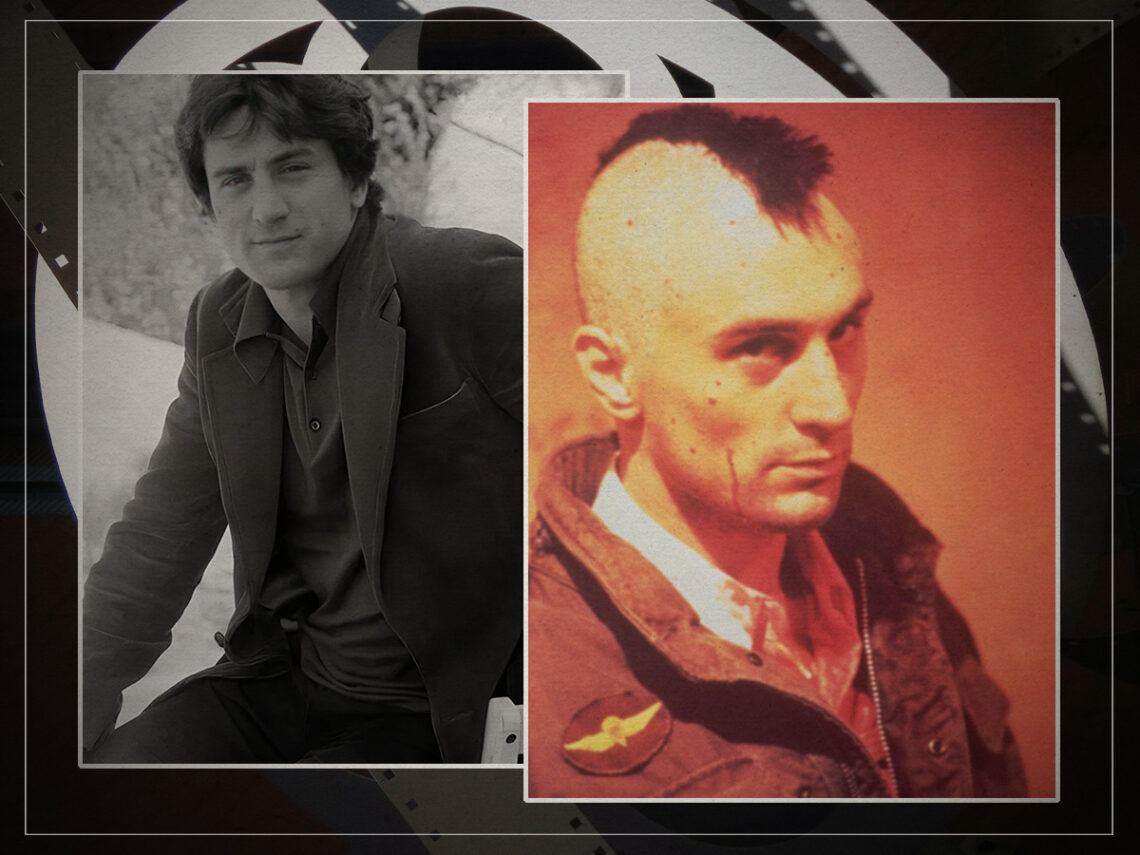
One Robert De Niro role was the polar opposite of Travis Bickle: “From black to white”

When Robert De Niro landed the role of Travis Bickle in Martin Scorsese’s gritty character study Taxi Driver, there was no doubt in anyone’s minds that he would master the role. Having previously worked with Scorsese on Mean Streets while also being fresh off the back of Francis Ford Coppola’s The Godfather Part II, De Niro had established himself as someone terrific at playing characters placed in gritty and seedy environments yet full of depth.
Thus, it was hardly surprising when he gave an incredible performance as Travis Bickle, the war veteran driving the streets of New York to distract from his insomnia, illuminated in neon and littered with needles and fast food. He drives the corrupted individuals that plague the city—the rude and the ruthless—and his disillusionment only keeps him up, terrorising his mind with their lack of respect. His mental state weakens as the movie unfolds, and he turns to thoughts of murder and vigilantism, cutting his hair into a sparse mohawk.
The film won the Palme d’Or at the Cannes Film Festival, while De Niro’s profile heightened even more, with the actor proving himself to be one of the most essential figures of the New Hollywood period. However, his string of intense roles took their toll on De Niro, who jumped at the chance to take on a part that would see him step into an earlier period of Hollywood—that famed golden era.
The Last Tycoon, directed by Elia Kazan, was an exciting opportunity for the actor. Not only did he get to work with an incredible cast and crew, including actors like Robert Mitchum, Tony Curtis, Jeanne Moreau, Donald Pleasence, and Jack Nicholson, but he also got to do something wildly different. “It was like going from the darkest depths to light and inspiration; from black to white; from total angst to being with Kazan and Sam Spiegel… It was a whole other thing,” De Niro once said (via Robert De Niro: A Life by Shawn Levy).
The film might have experienced a lukewarm reception, but he had a great time shooting it. He got to prove his versatility, that he could do more than New York stories featuring gangsters and family feuds. Kazan revealed in the same book, “Bobby has never played an executive, he’s never played an intellectual, he’s never played a lover. I had to find that side of him; it was unexplored territory.”
The movie would become Kazan’s last, and while it wasn’t exactly A Streetcar Named Desire or On the Waterfront, De Niro was just pleased by the opportunity it gave him. Still, many critics labelled it a disappointment, especially considering that the screenplay, adapted from F Scott Fitzgerald’s last unfinished novel, was written by the iconic playwright Harold Pinter.
Clearly, even a star-studded cast and an impressive list of people working behind the scenes couldn’t save the movie from becoming one of De Niro’s weaker films from a decade otherwise flooded with critical and commercial hits.
