


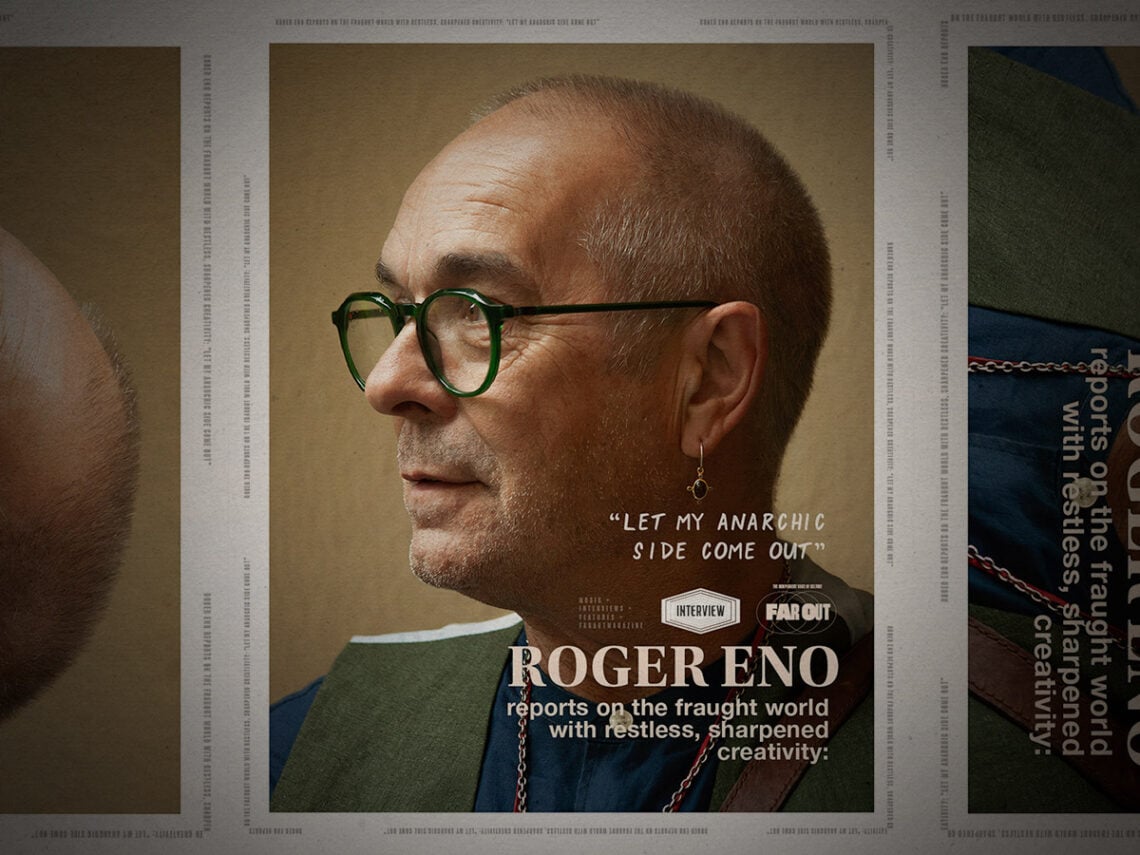
Roger Eno reports on the fraught world with restless, sharpened creativity: “Let my anarchic side come out”

On the face of it, composer and multi-instrumentalist Roger Eno was enjoying something of a creative peak, touring the US and Europe across early 2024, with a final date at Italy’s Algebra delle Lampade music festival in Pesaro’s Teatro Sperimentale arts venue that would see him perform an acclaimed solo piano concert to a well-receiving audience.
Finishing the piece and walking off stage amid the enthusiastic reception, Eno was struck with a nagging doubt: “Jesus, I’m really bored”.
A restlessness had crept in. Tired of old ways of working and too familiar with the material he was performing, Eno sought to upend his approach and hurtle straight into the unknown terrain of improvisation to glean gems of spontaneity informing the sessions of his awaited forthcoming album. Producer Christian Badzura was afforded free rein to pursue any creative intuition in the experimental process, and the Scoring Berlin classical musicians were pushed to deviate from the sheets in front of them, under the agreed rule that no such curious detours would be met with criticism.
Ephemeral frissons and a subtle crackle of urgency hovers all over the new album Without Wind / Without Air. Out via Deutsche Grammophon, Eno pours his musings on climate erosion and global conflict that bottles the ambiguous title’s fraught warning aptly, illustrating a meditative stillness while pointing toward the brittle, crumbling blighting nature and the world humanity has built for itself. As shaped by the reams of studio outtakes edited from copious recording takes to document every fleeting idea, a terse unpredictability and sonic bristle forever threaten Without Wind / Without Air’s otherwise muted and pensive compositions.
When Far Out asked if this is an arguably more confrontational album, Eno responded with some surprise. “I suppose it is,” he swiftly acknowledged, before recognising the fire in the record’s belly reflecting the engulfing political failure dominating the new cycle. “It’s certainly the one that probably even tangentially touches this world. I normally try and successfully keep out of any debate about it, but you know, I’m a socialist. I care about how people treat each other, and in this way, it had to be mentioned that I completely disagree with this. So if that’s confrontational, then yes, it is sure”.
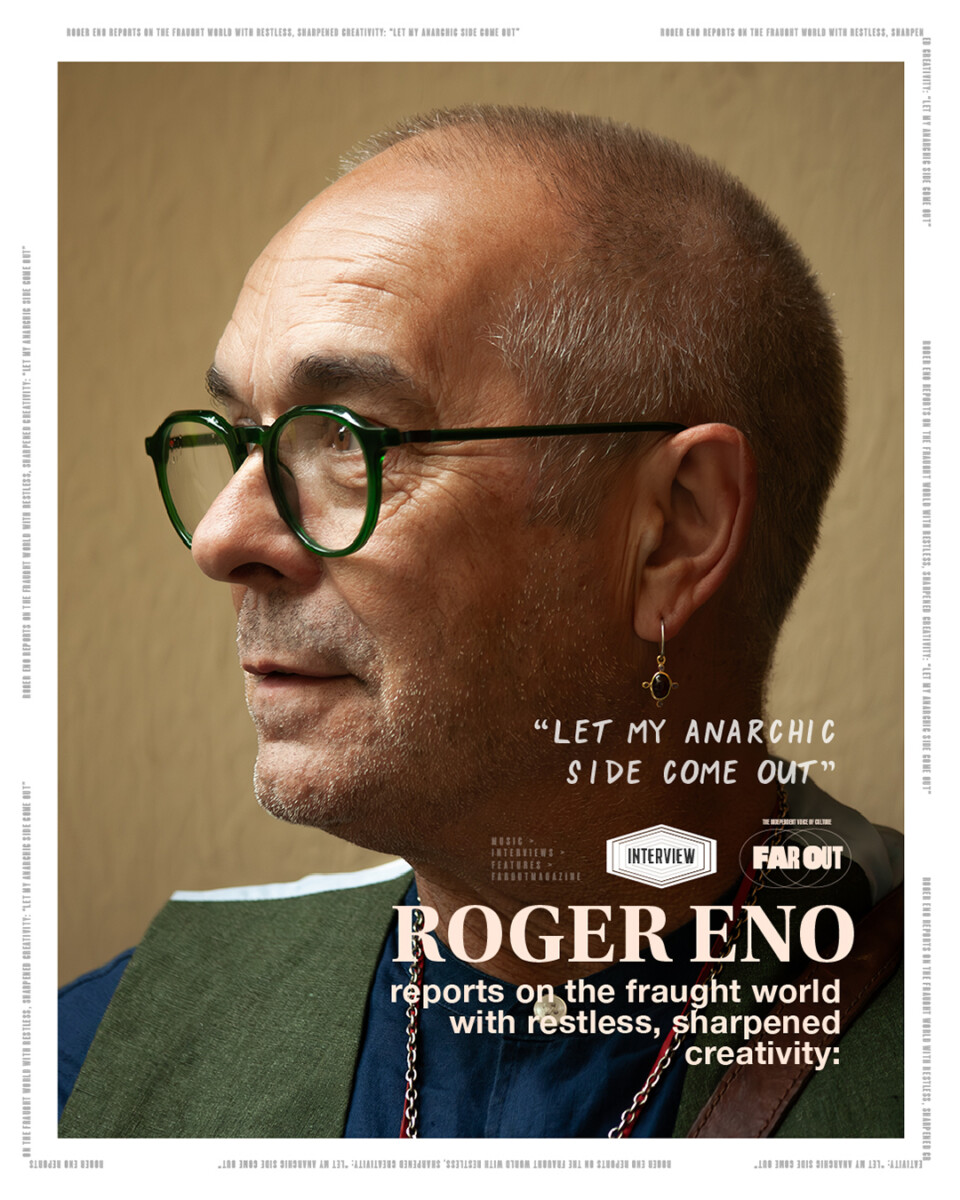
Eno confesses that the aural unruliness and creative rug-pull of his team’s studio practices also stem from a playfully chaotic side unleashed when the time calls for it, not obvious amid his considered ambient pieces or orchestral arrangements. “I’m quite off the rails,” he asserts with a laugh, “But that’s a side I tend to kind of keep to myself and my friends. But I thought this time, the slightly sort of more anarchic side is to come out, but it’s still nothing like it is when I’m roaring drunk, just talking nonsense for hours, which is what I really like doing, apart from making music.”
“So it’s a question of extremes,” Eno reiterates, “And I thought ‘the other side ought to be introduced here’, just to kick up the dust. And I was going to say, ‘kick up the shit’, but also kick up the dust, nice young man.”
Gleefully throwing convention in the air and being enamoured with the subtle art of kicking away at polite expectations are rooted in Eno’s steady musical reference points. Reaching back to as early as the 12th century, Léonin, Pérotin, John Dunstaple, and Guillaume de Machaut, the musician enthusiastically extolls the aforementioned figures of music history’s gift for distinctly unusual grammar in their works.
“They were interested in music as being a kind of symbol of the cosmos,” he tells us, “So, if things were moving in a certain way and they’d hit that, they would allow that collision to happen. Whereas now we’d think, ‘Oh, this is going to sound a bit weird’, and you’d avoid it, but they kind of sort of encouraged that behaviour, so I also like the using the material that I learned, and up until the great sort of ‘I’m bored’ moment, would consider that I have this kind of sachet of gems that I’m constantly polishing, trying to get them perfect, that I both continue.”
Nature, too, lends a powerful influence on Eno’s work. While at points exploring the Sakura flows of the Japanese foliage on ‘The Final Year of Blossom’, Without Wind / Without Air is an album well connected to the wonders to be found simply walking down the shore or venturing into the local woods. He reaches from his chair and scoops up a variety of fossils, vertebrates, and bones that he thinks could be whale or even mammoth relics unearthed from the East Anglia coastline, and it becomes apparent that his is as much a musical forager as he is a natural collector.
“Christian gave me a really good compliment,” Eno revealed, “I don’t know if he knew what he was doing. He said, ‘I treat the world like a flea market’. So that means you kind of go around looking, ‘Oh, that’s interesting. I’ll have that bit. I’ll have that bit’. And after doing that for a while, you realise that you’ve accrued enough stuff to make a thing, and that’s how I go about composing as well. So yeah, it plays. It’s not only nature that gives me influence. It’s the process of looking at it and thinking, ‘How many years did this take?’ or ‘What’s going to happen to this in the future?’ It’s the whole story about it.”
Darkness rears its head on Without Wind / Without Air as much as the reflections of nature. Unable to ignore the horrors unfolding in Gaza, a typical aversion to overt political reporting gave way to a poetic harnessing of the suffering meted out on the Palestinian community across the last two years, with particular highlight on the scores of murdered children at the hands of the Israel Defence Force. Looking back to the Old Testament, ‘Massacre of the Innocents, Part 1’ bores into eerie string arrangements tormented by palpable anguish and heartache, a piece clamouring for sanity as the West turns it back. The apocryphal tale of evil King Herod and his slaughter of the newborns felt all too contemporary when writing the work on December 28th, the day the Feast of the Holy Innocents is commemorated in the Western Christian tradition.
“It’s just unconscionable,” Eno relays, “So I felt that had to be said, because you’ll notice, on virtually all my other albums, I’ve not touched on anything political, I tend to think that that’s kind of that’s what the world is, that’s how it goes. But I thought this time it would have been completely disingenuous of me, not to mention something, because it was, it was deeply affecting me. And it sounds selfish, but it made the world a worse place for me. So Christ knows what happens? Happening for the people that were being bombed and seeing their children burnt. So it’s that something had to come out, and that was it.”
The threats to the natural world and war’s bloody trail never smother hope. Throughout Without Wind / Without Air, a light in the dark, or a shimmer of optimism is always within touching distance, owing to the artist’s gift for marrying sombre reflection with stirring resonance that recharges the spirit rather than drains. When asked about his ultimate faith in progress, Eno once again points to the world around him, rather than found in rage, or on farming social media or eternal X scrolls.
“I look at the people that aren’t making decisions,” Eno quips, “So the ones that are the Trumps, the political leaders of the world, seem to be inferior to me, to those that I meet in the street that are thoroughly decent, kind people that perhaps give money to charity and open doors for each other and don’t try to push in the way of each other. I want to get there before you all, that sort of behaviour. I look at basically the bulk of people that I personally see. And I think this, this might be OK.”
There’s a sense with Without Wind / Without Air that, through the tumult, things will be OK, and disaster will ultimately be averted, albeit not before rockier waters. Rounding off our conversation, Eno regales a whirlwind of man’s tapestry, weaving with reverence but also excitable fever the tribulations of the Black Death, the French Revolution’s world-changing upend, and our clumsy yet unscathed fumble through the Atomic Age without blowing ourselves up, before pointing to the simple but consequential geothermal heating in Iceland as the kind of optimistic beacons Without Wind / Without Air harnesses amid its rousing scores.
“You know, it could be this tiny, little, little island stuck up in the cold that shows the rest of the world,” he concludes, “This is how you can do it, ‘cos someone’s gotta just be asked, then to listen and say, ‘God, look at that. Look at the quality of their life’. So yeah, I’ve got hope.”
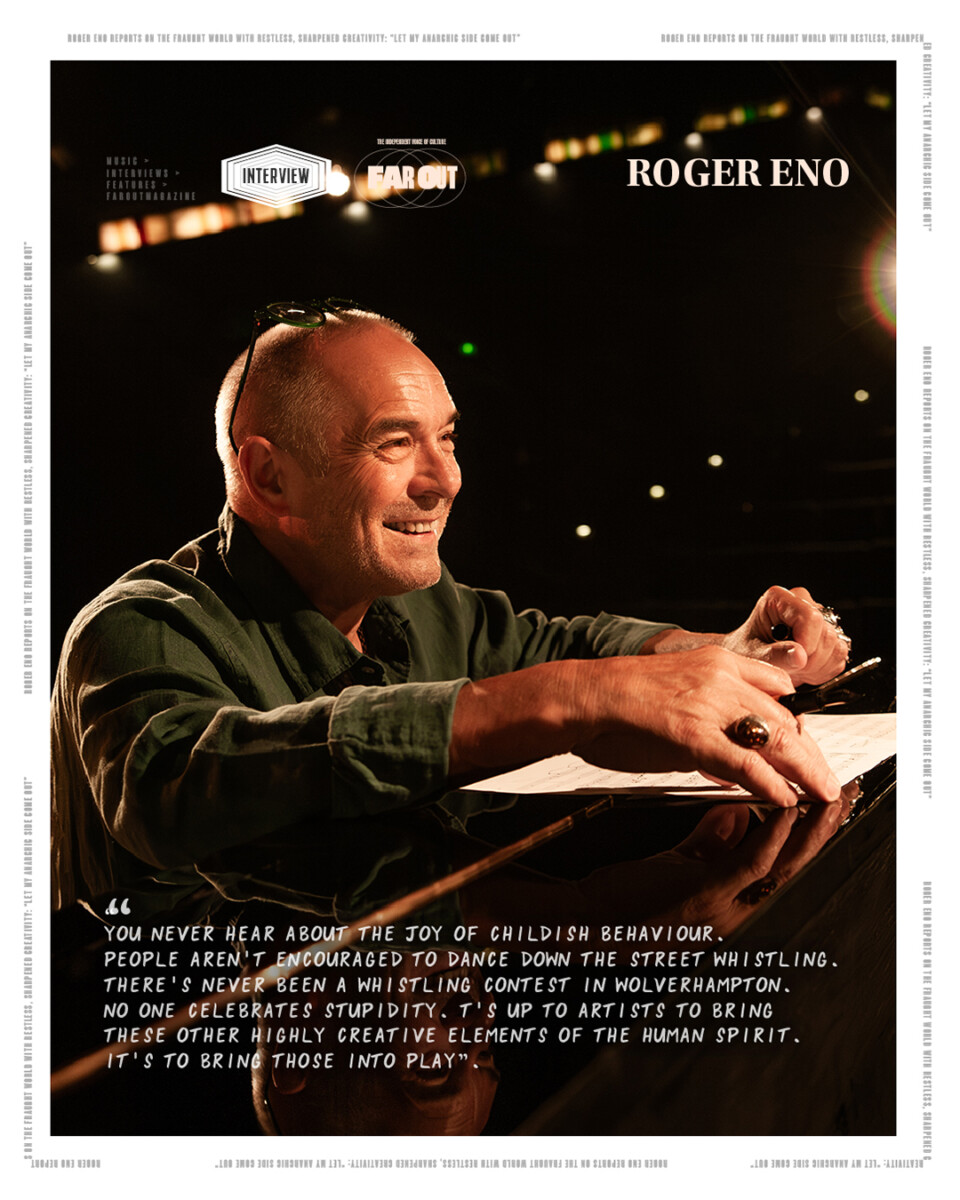
Such pockets of faith lie effervescently yet unassuming in the record, never a doubt on the musician’s erring on the side of humanity ultimately making it through, as we always have. These simple flashes of resistance can take place in everyday creativity. While disavowing any idea he’s an artist, a title he holds with utmost reverence, Eno stresses the better world to be had by nurturing the small-town eccentricity and communal wonder to be discovered if you just step a little further off the beaten track. “You never hear about the joy of childish behaviour,” he laments, “People aren’t encouraged to dance down the street whistling. There’s never been a whistling contest in Wolverhampton. No one celebrates stupidity.”
He adds, “It’s up to artists to bring these other highly creative elements of the human spirit. It’s to bring those into play”.
In a humble but moving way, Eno’s fidgety creativity of late and its resulting Without Wind / Without Air goes a small but essential way in achieving just that.
