


Robert Wyatt and his red era: how did communism shape his work?

Despite standing at the forefront of the UK’s psychedelic art-rock during the 1960s’ heady heyday, Robert Wyatt always harboured an apathetic impression of the counterculture he found himself pulled into. Never interested in LSD, a pop devotee at odds with the emerging rockist snobbery that plagued the ‘scene’, and viewing the hippy idyll more as an “épater le bourgeois shock to the system” over an upending revolution as promised. At the centre of the Canterbury music community, playing drums for The Wilde Flowers, Wyatt would found the lauded jazz-rock fusion Soft Machine and play routinely along with Pink Floyd at London’s UFO Club as one of the leading resident acts.
With his first solo album behind him and captaining the experimental Matching Mole project, a life-changing accident would alter the course of his life as well as his creative path. Having developed a severe alcohol problem in the early 1970s, an appetite for the sauce influenced by partying with The Jimi Hendrix Experience and The Who’s Keith Moon, an intoxicated Wyatt fell from a fourth-floor window at poet Lady June’s London flat while celebrating Gong singer Gilli Smyth’s birthday, breaking his spine and permanently paralysed from the waist down.
Unable to commit to conventional touring schedules and now lacking the will to corral band members for rehearsals, Wyatt rethought the material he’d already composed and sought to twist his progressive jazz stylings with a looser, slapdash songcraft and dolloped with oodles of keys and synthesisers. For many, Wyatt’s discography starts here, first establishing his unmistakable melancholic vocals, playfully eccentric lyricism, and evocative atmosphere that straddle strange, artful dwellings of philosophical reverie and everyday absurdities.
Produced by Pink Floyd drummer Nick Mason, 1974’s darkly ironically titled Rock Bottom documented an artist unburdened with the trappings of a former lifestyle. “I was just relieved that I could do something from a wheelchair,” he told Q in 1991. “If anything, being a paraplegic helped me with the music because being in the hospital left me free to dream, and to really think through the music.”
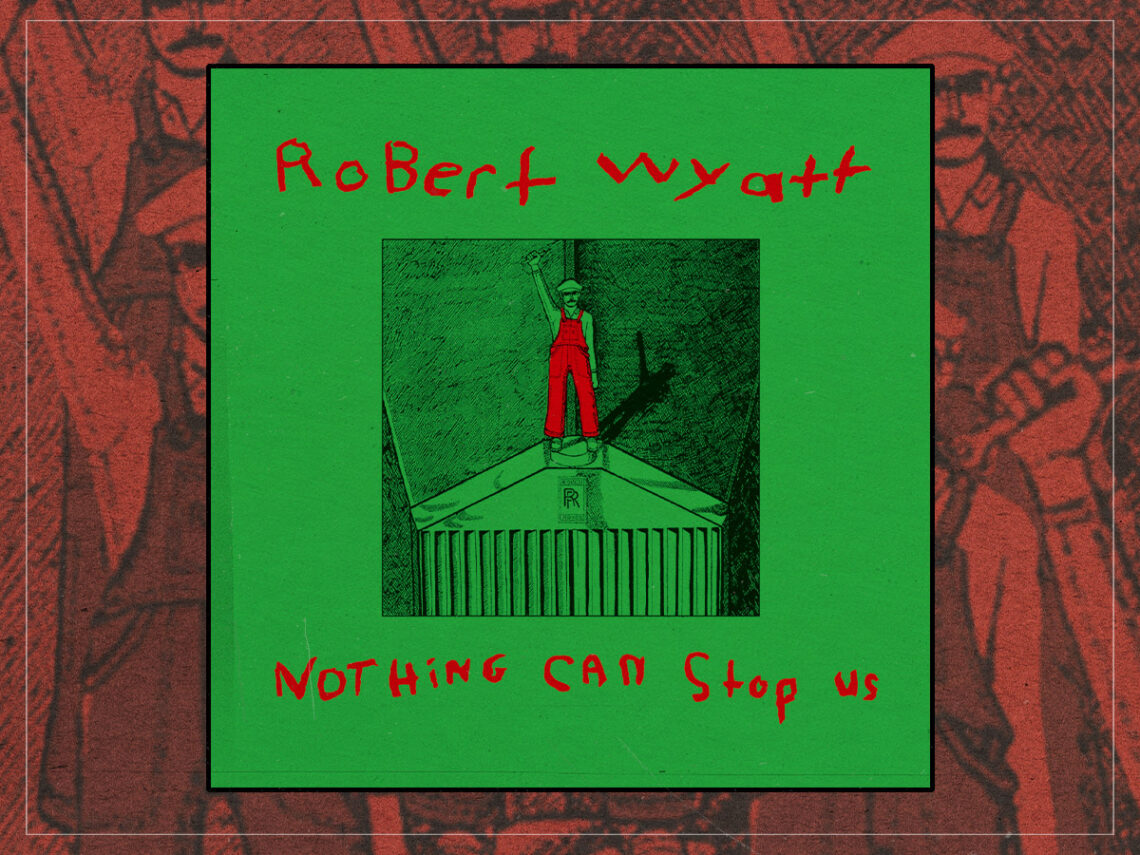
A fiercer and more diligent Left politics had shown signs early on—Matching Mole’s 1972 sophomore LP Matching Mole’s Little Red Record adorned with Chinese Cultural Revolution-style artwork complete with Wyatt donned in Red Guard paramilitarism—but as the 1980s loomed, socialist rigour would form a greater feature of his work. Adjusting to his reduced mobility, a musician’s career free of the burden of touring and travelling allowed him to spend time devouring a broader scope of books and music, which only sharpened his political intuitions. Incensed with South Africa’s continued Apartheid regime and perceived NATO neocolonial interventions, Wyatt and his married muse and illustrator, Alfreda Benge, both joined The Communist Party of Great Britain in 1979.

While adopting a relatively strong party line against the Eurocommunist trends of the day resisting the Soviet Union’s authority on global socialism, and coloured by a sentimental attachment to Clement Attlee’s post-war social democracy, Wyatt poured his political resolve into a string of idiosyncratic singles across 1980–’81 for Rough Trade Records, lending his mournful croon to a bag of covers across Cuban patriotic songs, an eerie version of Billie Holiday’s ‘Strange Fruit, Mapuche revolutionary anthems, and Christian communist Peter Blackman’s ‘Stalingrad’ poem spoken by the Civil Rights activist himself.
None of these renditions and numbers are ever bogged down in stuffy seriousness, Wyatt always gifting his Left-pop with his firm humanitarian warmth and hopeful vision for humanity. Party doctrine and his reverence for the USSR’s war effort saw his cover of the American acapella gospel group Golden Gate Jubilee Quartet’s 1943 hit ‘Stalin Wasn’t Stallin’, a wartime morale booster praising the Soviet Red Army’s bitter Eastern Front resistance against the Nazi Wehrmacht. Angered that the USSR’s bloody role in the Allied victory of World War II had been scrubbed from commemorative memory, Wyatt’s intriguing effort to counter the nation’s willful amnesia of former Soviet solidarity in the depths of the Cold War couldn’t have been more confounding in the pop world at the time, unsurprisingly failing to chart.
After his socialist singles were collated for 1982’s Nothing Can Stop Us compilation, Wyatt found himself on Top of the Pops again nearly ten years after his cover of The Monkees‘ ‘I’m a Believer’. Written by Elvis Costello and Clive Langer with Wyatt in mind, ‘Shipbuilding’ depicts the working class communities’ anticipated economic prosperity returning as The Falklands War’s need for ships brings jobs to the area while sending their sons on the same ships sailing toward a conflict they may never return from. Exploring its political backdrop through the lyrical lens of an almost soap-style vignette of domestic conversation and front-room small talk, all are held together by Wyatt’s moving but ‘ordinary’ sung narration, pushing the single to number 35 on the UK Singles chart upon its 1983 rerelease on the conflict’s first anniversary.
‘Shipbuilding’s success saw Wyatt steer away from pop appeal to 1985’s foggy and haunted Old Rottenhat. Born from the horror of his songs played on Radio Europe or Voice of America radio stations—Western propaganda channels beaming anti-communist programming into the Eastern Bloc—Wyatt penned a record to ensure his red principles were without doubt. Set to a minimalist, DIY score of homespun synths and languid jazzy arrangements, Wyatt attacked everything from the SDP–Liberal Alliance to brutal American foreign policy informed by his copious immersion in Noam Chomsky’s various essays and books excoriating US imperial gameplaying. Old Rottenhat was even dedicated to Michael Bettaney, an MI5 intelligence officer caught passing secrets to the Soviet Embassy in London.
As the USSR dissolved and liberal democracies had swept across its satellite states, both Wyatt and Benge called it a day on their card-carrying communism and entered the new decade with a broader Left perspective untied to any party but still firmly planted in socialist principles. 1991’s Dondestan would shift its political attention from East and West to global North and South, examining Palestinian and Kurdish struggles and the wider exploitation still rife in the colonial legacy across the world. Wyatt would enter a late creative spurt with some of the most celebrated albums of his career, 2003’s Cuckooland nominated for the Mercury Music Prize.
Left politics beats in the heart of his work, despite its seeming softening toward more explorations of the human condition in recent records. Reportedly, when preparing his 2002 Meltdown curation, he initially wanted to invite “every single economic migrant and bogus asylum seeker who could sing or play a musical instrument and let them completely take over the South Bank” as a protest to then Shadow Home Secretary, now Reform ghoul, Anne Widdecombe. Overcoming stage fright and stepping out of retirement in 2016, Wyatt joined Paul Weller for a benefit gig in support of Labour leader Jeremy Corbyn’s party push toward a policy agenda closer to the former big state Labourism Wyatt was so attached to. “I think it’s time to take the power out of the hands of the elite and hand it back to the people of this country,” he told Uncut. “I want to see a government that has some integrity and compassion.” Don’t we all.
