


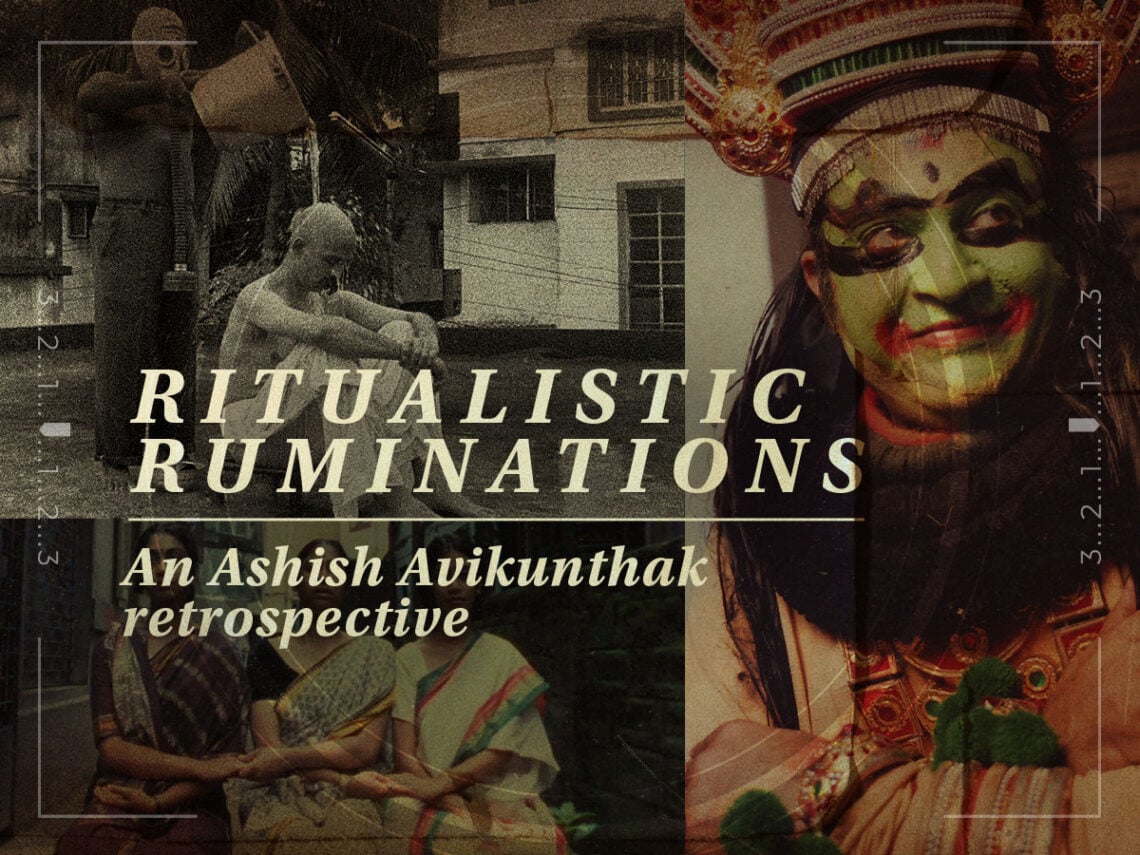
Ritualistic ruminations: An Ashish Avikunthak retrospective

At a time when the cinematic global avant-garde has to reckon with its almost inevitable systematic disintegration, succumbing to the logic of the economies that govern some of the most “prestigious” film festivals around the world, it is imperative to re-evaluate the direction in which the seventh art is hurtling. Terms like “mainstream” and “alternative” are always thrown around at the start of these discussions, but is there anything that exists outside all of it, attempting to forge its own philosophical foundations that are not just separate but severed from such taxonomies?
Indian auteur Ashish Avikunthak, the latest recipient of the Ground Glass Award, is one such artist whose oeuvre contains complex and contemporary multiplicities to elude these crude attempts at categorisations. The Ground Glass accolade, which has previously been handed out to esteemed filmmakers such as Lynne Sachs, champions outstanding experimental artists, but that’s also a term Avikunthak has rejected in the conversations that we’ve had before.
Perhaps that’s the only way to introduce philosophically and mythologically dense opuses such as Glossary of Non-Human Love to the uninitiated, but as Avikunthak has always put it to me, he knows what he’s doing, and his artistic vision is simply unwavering. Anyone who has managed to catch rare screenings of his works already knows that there is a coherent framework that lays the groundwork for everything he has ever made, from his debut feature Nirakar Chhaya (Shadows Formless) to last year’s incisive and incendiary political protest Vidhvastha (Devastated).
Interestingly, this year’s Ground Glass Award program has chosen four early shorts to showcase Avikunthak’s singular approach to his craft instead of the features that usually take the spotlight whenever his body of work is brought up. That ties in very nicely not just to Avikunthak’s evolution as a director, but to the Indian avant-garde cinema as a whole, because it’s the short film format that has been the most conducive to its growth.
Many young artists currently working in the Indian landscape have resorted to the experimental short as a training ground for their own conceptual subversion of modern digital media, but that lineage has existed for a long time. It can be traced all the way back to Ritwik Ghatak and Mani Kaul, who, with their feature-length deviations from Indian cinematic conventions, paved the way for notable experimental shorts from the likes of Pramod Pati.

However, some of the biggest names in the space who are actively working on redefining the identity of Indian cinema, including Avikunthak, Amit Dutta, Vipin Vijay, and more, have welcomed the term ‘Cinema of Prayoga’ instead of ‘experimental’ or ‘avant-garde’ (labels which are burdened by Western connotations), coined by film historian Amrit Gangar. All of them have produced fascinating works when working with the short film format, but it’s Avikunthak’s shorts that especially stand out in the context of the history of the Indian short film.
This active conversation between the practitioners of the Cinema of Prayoga and the Western avant-garde, as well as the Western cultural capital that has permanently shaped the thinking patterns of Indian artists in the postcolonial era, is stunningly captured in all four shorts that are being screened in this week’s program. At first glance, it might seem like the selections have been randomly gathered to showcase the technical innovations of the visual language on display, but the thought that has been put into the curation is much deeper.
Both Brihannala ki Khelkaki (Dancing Othello) and Antaral (End Note) are in a constant cultural negotiation, with the former perhaps being one of the finest pieces in Avikunthak’s illustrious filmography. It stars Arjun Raina, a veteran kathakali performer, reciting iconic lines from Shakespeare while combining them with traditional gestures of the aforementioned dance form that also originated in the 17th century. The paranoid delirium that Avikunthak manages to capture is almost palpable, as Raina eventually rebels against the constructs of the film itself, directly interrogating the filmmaker about the conditions of his ephemeral existence.
Antaral is another multi-layered continuation of this important postcolonial discourse, transplanting Samuel Beckett’s Come and Go (which is also in conversation with Shakespeare) in the familiar spaces of old Kolkata that acquire a heterotopic nature in Avikunthak’s vision. The image saturation fluctuates as colour fills in and drains out of the frame, interspersed with (what might be jarring to Western audiences) documentations of fish guts for sale and ritualistic prostrations on the street.

The religiosity that underlines the imagery and the rhythm of Aviktunhak’s works is also a vital vein to tap into, especially when considering the rise of Hindutva as a dominant ideological form of authoritarianism in the country. Kalighat Athikatha (Kalighat Fetish) marks a staunch attempt to counter such falsely homogenising waves of fascism by exploring the performativity involved in the worship of the Goddess Kali, following a male impersonator whose cross-dressing transformation is a direct attack against the binaries of conservative thought.
Through images, including those of ritualistic animal slaughter, that destabilise and signifiers that are permanently severed from what is signified, such as the man dressed as the goddess Kali drinking from a bottle of Coca-Cola, are emblematic of an India that has permanently changed. In a land that is constantly in flux due to neoliberal economic policies, neo-colonisation masquerading as globalisation, and the weaponisation of grand religio-historical narratives, the act of invoking Hindu mythology the way Avikunthak does is a form of resistance in and of itself.
However, perhaps the most personal of these all is his 2010 short Vakratunda Swaha, which is also cinema as memory, subject to entropy and decay. Avikunthak describes it as a “requiem to a dead friend”, who is featured in the film with an idol of Ganesha, but tragically ended up taking his own life a year later. It’s that and much more, brimming with emotion but simultaneously controlled. The characters inhabiting the frames are often faceless (obscured by industrial issued gas masks or that of Ganesha himself), but there’s one shot that I’ll never forget: of a person donning an unconnected gas mask, forging ahead through the middle of a busy street while the world around them shifts in reverse.
It delivers a more powerful socio-political and aesthetic statement in a handful of seconds than most filmmakers manage to convey in their lifetimes. Whenever someone asks me about an example of Indian cinema at its most potent, that shot is the first thing that I have always thought of, and I don’t see that answer changing anytime soon.
Catch this program at Anthology Film Archives on Saturday, May 3rd, at 14:15.
