


‘Riot!’: Examining the enduring importance of Joe Bataan in 2025

Four years on from spurring his army of followers to attack and invade the US Capitol Building in Washington D.C., Donald Trump is the leader of the free world once again. In the few short months since his presidency began, the United States has descended slowly but surely into the early stages of fascism, with the added help of an unelected South African billionaire.
Trump’s second term might still be in its early stages, but his actions and policies draw from an extensive history of oppression and dictatorship. The only question which remains is how far the American people can be pushed before the word ‘Riot’ is splashed across every newsstand from New York to L.A.
The United States has an incredibly complex political history, particularly for such a young nation. Thankfully, though, the American people have routinely shown a desire to stand up against oppression and authority, regularly taking the fight for freedom out into the streets. This was particularly notable back in the 1960s, an age dominated by themes of division – racial division, class division, and gender division being prominent examples. As such, the 1960s was also an age of protest and political activism.
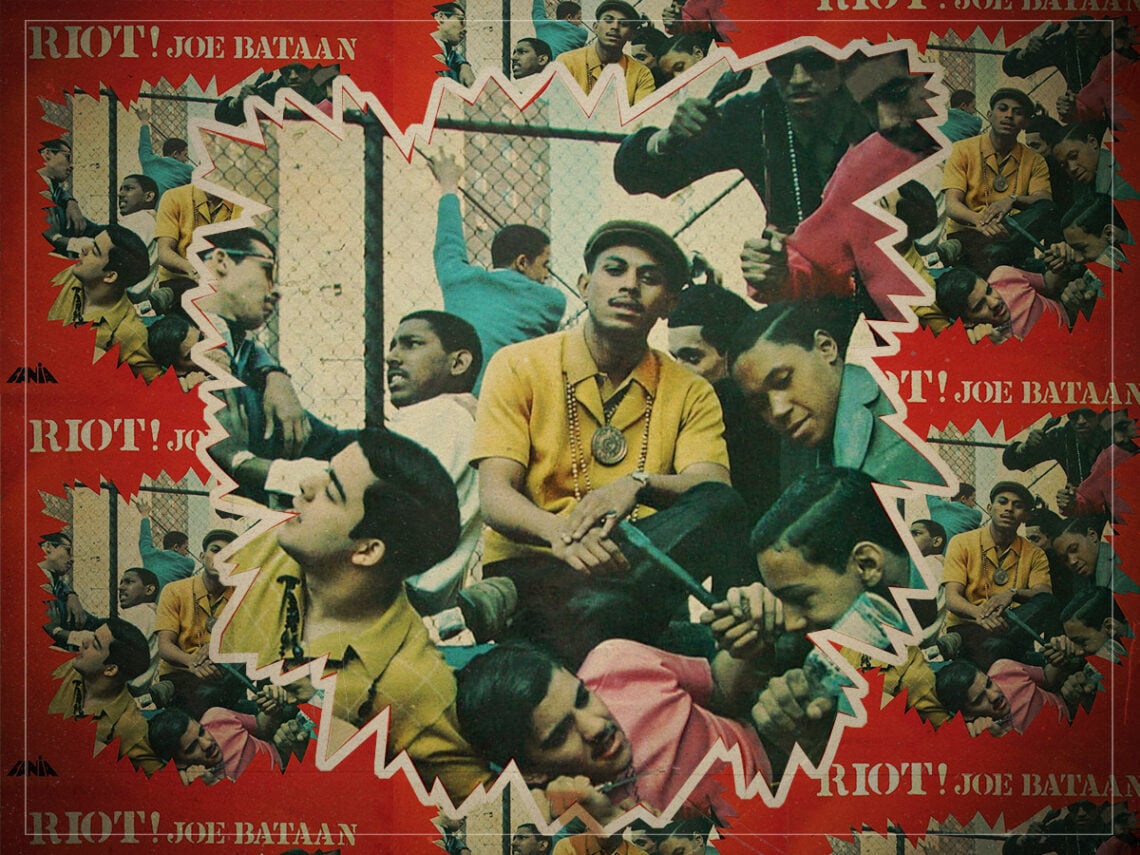
That age of activism was fought largely out in the streets, but the landscape of cultural activism should certainly not be underestimated. Artists like Nina Simone, Marvin Gaye, and Aretha Franklin crafted a captivating, mind-altering soundtrack to the age of the civil rights movement, bringing the fight into the living rooms and stereo systems of people across the globe. Towards the end of the decade, Latin soul pioneer Joe Bataan unleashed a stunning example of cultural defiance in the form of his 1968 record Riot!.
Growing up in the Spanish Harlem area of New York during the 1940s and 1950s, Bataan has always been well tuned in to the attitudes of the streets. During his adolescence, the future musician was briefly a member of a street gang, which eventually landed him in Coxsackie prison for car theft. Upon his release in 1965, Bataan had a spiritual awakening, choosing to reflect the realities of everyday life in his community as well as providing a voice for other young people being led down the wrong path in life.

Blending the sweet sounds of soul music, which dominated the pop charts for much of the 1960s thanks to labels like Motown, with the Nuyorican rhythms he grew up hearing in Spanish Harlem, Bataan quickly became a leading figure within Latin soul music. In 1967, the legendary Fania Records unveiled his debut album, Gypsy Woman, which captured the essence of Baatan’s euphoric and captivating sound. However, it was his third album which came to define the performer’s career.
1968 was an incredibly tumultuous period for American politics. Tensions surrounding the war in Vietnam were reaching boiling point as the growing student and hippie protests began to sway public opinion on the conflict. At the same time, the fight for Black civil rights raged on. In May 1968, civil rights leader Martin Luther King Jr was assassinated in a Memphis motel room, an Earth-shattering event which rightly led to widespread unrest and uprising, particularly among America’s Black community.
‘Riot’ quickly became the word of the year as people took to the streets to demonstrate their disenfranchisement. So, when Bataan unveiled Riot! that very same year, it captured the zeitgeist of the era perhaps better than any other record. Instead of opting for a macabre exploration of political unrest, Bataan managed to imbue his stunning sense of social commentary with the euphoric kind of Latin soul music he had become synonymous with.
Joy is one of the greatest weapons against oppression, and Riot! was an album awash with joy. Not only did this give audiences an outlet to express themselves in a period in which their expression was greatly limited, but it also acted in defiance of authority and oppression. It was joy in the midst of upheaval, and the album’s opening track ‘It’s A Good Feeling (Riot)’ captures that spirit expertly.
An eclectic mix of soul, rock and roll, and Latin congo, the song blends blaring horns and soul rhythms with the sounds of sirens and chanting, perfectly summarising the atmosphere of political unrest at the time. Immediately, the public responded to Bataan’s defiant album, seeing the record become one of Fania’s biggest-selling records and the biggest-selling Latin record up to that point.
Over half a century since its release, the pioneering album still remains incredibly relevant to the modern political climate, for better or worse. What’s more, the groundbreaking Latin soul style of Bataan has certainly not lost its appeal in the intervening years, marking it as a great overlooked masterpiece of the 1960s, and its political turbulence.
So, here we are in another age of political unrest, which shows little to no signs of getting better anytime soon. It is easy to draw parallels between the current climate and that of the 1960s, but perhaps the best way to do so is to look at the cultural artefacts of those past decades and examine them in the light of modernity. Upon doing so, it is clear that Joe Bataan’s Riot! still stands as one of the most stunning examples of social commentary in musical history.
