


Revisiting the final episode of Lena Dunham’s ‘Girls’

Even 14 years after the release of the final season, Girls has continued to divide and delight audiences through the story of Hannah Horvath and her three 20-something friends as they navigate post-graduate life in New York City. Lena Dunham has been subject to endless (and often harsh) scrutiny for her creation of the show and limited perspective of the central ensemble, despite the fact that her critique of their privilege is the unspoken focus of the show.
In many ways, Girls is a period piece that captures a hyper-specific era of the 2000s and city life in Manhattan. It follows a group of middle to upper-class white women entering a new era in which their liberal arts degrees are insufficient to sustain their lives. They are startled by the sudden arrival of mild struggles and everyday hardships after years of a blissfully sheltered life, mostly encountering privileged problems.
However, at the time of its release, audiences and critics were quick to condemn Dunham’s characters, dismissing them for their flaws, which were purposely written to comment on this particular breed of New York yuppies and the permanent state of delusion and denial that comes with being in your 20s. The exaggeration highlighted their aimlessness in navigating their adult lives and the emotional fallout from failed romantic relationships, creative pursuits and inability to hold down jobs.
But after a reparative viewing, some audiences are waking up to the simple truth that Dunham was a victim of a ruthless culture that eviscerated women for not fitting into prescribed definitions of femininity, with Dunham’s body type and appearance being subject to public ridicule. People were also quick to dismiss her masterful writing of the show, unable to see that Hannah’s relentless monologuing and narcissism were an intentional choice and the result of careful considerations and undeniable talent. Critics labelling it as pretentious failed to see its clear satire. This is something that female artists have battled against for decades, with male writers and directors being praised for the complexities that Dunham was critically eviscerated for.
While the show is certainly not immune to all criticisms, with audiences rightfully highlighting the glaring lack of non-white characters, the rushed writing of some episodes and inconsistent character arcs, there is much to be praised. Episodes like American Bitch, Panic in Central Park and One Man’s Trash capture the loneliness, melancholia and volatility of the 20-something life, while also adding poignant commentaries on post-feminist issues that were rarely tackled in mainstream media. There are few shows that depict this emotionally fraught era of life so frankly, with each character flitting between obsessions as they try to maintain a spark of optimism and a sense of control while fleshing out their future, often floundering, unable to latch on to a singular path.

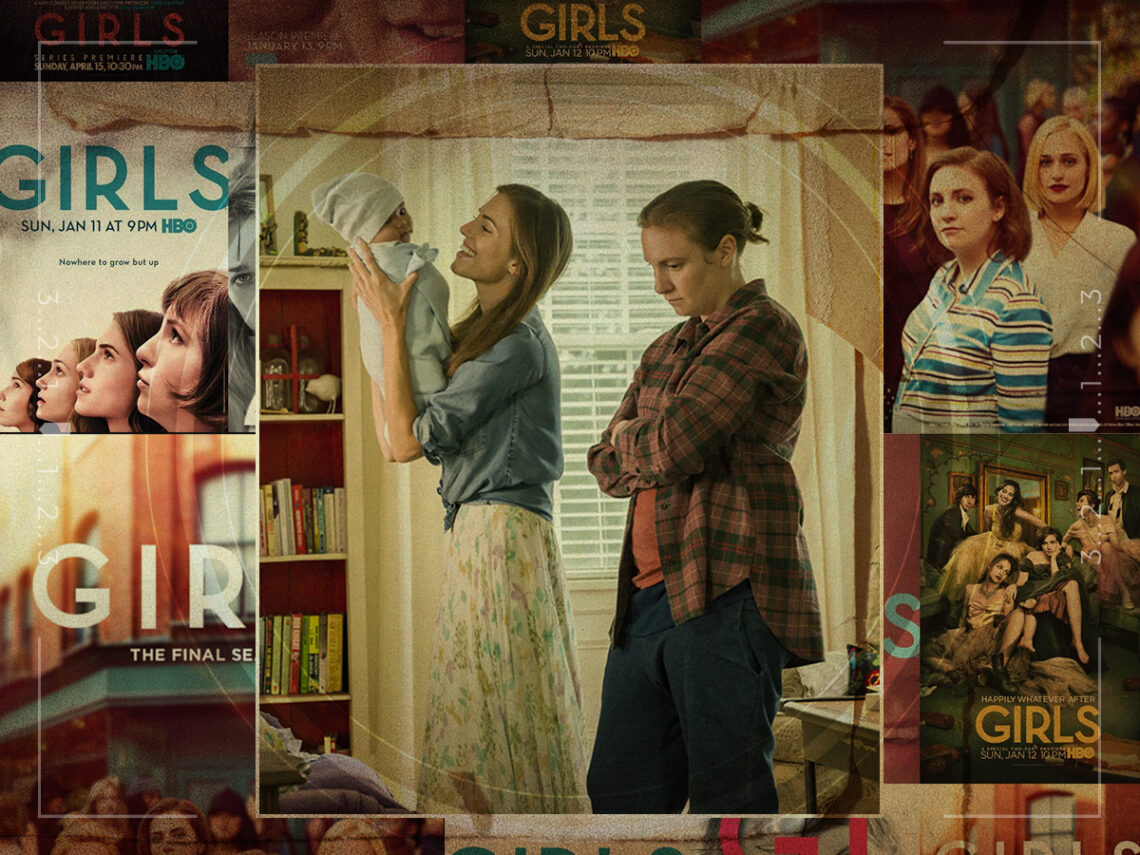
And it is the idea of latching that became the focus of the show’s final episode, one that fans are still debating to this day. The controversial final episode of Girls, titled Latching, takes place after a five-month time jump in which Hannah has a baby after a one-night stand with a surfer (played by Riz Ahmed). Rather jarringly, we discover that Hannah has moved away from the city and lives in upstate New York with Marnie and her son, attempting to co-parent together. Parenthood doesn’t seem to come naturally to Hannah, nor does her friendship with Marnie, with the pair living on the rocks as unspoken tensions and bitterness seep through their every interaction. Amidst the chaos of early motherhood, Hannah’s particular struggle in this episode is with her son’s inability to breastfeed, failing to latch onto her breast and placing a strain on the entire household.
In the penultimate episode, we learn that the central ensemble has crumbled, with each girl acknowledging during a cutthroat scene that there is nothing but nostalgia linking them together, and hence they should let go of the dwindling threads of friendship. In the finale, the friendship between Marnie and Hannah is equally threadbare, with Marnie seemingly going through a quarter-life crisis and devoting herself to the task of co-parenting in an attempt to find higher purpose and meaning. Only Hannah recognises that as a selfish act and unleashes her frustrations over being a single parent on the only person who stuck around.
After an existential crisis about her ability to be a mother, Hannah finds herself comforting a sobbing teenage girl on the street who is in the middle of an argument with her parents, sparking an emotional catharsis in which she realises that she is capable of nurturing and caring. The episode ends with her returning home, feeding her baby and finding that he is finally latching. As the credits roll, we hear nothing but the sound of him feeding, ending on a profound yet rather sudden note.
Audiences criticised Hannah’s sudden escalation into motherhood, claiming that this decision was an attempt to clumsily resolve her character arc, coming full circle with a plot trope that felt cliché and predictable. While I certainly found this choice jarring, I have come to view it in a different way as I’ve grown older. I feel that this decision was not Dunham’s way of creating a resolution for Hannah, but a symbol of permanent reinvention and messiness.
We often portray mothers as being all-perfect beings who adapt to the challenges of motherhood with ease and complete comfort, embracing a job that is built into their DNA, with no qualms or difficulties. It is a silencing narrative, and one that dismisses the many mothers who deeply struggle with the expectations placed on them to blindly accept all aspects of the role and welcome it with open arms, while painting on a smile. While Hannah’s journey to motherhood feels sudden, her many flaws continue into her era of parenthood, with her remaining just as selfish and self-absorbed as before.
In a show that never played safe, it is perfectly fitting that the final episode would stay true to Dunham’s tonally jarring style, with a rather blunt and out-of-the-blue ending that spares us from cliched goodbyes and predictable resolutions. There is nothing easily definable about Girls, with each character experiencing constant evolution, defying easy categorisation and reflecting the mess of self-actualisation and discovery in your 20s. While we are told that the people who raise us have it all figured out, Hannah’s parents undergo as many changes as her and her friends, with their lives being uprooted in similarly absurdist ways, showing that adulthood is a mythological state of being.
Girls begins with Hannah having dinner with her parents, pleading for financial support and being forced to enter the real world and find a job that pays the bills. But as the show spirals towards the end, with Hannah seemingly no closer to having a handle on this elusive ‘adult world’, her sudden journey to motherhood highlights the one consistent truth within the show.
Perhaps we will never reach this state of completion, this so-called state of togetherness that allows us to delve into the more demanding challenges of life with ease and composure. We are always unfolding, with our many flaws and infallibilities never lingering far enough behind us to outrun them. Hannah might be messy, but messy isn’t a state exclusive to being young, which is reflected through all the characters in the show. And as she embarks on her next chapter of life, we realise we’re all stuck in the same strange boat of trying to hold it all together; never quite complete, and never finished with growing up.
