


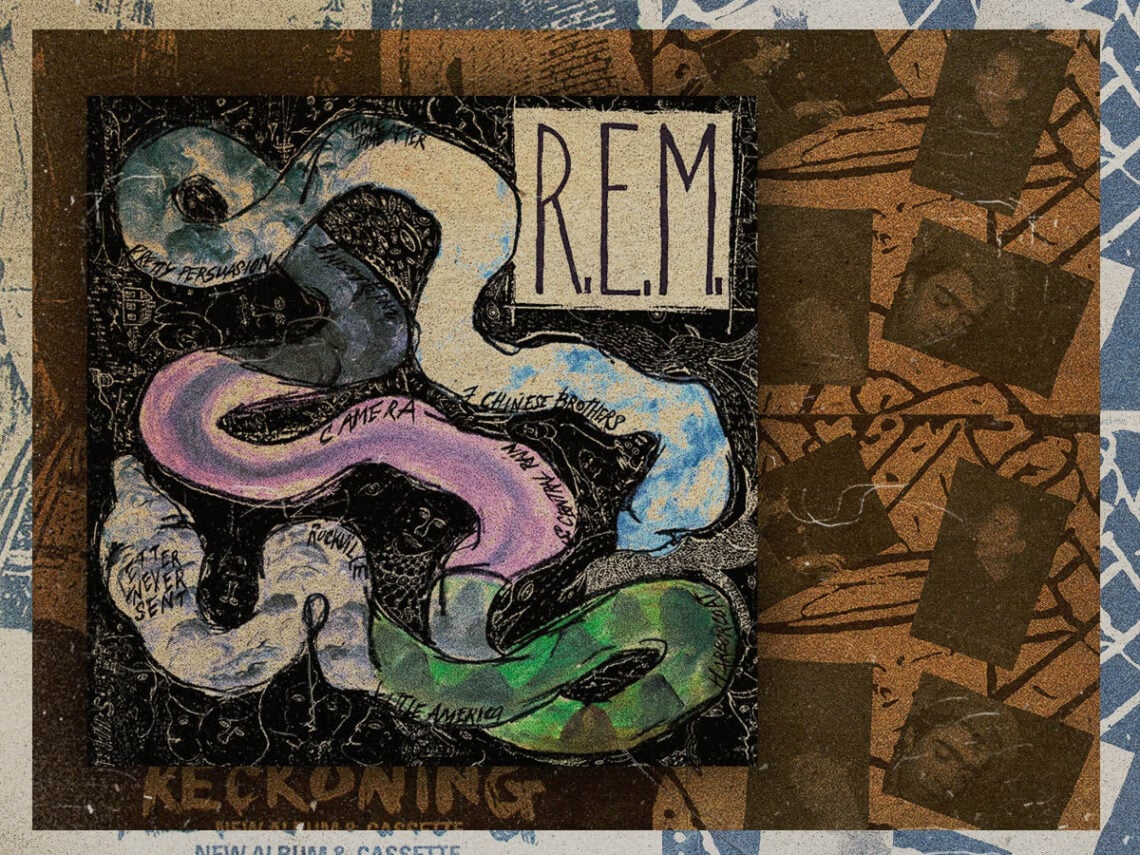
R.E.M. – ‘Reckoning’

In 1982, the world was introduced to R.E.M. with the release of their debut EP; a success followed up with 1983’s debut album Murmur. Audiences quickly understood the kind of approach R.E.M. were taking to the pre-established rock formula; tight drums, arpeggiated guitar chords, melodic basslines and barely distinguishable vocals.
When the Athens, Georgia, band released their second studio album Reckoning in 1983, the question hung in the air over whether they would stick to their newfound method or twist it in a new direction. By that point, R.E.M. had grown as an excellent live band and producers Don Dixon and Mitch Easter hoped to capture that live energy as much as possible throughout the recording process.
If there is a song to showcase the fact that R.E.M. are capable of being down rightly dour and sugary sweet all in the same breath, then it is Reckoning’s opening track ‘Harborcoat’. The song begins with an upbeat intro and delves into a minor key bass and guitar line verse before coming back full circle in a chorus of true elevation.
As is often the case with Michael Stipe in the early days of R.E.M., we rarely have the foggiest idea as to what he is actually singing about, mostly because of his mumbled, shy vocal delivery. Even upon actually reading the lyrics in ‘Harborcoat’, for example, “Metal shivs on wood pushed you right back / There’s a splinter in your eye and it reads react”, we are no closer to knowing quite what the hell Stipe is talking about, but admittedly that’s part of the early R.E.M. charm; one must simply make up their own mind and create their own meaning.
Follow-up track ‘7 Chinese Bros.’ fares a little differently in its obscurity. “This mellow, sweet, short-haired boy, woman offers pull up a seat / Take in one symphony now, we’ve just begun to battle,” Stipe sings. The song also follows suit in structure too, with a melodic bassline, a simple riff, and an elevated chorus.
There is real confidence on Reckoning’s best song, ‘So. Central Rain’, though, from Mike Mills’ wonderful backing vocal to the fact that we can now actually hear Stipe’s words. Most likely, this is because the song’s lexical choices are some of his definitive best, from the glorious line, “These rivers of suggestion are driving me away”, to the simple yet wonderfully effective chorus call of “I’m sorry”.
While bands further down the line would discover the joys of loud-quiet-loud, R.E.M. are keen proponents of Major-Minor-Major (or vice versa) on Reckoning, and ‘Pretty Persuasion’ arrives in a similar fashion to much of the record. Peter Buck’s guitar rarely misses a note, always perfectly in time, showing that R.E.M. had grown into one hell of a tight live unit by the time their second album arrived.
However, ‘Time After Time (Annelise)’ shows a different side to the band, slower and more reflective, perhaps indicating the kinds of songs that would arrive on the band’s albums towards the end of the late 1980s and early ’90s. Stipe’s vocals shine through, and there is just a hint that he has finally begun to believe in his voice at last. The bridge is beautifully reminiscent of Stipe’s beloved The Velvet Underground, as is the song in sum, perhaps.
Immediately after, though, we are back to standard, Bill Berry’s tight drumming on ‘Second Guessing’ brings Buck and Mills into the zone in terms of their rhythmic approach, and there is certainly a live room feel to the track. ‘Letter Never Sent’ seems to come and go just as quickly as it arrived; not a bad song, just one lacking any true defining features, and Stipe’s half-arsed drawl does not really help in this light.
‘Camera’, like ‘Time After Time’, slows things down, and once again is one of the shining moments of the record. Mills’ effortless backing vocal sings through, giving Stipe’s lackadaisical approach more weight. There’s a patience to the song, too, that is certainly a refresher to the album’s more up-tempo rocky efforts.
Record closer ‘Little America’ calls back memories of the faster moments of R.E.M.’s debut while issuing a hint as to what was to come throughout the 1980s in what is a blueprint for Lifes Rich Pageant track ‘These Days’. The penultimate song, ‘(Don’t Go Back To) Rockville’, is perhaps the most upbeat, twee moment on the record with a chorus that simply puts a nostalgic smile upon the faces of those who listen to its harking back refrain.
The downside to Reckoning is that it can often feel a bit unvarying, even if the individual songs on it are some of R.E.M.’s best, and they are admittedly punctuated by a slow number or two. It’s easy to forget that the record is still one written by a young band finding their feet and discovering their sound as they go along, so a lack of variety ought to be forgiven somewhat. Reckoning is not the best R.E.M. album by any stretch of the imagination, but it does contain some of their finest and most important moments as a band.
