


Revisiting R.E.M. and the beauty of ‘Chronic Town’ as their debut EP turns 45

In August of 1982, R.E.M. had only been a group for two years. While those two years had been a fruitful time of songwriting and identity building, the Athens, Georgia quartet were still a little bit away from having the necessary tools to record a full-length album. The band’s first single, ‘Radio Free Europe’, had been enough of a success to establish R.E.M. outside of their hometown, so it was decided that an appropriate in-between step from a single to an album was the next step: an EP.
That’s how Chronic Town was born, a 20-minute blast of jangly guitars, frantic overlapping melodies, and idiosyncratic rhythms that solidified just how unique R.E.M. was in the burgeoning college rock scene. That scene would quickly grow into the behemoth of alternative rock, and if you’re looking for the starting point of the genre, it’s hard to find a better example of ground zero than Chronic Town.
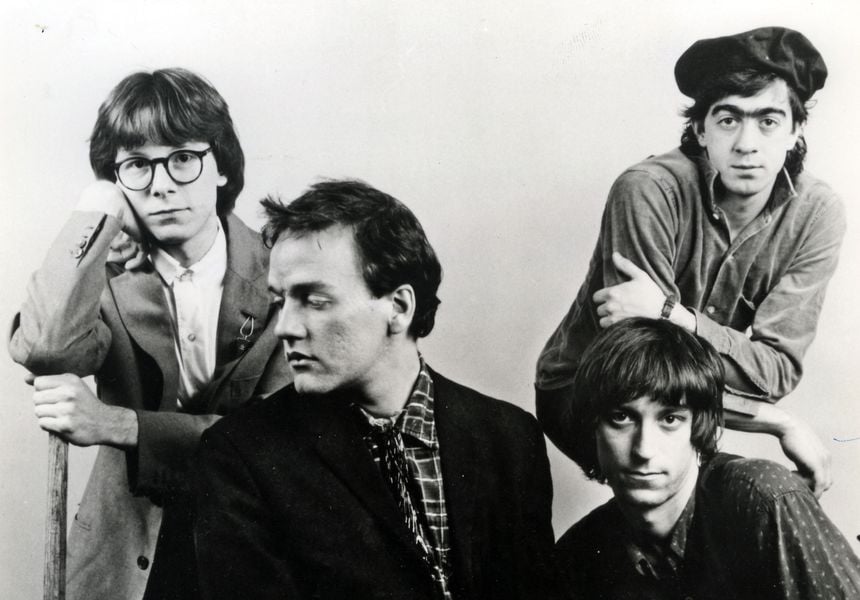
While they might not have been ready to record a full-length LP, R.E.M. had definitely found their signature sound by 1982. Peter Buck’s guitar style was leading the way, punctuated by intricate arpeggios and unique chord changes. Behind him was the contrapuntal bass work of Mike Mills, who created countermelodies that were just as memorable as Buck’s lead guitar. Bill Berry kept it all together with precise yet singularly off-kilter rhythms. At the very back, seemingly trying to hide from it all, were the lead vocals of Michael Stipe.
The idea that Stipe purposefully obscured his lyrics was a popular one amongst detractors (and even some fans), but one listen to the opening track ‘Wolves, Lower’ proves that not true. Stipe was comfortable enough in his own abilities to let his words ring loud and clear, even if it wasn’t quite time to put the lyrics on the album sleeve. That was until the very next track, ‘Gardening At Night’, where Stipe sings in a mumbly tone that only vaguely hints at being in the English language (a more spirited and clearly articulated vocal take appeared on the 1988 compilation Eponymous).
The EP’s title crops up loud and clear on ‘Carnival of Sorts (Boxcar)’, another showcase for the overlapping backing vocals from both Mills and Berry. One of the biggest appeals of R.E.M., especially during their early career, was the sheer density of their arrangements: between Buck’s guitar, Mills’ bass, Berry’s drums, and the different melodies from all three vocalists, there was something new to discover each time you listened to a song.
Despite being associated with Athens, the band agreed to travel up to Winston-Salem, North Carolina, to work with producer Mitch Easter. The frontman for fellow 1980s alternative rockers Let’s Active, Easter was a peer who could translate the treble-heavy sounds of R.E.M. to vinyl without losing a sense of dynamics. Easter had previously produced ‘Radio Free Europe’ and would continue to work with the band through 1984’s Reckoning.
‘1,000,000’ and ‘Stumble’ round out the EP’s second half, keeping the record’s jangly momentum riding high until its last notes. ‘Stumble’ is perhaps the only sign that R.E.M. recorded the album in the ’80s, featuring a more expressive drum sound that flirts with gated reverb. The band elected to move away from this sound on their future records, preferring that their sound be timeless and less reliant on the production gimmicks of the contemporary music scene.
The results were five songs that all sounded similar enough to hang together but remained complete different from any other band of the time. Chronic Town was recorded under the assumption that the band would separate themselves from Hib-Tone, the label that released ‘Radio Free Europe’. The first idea was to create their label, but when I.R.S. Records became interested in releasing the album, R.E.M. found their home for all of their albums up to 1988’s Green.
Chronic Town has now transcended its original purpose of showing off R.E.M.’s promising future. Instead, it now stands as a time capsule for the sounds that most original fans fell in love with, the same sound that the band would move away from starting in the mid-1980s. Chronic Town doesn’t quite have the pop song sensibility that the band would begin to integrate into their sound, but it does serve as the purest distillation of basic R.E.M. at its finest. That remarkably unique sound doesn’t sound like it has aged a day, even as Chronic Town celebrates its 45th anniversary.
