


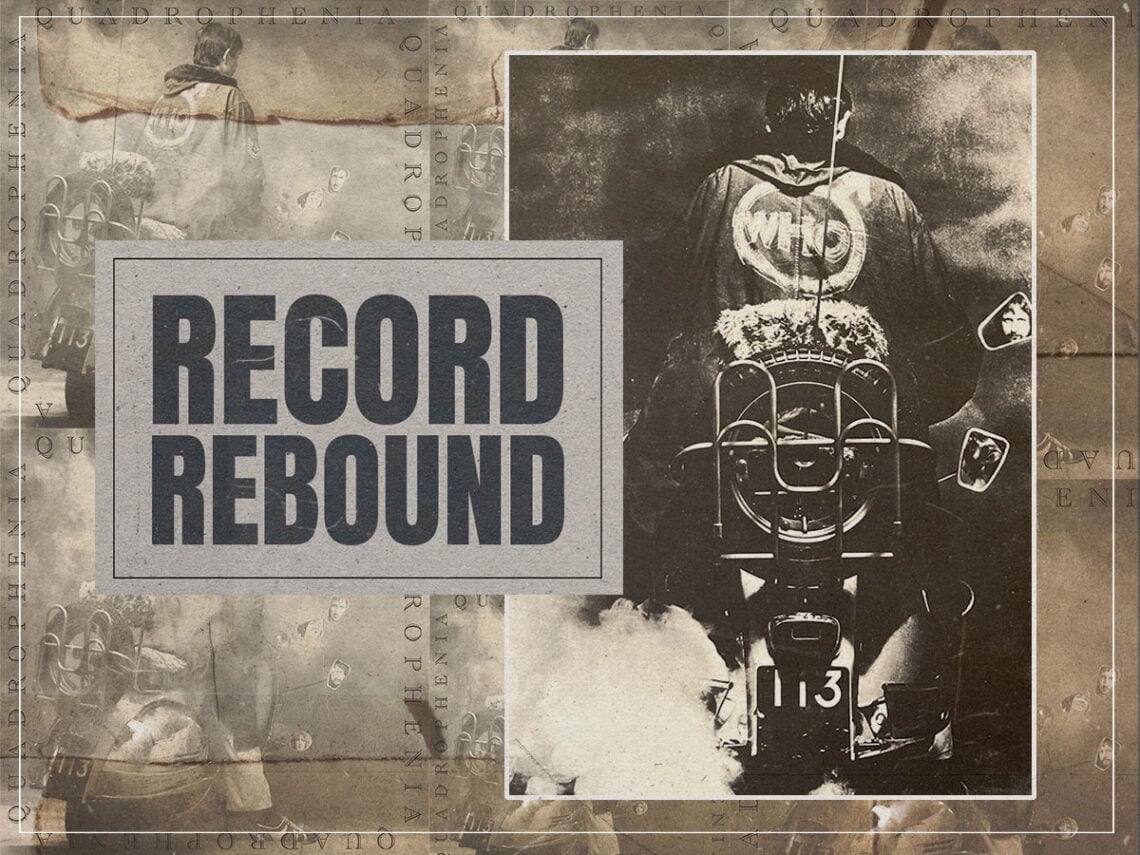
Record Rebound: The Who reissue their greatest rock opera, ‘Quadrophenia’

After giving the post-war generation something to sing about and smashing several dozen semi-expensive guitars, The Who settled into a more stable and artistic identity. Inspired by his childhood fascination with comic books and a newfound spirituality, courtesy of Meher Baba, guitarist and songwriter Pete Townshend steered The Who towards more conceptually focused material.
The Who became one of the first bands to explore the rock opera medium and released their first fully-fledged concept album, Tommy, in 1969. The album was a resounding success, encouraging Townshend to pursue a more audacious rock opera project. Titled Lifehouse, this follow-up sought to explore a spiritual connection between the artist and audience. However, Townshend’s multi-media concept proved unworkable due to the lack of technology. Lifehouse was ultimately abandoned, with many of its surviving songs appearing on the masterpiece 1971 album Who’s Next.
Although Townshend was pleased with Tommy and Who’s Next, he still had unsated ambitions. Tommy was finally adapted for the screen in 1975, but before that, Townshend sought to create another rock opera to fulfil his dream of movie adaptation. The result of such aspirations was Quadrophenia.
“I’ve got to get a new act together… People don’t really want to sit and listen to all our past,” Townshend told Melody Maker at the time. Tommy reflected abstractly on Townshend’s childhood, and Lifehouse was a spiritual dystopian sci-fi plot. In contrast, 1973’s Quadrophenia was a calculated return to reality, a search for belonging in the South of England.
The finished product comprised 17 songs across two LPs spanning 81 minutes and 42 seconds. Quadrophenia returns to the mid-1960s to follow the story of a young mod named Jimmy. As he navigates London’s pill-popping nightlife, his associated mods lock horns with the antagonistic rockers in several skirmishes. Later, reality bites hard with heartbreak and isolation, leaving the young man desperate to find purpose on the cold pebbles of Brighton Beach.
The album unfurls Townshend’s narrative with impressive depth and artistic flair. The powerful closer, ‘Love, Reign o’er Me’, is an undeniable highlight. The song’s gyrating synthesiser arrangement is heard in the bookending opener ‘I Am the Sea’ and returns as a motif elsewhere in the album. However, little can compare to the climactic conclusion of ‘Love, Reign o’er Me’, widely considered to boast Roger Daltrey’s finest vocal achievement.
“‘Love, Reign o’er Me’ refers to Meher Baba’s one-time comment that rain was a blessing from God; that thunder was God’s Voice,” Townshend once noted. “It’s another plea to drown, only this time in the rain. Jimmy goes through a suicide crisis. He surrenders to the inevitable, and you know, you know, when it’s over, and he goes back to town, he’ll be going through the same shit, being in the same terrible family situation and so on, but he’s moved up a level. He’s weak still, but there’s a strength in that weakness. He’s in danger of maturing.”
Other notable highlights include the psychoanalytic ‘The Real Me’ and ‘I’m One’, but more so than any 1970s release, this one must be enjoyed as a monolithic listen from start to finish. In 1979, the concept was finally adapted into a movie directed by Franc Roddam, starring Phil Daniels in the lead role alongside Leslie Ash, Ray Winstone and Toyah Willcox.
Although he was involved in the screenwriting process, Townshend told me he wasn’t particularly pleased with how the movie turned out during a recent interview about the new Life House graphic novel. It followed the album’s narrative loosely and only contained ten of the 17 songs in the soundtrack, many of which were abridged versions. Hence, the only way to have the authentic Quadriphenia experience is to drop the pin.
Fortunately, The Who has announced a new reissue for those interested in adding this essential rock opera to their vinyl collection. Hitting shelves on Friday, February 2nd, the celebratory 50th-anniversary reissue includes two 180-gram records with half-speed masters cut by Miles Showell at Abbey Road Studios. Packaged in the original gatefold sleeve design, this reissue also features a 44-page information booklet.
You can preorder the album and view purchase options here.
Far Out Magazine may earn from qualifying purchases.
