


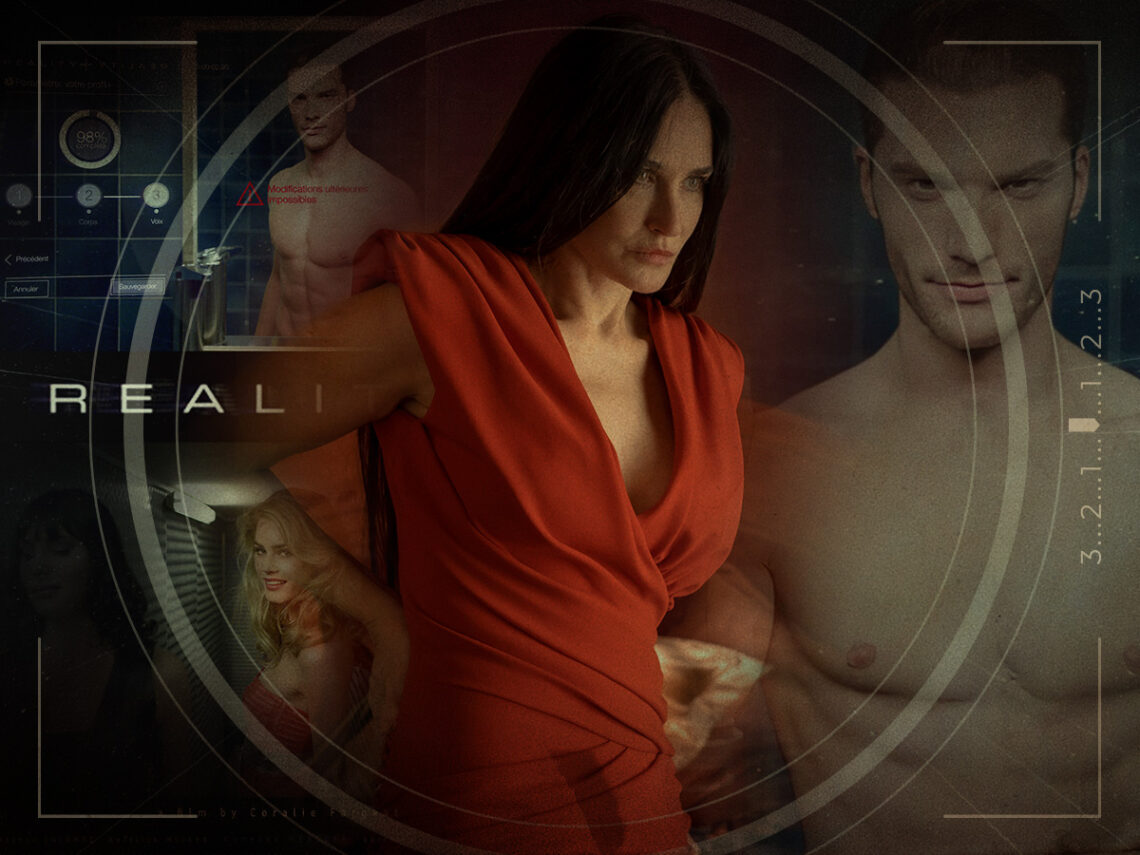
‘Reality+’: the key to understanding ‘The Substance’

When Coralie Fargeat released her debut feature The Substance in 2024, it didn’t just mark her arrival as a filmmaker—it saw her kicking the door down and drenching everyone in fake blood, demanding their attention. To call the film bold would be an understatement, given its unhinged, no-holds-barred approach, but when revisiting her earlier short, Reality+, suddenly everything makes perfect sense.
The Substance is a film that both does and says a great deal. Let’s start with its message. Casting 62-year-old Demi Moore, an actor who has never truly received the recognition she deserves beyond superficial praise for her looks, is a stroke of brilliance. Through Moore’s performance, the film vividly captures the battle between two conflicting identities within one person, creating a visceral metaphor for ageism and its insidious impact on self-esteem. The internal struggle between these two conflicting sides becomes a powerful exploration of how society views ageing, especially its damaging effects on self-worth.
Though the pair are constantly reminded, “You are one,” they cannot and will not accept it. Sue is battling to take over more and more of their lives, defying the rules and injuring Elisabeth so they can all hold onto the power of youth and beauty longer. Meanwhile, Elisabeth suffers the consequences and complexly grows to hate Sue for everything she has and everything youth can give her, despite that being, well, still her.
It’s a bold concept from Fargeat, who blends visceral body horror with dystopian dread, creating a world in which identity is both fluid and violently disposable. She imagines a chilling future where people willingly tear themselves apart—quite literally—to accommodate an idealised self, a perceived improvement over their current existence. The Substance isn’t just a shocking spectacle; it’s a sharp, unsettling vision of a world obsessed with self-perfection, capturing humanity’s willingness to sacrifice everything for youth, beauty, and the promise of a better self.
As Sue emerges, Elisabeth essentially stops living. During the weeks she has to present herself, Elisabeth does nothing; she can’t get the self-confidence to face the world with her own face, so she isolates herself until she can step into this perceived better skin. It’s all about the loneliness of striving for beauty in contrast to the social power it seemingly provides – which is basically the plot of Reality+.
It almost feels like this 2014 short could serve as the perfect introduction to The Substance, offering an early window into Fargeat’s twisted yet fascinating world. The short brilliantly captures the themes she would later explore in more depth, presenting a vision of self-perception that’s as intriguing as it is unsettling. Here, the protagonist uses technology to transform into an idealised self—allowing him to see others as enhanced versions too—a clear precursor to the body-horror and dystopian vanity explored more viscerally in The Substance.
Through his eyes, we see Paris as a mecca of models, all with the same kind of beautiful face as they pick their new identity from a menu. As he moves through the world with the confidence granted by this new virtual mask, he falls for Stella, another user, but they’ll only ever hang out during their 12-hour window, running away from one another if that ever threatens to falter and refusing to reveal their true selves.
The short carries all the same considerations as The Substance: self-worth, the cultural currency of beauty, and the way striving for beauty hurts the person underneath and only makes them strive harder in a toxic cycle. They even both touch on the way beauty standards and self-esteem impact our ability to connect as the heart-aching connection between Vincent and Stella, these two people hiding their true selves, mirrors the moment in The Substance where Elisabeth can’t get herself out of the house to go on her date, leaving a kind man waiting because she can’t put her self-critique aside. It’s simply that the vehicle is different; where Reality+ uses technology, The Substance uses pure gore.
But that difference feels necessary. Ten years on from the short, the conversation about beauty and tech has gone as far as it probably can in a world where face filtering and AI now know no bounds. But as things like Ozempic are on the rise and the accessibility of major plastic surgery continues to grow, perhaps Fargeat knew that it was time for contemplation of beauty to get truly ugly as she returned to this topic she’s always been interested in, and gave it a new and bold makeup.
