


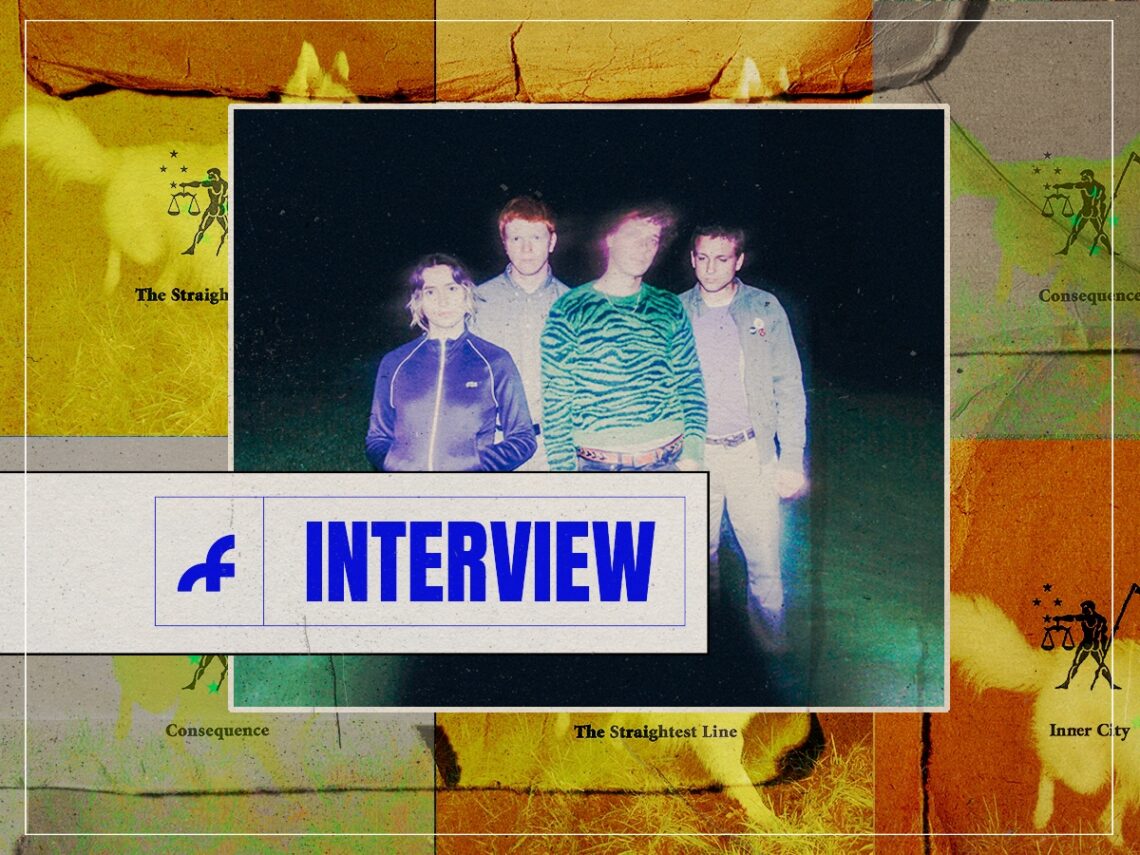
Real Farmer on the ‘Dutch scene’, Groningen and the punk spirit: “For the love of the music”

Punk is having a moment. Groningen’s Real Farmer are one outfit that has succeeded in taking the formula back to its roots and instilling genuine vitality into it. Continuing to make waves on the live circuit at home and in the United Kingdom, in March, they released their debut album, Compare What’s There, to much fanfare on Peter Doherty’s Strap Originals. A cult act in the making, these purists are spreading the gospel in the right way with the proper attitude, blending a dedication to being better with the communal, countercultural spirit at the genre’s heart.
With a successful UK tour under their belt to mark the release, the band are presently gearing up to play Strap Originals’ fifth-anniversary celebration at London’s 100 Club on May 30th, alongside labelmates Pregoblin and Jack Jones, the final of three celebratory evenings compèred by Doherty himself.
As expected, the quartet are in a good place. I caught up with them at the end of March, just as they had returned home from their UK jaunt. Frontman Jeroen Klootsema and bassist Marrit Meinema joined me to delve deeper into Real Farmer, their praxis, and the apparent ‘Dutch scene’.
Connecting over Zoom, it was Meinema and myself for the first few minutes. She had just finished work as a writing coach at the University in Den Haag. Klootsema had also just completed a shift and was on his way, but he was making coffee.
The sun was shining on Den Haag, and Meinema seemed in good spirits about Compare What’s There and the future of Real Farmer. “It’s been really fun,” she says of the release. The quartet had been working on the record for an extensive period, balancing focusing on it and working on new material, and in proper form, they marched on undeterred, delving into shows as soon as it was out.
After discussing a few UK bands Real Farmer has played with recently, including South London favourites My Fat Pony, another screen popped up. It was Klootsema. He echoed Meinema’s points about the album and was pleased with how it turned out and that people liked it. Given that it was their debut, he didn’t know what to expect from the release, but the response was cause for merriment.
Working with Strap Originals is a new experience for Real Farmer; naturally, they are still getting used to it. Meinema explains that her previous bands had always been independent and DIY, with Real Farmer’s approach mostly the same. However, despite the transition, the label has been facilitatory in its presence. “They give us a lot of freedom, which we prefer,” they explain.
For instance, Real Farmer organises their own videos, with Klootsema handling most of the direction and designing release artwork. As for Meinema, she plans the shows and tours. Notably, the band were signed after they received an Instagram message from a label staffer who had caught them playing at the unofficial counterpart of Groningen’s annual bonanza, the Eurosonic Festival. When it’s on, they mainly hang out at these alternative shows, giving a flavour of their ethos.
This sense of proud collective mainstream indifference, hints at a burgeoning Dutch scene. Several notable bands, such as Pip Blom and Personal Trainer, have been rising to prominence at home and in the UK, with cross-pollination occurring between outfits. For instance, Meinema is from Dokkum and previously played in Yuko Yuko. She recently joined Amsterdam’s The Klittens. Elsewhere, Real Farmer drummer Leon Harms played guitar on Personal Trainer’s 2023 tours.

Klootsema formed Real Farmer in 2018 with original members Anna Fleuri Wolters and Jesper Vos. Yet, this is not his only musical outlet. He started playing in hardcore bands in 2015, the most recent being Glitch, which formed in 2019 and disbanded in 2023. They also featured Real Farmer guitarist Peter van der Ploeg.
A Renaissance man, the vocalist not only makes music and is a graphic designer but also props up the Groningen DIY scene. He grew up on a farm near the city, hence his group’s name and his dedication to fostering its culture. He holds the hardcore night Rat Race at the MOC venue nearly every month. Delineating just how close-knit the local scene is, the venue is also the rehearsal space of Real Farmer, The Homesick, Geo, and others.
Meinema says the pandemic played a role in such intense creative activity across the country. “Most bands were already doing a lot in the Netherlands, but there’s this new urgency to do things.” Many DIY spaces are “slowly dying out”, so she posits that bands felt compelled to keep going and create new material to hit back. There’s an organic factor, too: “We have a lot of ambitious people around us who want to try and do as much as possible.”
Klootsema, however, says this is rather more localised than many might expect. “I’m not sure if it’s necessarily about the whole Dutch scene. I would say that we try to build up more of the Groningen scene,” he explains. “What I’m working on at the moment is especially based on punk, let’s say, but it’s hard to give it a more global answer in the sense of like, why, or how come there’s a lot of music coming out right now. I think for punk, it’s just nice to see that the urgency of it is coming back and that a lot of young people are picking that up and just trying to be a part of it for the love of the music.”
Offering a general contrast with Real Farmer, he uses his hardcore nights at the MOC to illustrate it: “I’m not sure if that necessarily correlates with our band because, for example, we wouldn’t play at that space specifically, but there’s a new sense of discovering the more direct way of making music.”
“Of course, we’re really fortunate with the kind of bubble we’re in because our friends like organising things a lot,” Meinema says, with the Real Farmer frontman adding, “Basically, we’re all just friends; we’ve known each other for a very long time.” Simply put, the Groningen scene merged through people making music and hanging out; they were in the right place at the right time.
Proceedings are also dictated by geography. Meinema explains that Amsterdam and Rotterdam have their own bubbles, and there is some cross-pollination, as when you come from the North, most shows – either to attend or play – are in the two traditional hubs. Even the student town of Utrecht has a few notable venues.
There is a North/South divide in the Netherlands, but there’s a third place to account for: The Randstad, the conurbation encompassing almost half the country’s population, and its four biggest cities, Amsterdam, Rotterdam, Den Haag and Utrecht. “It’s three different things”, Meinema says. This is fascinating because, from an outsider’s perspective, you’d naturally think of a unified ‘Dutch scene’ due to the number of bands emerging and the growing prominence of Rotterdam’s Left of the Dial festival.
Klootsema says that the festival places all the bands on the same couple of stages, which might appear as a loose “representation” of the scene. Still, “I wouldn’t say we’re all in contact with each other; it’s just we’re all riding the same wave and/or have the same vision.”
Is it lazy to group Dutch acts in such a way, then? Klootsema provides a balanced answer. “Well, it’s easy to make sense of it like this, and if you look into it deeper, it’s a bit more complicated, but I wouldn’t say it’s lazy. If I look at bands from any other country apart from the Netherlands, and I don’t know anything about them, I would also be like, ‘Oh yeah, what’s linked with them, or what label are they on?’ and you make this own story in your head. In reality, it’s a bit less spectacular.”
Regarding the scene in Groningen, Klootsema says, “It’s nice to be a part of in the sense of helping with something to do.” He’s been holding Rat Race for a year and can tell that people care and that something special is forming. People he doesn’t know and teenagers are attending and learning how to be punk: another cause for satisfaction.
That is punk’s countercultural essence in practice: it needs to be cherished, incubated, and looked after for the next generation, not antagonistically gatekept.
This is also precisely the point with Real Farmer: whatever they’re doing, part of a ‘Dutch scene’, a Groningen one or otherwise, they’re there to wave the flag in the most inclusive way possible without losing sight of their identity and ethos. They chart their own path and will continue to do so regardless of the extraneous noise.
