


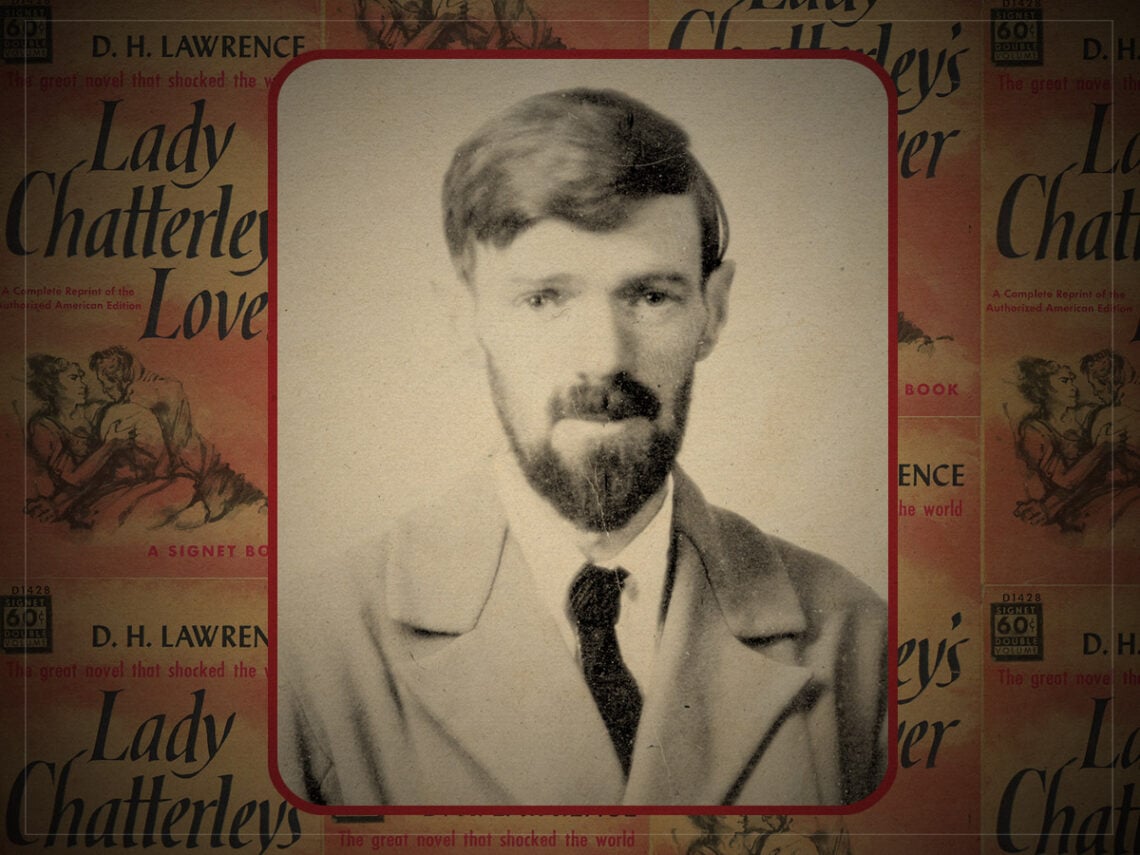
‘Lady Chatterley’s Lover’: The raunchy banned book that became a best-seller and helped to launch counterculture

English writer DH Lawrence had long championed the themes of modernity, sexuality, vitality and instinct in his works, which spanned short stories, novels, poetry and plays.
Four of his novels, published between 1913 and 1928, were subject to censorship trials, with the last, Lady Chatterley’s Lover, being his final work and later causing so much controversy that it inadvertently sparked a revolution.
Lawrence’s novel was privately published in Florence, Italy, in 1928 (it would find its way to Paris, France, the following year), but was subsequently banned in several countries, including the United States, Australia and Japan; Lawrence would pass in 1930. A complete, uncensored version would not be published openly in the United Kingdom until November 1960, when it was the subject of an obscenity trial, on the grounds of a law which criminalised the publication of material considered immoral.
The British publishing house, Penguin Books, decided to challenge the UK Parliament’s Obscene Publications Act of 1959, which promised “to provide for the protection of literature and to strengthen the law concerning pornography” and allowed a defence to argue that a work deserved to be published if it had literary merit, with its publication of Lawrence’s complete work, marking a shift in the social changes that were beginning to brew.
The story of Lady Chatterley’s Lover follows a young married woman, Lady Constance Chatterley, whose husband, Sir Clifford Chatterley, is an upper-class baronet who is paralysed from the waist down because of an injury endured in the Great War, with Constance embarking on an affair with Oliver Mellors, a working-class gamekeeper, their class difference being a primary motif in the novel, as is its portrayal of female sexuality.
Beyond its explicit contents, including swear words and descriptions of sex, the plot of the story considers the themes of the mind and body, and how they each relate to the search for integrity. As quoted in 1961’s A Propos of Lady Chatterley’s Lover and Other Essays, Lawrence intended to challenge British taboos surrounding sex, allowing men and women “to think sex, fully, completely, honestly, and cleanly”.

In 1960, Penguin Books wrote to the Director of Public Prosecutions, warning that they intended to publish the original version of Lady Chatterley’s Lover. That August, Reginald Manningham-Buller, the chief legal adviser to the Crown, read the first four chapters of Lawrence’s novel before writing to the DPP for approval of legal proceedings against Penguin, writing, “I hope you get a conviction.” The founder of Penguin Books, Sir Allen Lane, was in Spain and was advised to return home as soon as possible.
The subsequent trial was the first of its kind under the revised Obscene Publications Act. Penguin assembled several expert witnesses, including writer EM Forster, critic and academic Helen Gardner, writer Raymond Williams and more, to aid their case. Academic and author Richard Hoggart, in particular, was a key witness who argued that the novel was moral and “puritan”.
In contrast, Mervyn Griffith-Jones, as the leader of the prosecution, argued that the sex depicted in the novel was pornography, asking the jury, “When you have seen the book, just ask yourselves, would you approve of your sons and daughters reading it? Would you leave it lying about your house? Is it a book you would even wish your wives and servants to read?” Mr Justice Byrne, the presiding judge of the trial, did note that the low cost of the book would allow it to “be available for all and sundry to read”.
On November 2nd, 1960, after a six-day trial and three-hour jury deliberation, the unanimous decision found Penguin Books “not guilty” under the Obscene Publications Act. Lady Chatterley’s Lover promptly went on sale, printed by a new firm. The trial effectively promoted the book, which sold all of its initial 200,000 copies on its first day of publication. Though many bookstore customers were embarrassed to ask for the novel, simply referring to it as “Lady C” or silently offering its cost of “three shillings and sixpence” to the cashier, it would go on to sell 3million copies in three months.
Penguin’s second edition of Lady Chatterley’s Lover, published in 1961, included a publisher’s dedication: “For having published this book, Penguin Books was prosecuted under the Obscene Publications Act, 1959, at the Old Bailey in London from October 20th to November 2nd, 1960, this edition is therefore dedicated to the twelve jurors, three women and nine men, who returned a verdict of ‘not guilty’ and thus made DH Lawrence’s last novel available for the first time to the public in the United Kingdom.”
The publication of Lady Chatterley’s Lover in its original form came to symbolise a shift in Britain’s culture, and in the United States, likewise, the novel’s publication preceded the sexual revolution of the 1960s, signalling a move towards a more inclusive conversation and acceptance surrounding freedom of speech, expression and sexuality.
