


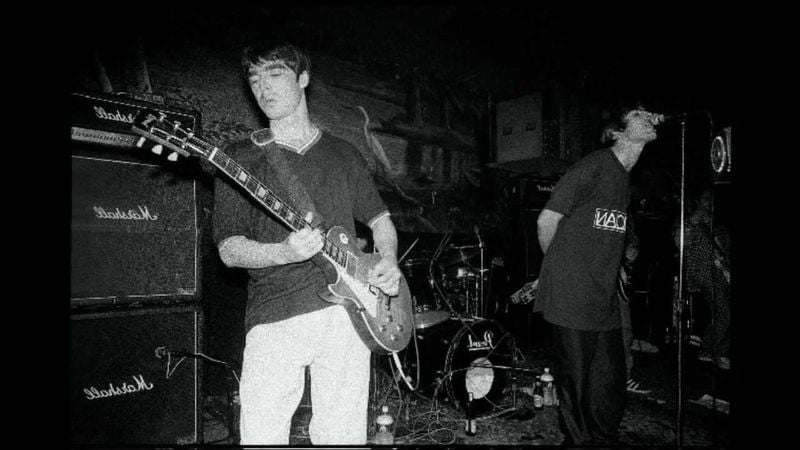
Watch rare footage of Oasis live at Gleneagles, 1994

By 1994, Oasis were on the cusp of greatness. Just a few years previously, Liam Gallagher had informed his music-obsessed brother that he was singing with a local band. Seizing control, Noel Gallagher ushered in a new age for the fledgeling outfit, bringing with him a heap of new material. This was the birth of Oasis, perhaps the most celebrated and derided of all the Britpop guitar bands. We’ve bought you some rare footage of the group performing live a Gleneagles in 1994, shortly after the release of their first single, ‘Supersonic’.
Arguably one of the band’s best-ever performances, Oasis 1994 concert at Gleneagles came just a year after Creation records boss Alan McGee spotted Noel, Liam, Bonehead and Tony McCarroll at Glasgow venue King Tut’s Wah Wah Hut. That fated gig had won Oasis a record deal with the UK’s coolest label and the faith of the industry’s most respected label owner. If Liam’s voice sounded as good in King Tut’s as it did in Gleneagles, it’s no surprise McGee was impressed. That night, the frontman was a songbird in a baggy parka.
Following the white label release of their track ‘Columbia’, Oasis unveiled their debut single ‘Supersonic’. On its release in April 1994, the track reached number 31 in the charts and was followed by ‘Shakermaker’, which landed Oasis with a plagiarism lawsuit, robbing them of $500,000 in copyright damages. The success of their third single, ‘Live Forever’, more than made up for these losses, however. A sign of things to come, it marked Oasis’ first single to enter the UK top ten.
Oasis arrived at Gleneagles a few months before the release of Definitely Maybe in August 1994. To record the album, Oasis had travelled to rural wales, where they booked Valley Studios near Rockfield at the tail end of 1993. Their producer was Dave Batchelor, who Noel knew from his days working as a roadie for Inspiral Carpets. Sadly, Batchelor turned out to be the wrong man for the job. Unable to capture the raw energy of the group’s live sound, he was fired. Noel was, by this point, becoming increasingly frantic, which might explain why he gave his brother such a hard time during interviews about Oasis’ deportation from Amsterdam following an iconic ferry bust-up.
On the band’s return to England, they travelled to Sawmills Studio in Cornwall, where Noel produced the sessions alongside Mark Coyle. The pair decided that the best way of replicating the band’s live sound was to record instruments together, allowing for a degree of sound leaking. However, it wasn’t until the arrival of engineer and producer Owen Morris that things really began to take shape. Morris stripped away layers of Noel’s overdubs, retaining and emphasising the dynamism at the core of the recordings. After bathing the recordings in tape delay, Morris surfaced with a set of tracks so in-ya-face that even Johnny Marr was a little taken aback. It was the beginning of everything.
