


‘Rain’: Joris Ivens’ poetic vision of Amsterdam

When European student movements gained momentum in the latter half of the 20th century, it was always a manifestation of the youth’s intense political dissatisfaction with oppressive societal structures. Their critiques targeted several sociopolitical sectors, and one of those points of concern was the dangerously uninspired visual language of contemporary mainstream cinema. They had their own champions, such as Dziga Vertov and Joris Ivens, who revolutionised the medium instead of adding to the excess of hollow images.
Ivens is a particularly interesting example since his work spans several markedly different eras of cinema that were governed by varying evolutionary principles. Ranging from his early shorts that tried to experiment with the boundaries of cinematic grammar to later high-profile collaborations with the likes of Ernest Hemingway and Orson Welles, the Dutch auteur’s artistic trajectory still piques the curiosity of cinephiles who are always obsessed with the form’s history.
While the second portion of Ivens’ career is equally fascinating, the film that undoubtedly defines his original style is his and Mannus Franken’s 1929 project, Rain. On the surface, it’s a simple enough assignment: a collection of vignettes that document a city subjected to the onslaught of incessant rain. However, to focus solely on the subject would be a grave mistake since it’s primarily an exercise in exploring the linguistic frameworks of cinema.
A major addition to the city symphony genre alongside other masterpieces like Manhatta, Rain isn’t interested in painting a conventional portrait of Amsterdam. Instead, it is only curious about the seemingly infinite ways in which a city interacts with rain. Fashioning out moments of magic from a universally mundane phenomenon, Ivens and Franken rely on the visual potential of the medium to completely mesmerise us.
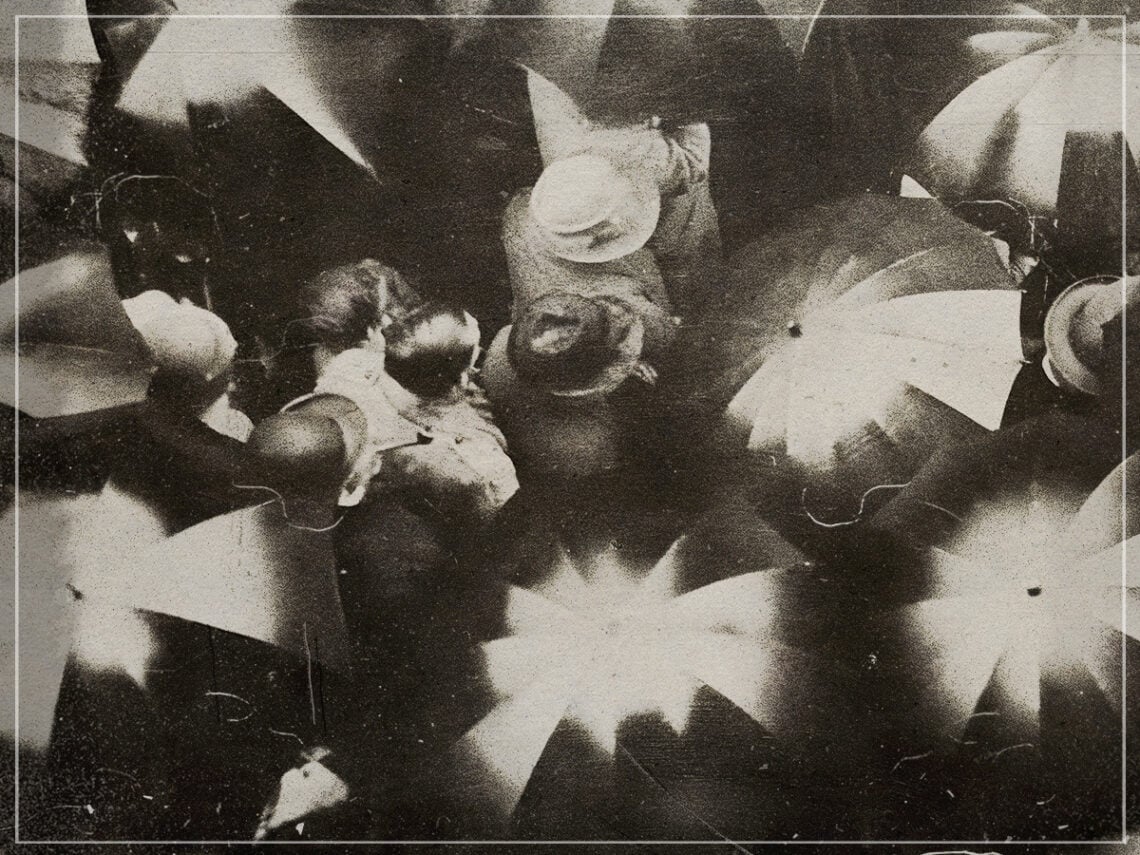
Understanding where the camera chooses to look in Rain is the key to its philosophical foundations. Alternating between light and shadow, between liberated shots of clouds in the sky and concentrated gazes directed at the ground, the filmmakers ask us to rethink the rigid associations we make with the idea of a city in our minds. It can be as simple as observing how someone’s shoe either avoids or succumbs to a puddle on a rainy day. If we give our imaginations free rein, even a congregation of umbrellas might look like exotic fauna on a strange planet (as it does in the film).
Inspired by Soviet Montage theory, the sum of the individual shots is far greater than its parts, elevated by brilliant editing. Very elemental in nature, Rain isn’t just a meditation on water but also a unique chronicle of wind, which is even more noteworthy since Ivens’ final project (A Tale of the Wind) is fully dedicated to the latter. It is only by revisiting Rain that we can comprehend how revelatory Ivens’ style was even in those early years, effortlessly rising above the limited paradigms of documentary realism.
Watch the film below.
