


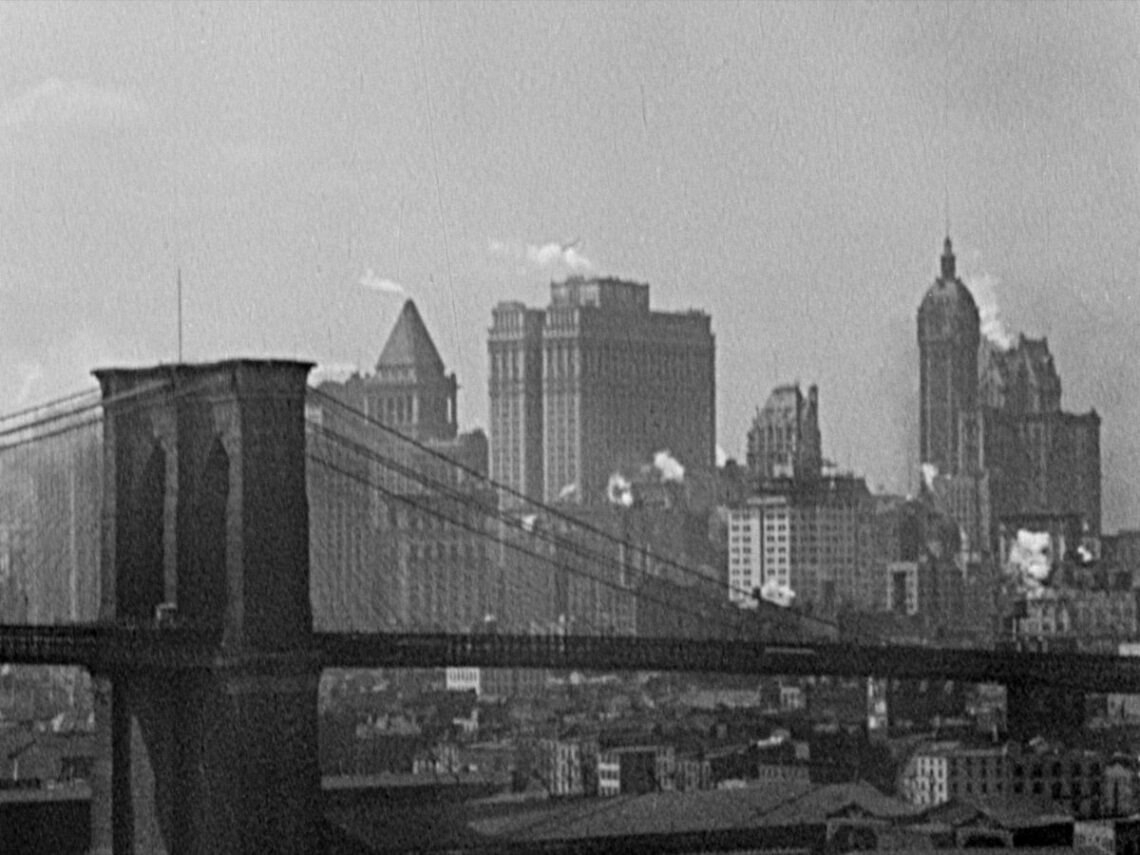
‘Manhatta’: an early 20th-century portrait of New York City

It’s always interesting to revisit old photographs and archival footage of cities, not only to see how they have changed but also to find out what they have retained over the years. Of course, the world’s biggest cities are much more well-documented than the rest, especially when it comes to films from the silent era that date back to the very beginning of the art form. Among them, New York City is probably the most mythologised urban hub in film history.
Ranging from Martin Scorsese to Woody Allen, some of the most celebrated American filmmakers have attempted to translate the city’s unique cultural identity to film. Even in recent years, younger generations of artists have continued to explore what makes New York so special, proving that it always be a riveting subject for visual projects. The most notable recent example is the recent HBO series How To with John Wilson, which tries to untangle the bizarreness of the city and its inhabitants.
Such cinematic portraits of the city were made even in the late-19th century, but they were usually one-dimensional and only contained historical value. It wasn’t until Charles Sheeler and Paul Strand’s Manhatta that the format became a much more complex one, presenting an abstract, self-aware look at the rapid industrialisation that took control of the city. It draws us into an old world that is caught between the states of existence and non-existence, lodged in the crevices of our collective memory.
Made in 1921, Manhatta is a non-narrative work that doesn’t rely on a specific direction to tell a story. Instead, it paints a comprehensive picture by threading together shots of architectural structures, the seemingly random movement of the city’s endless population, the water bodies that surround it and the ships that connected it to the rest of the world. Due to this abstract nature, some scholars have cited it as the first entry to the American avant-garde tradition.
With intertitles featuring the poetry of none other than Walt Whitman, many have interpreted Manhatta’s images as inherently optimistic visions of the future that was yet to come. Often associated with the American Precisionist Movement, Manhatta’s modernist depiction of New York City inevitably reminds viewers of the great expressionist work that would soon follow: Fritz Lang’s Metropolis. However, for modern audiences, the film might mean something completely different.
In previous years, where others have seen images of progress and prosperity, Manhatta now appears as a ominous warning of the urban wastelands that we are now familiar with. Whitman’s poetry, juxtaposed with the shots of active and unfettered air pollution, seems almost cynical about the version of the city that future generations would inherit. Manhatta can now be seen like a horror film, documenting one of the world’s worst urban monstrosities in its nascent stages.
While watching it now, it’s impossible to dwell on Whitman’s writings. Instead, I found myself repeatedly thinking of Antonio Gramsci’s apocalpytic quote: “The old world is dying, and the new world struggles to be born: now is the time of monsters.”
Watch the film below.
