


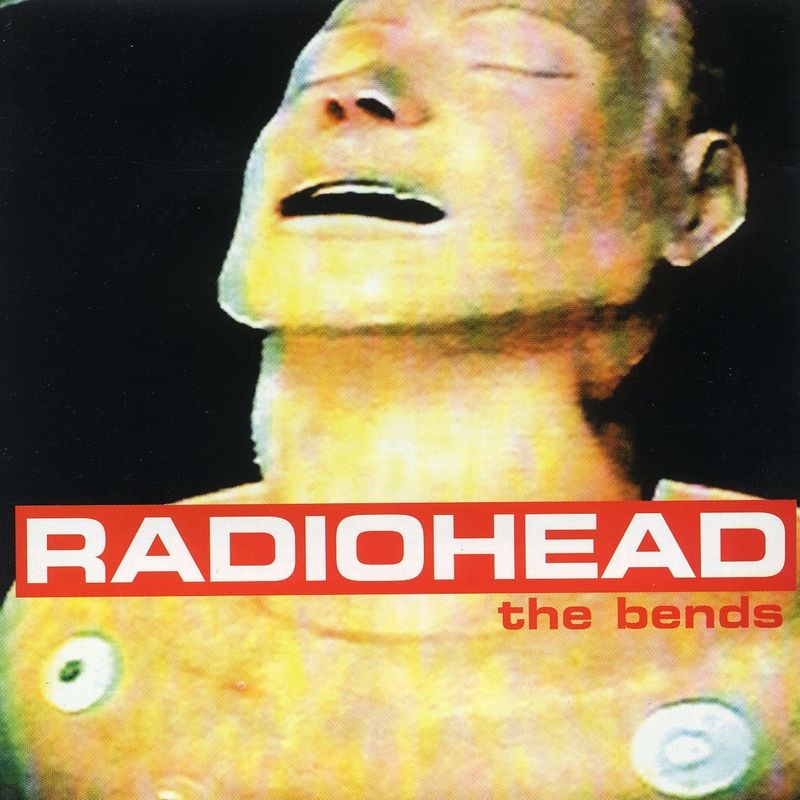
Radiohead – ‘The Bends’

Say what you will about the first Radiohead album, Pablo Honey, but without its smash hit single ‘Creep’, it’s unlikely that we would have been treated to the wonders that the Oxford band would provide for us over the following years. Without ‘Creep’, The Bends might never have existed, and Radiohead may have just about faded into unexistence.
However, perhaps there is also a sense that the success of ‘Creep’ also contributed to growing pressures within the Radiohead camp to follow up on its impact on the charts. That pressure led to Thom Yorke explaining a cancelled appearance at Reading Festival by saying, “Physically, I’m completely fucked, and mentally, I’ve had enough.”
Maybe it was that short break that allowed Yorke and his bandmates to get their shit together after relentlessly touring Pablo Honey. When Yorke played producer Paul Q Kolderie some demo tapes of songs for Radiohead’s sophomore effort, he was blown away.
Guitarist Ed O’Brien also once noted the improvement of song quality from Pablo Honey to what would become The Bends. “After all that touring on Pablo Honey, the songs that Thom was writing were so much better,” he said. “Over a period of a year and a half, suddenly, bang.”
And that “bang” is a rather suitable sound for the transition from Radiohead’s first messy alt-rock record to their second album. In some ways The Bends almost feels like the first proper Radiohead record, tapping into a groove that would keep us trapped for the next few decades.
As soon as The Bends opens with ‘Planet Telex’, we notice the work that producer John Leckie had done with Jonny Greenwood. The collaboration brings out the more subtle swells of his guitar that are contrasted by the distorted tones that rise to the surface in the solos. It’s a sonic juxtaposition that really makes the album sing.
And so too had Yorke’s voice found a higher register, as influenced by the likes of Jeff Buckley. Yorke’s singing had always been at its best when he is almost stretching to his limit, and the chorus of ‘Planet Telex’, “Everything is broken, everyone is broken”, is a perfect example of Yorke suddenly believing in his voice, rather than somewhat being ashamed of its limitations as he had been on Pablo Honey.
The newly poignant depth to these lyrics also forecast the themes of social ennui that Yorke would whack us over the head with on OK Computer a few years later. The album’s title track follows in a similar fashion thematically but still retains the pop sensibility of ‘Creep’. Even just two tracks into The Bends, it is clear that Radiohead had grown as a band.
While songs like ‘The Bends’ and songs like ‘Just’ showed the new Radiohead at their most ferocious, suddenly, we were also treated to the band at their most tender. Take, for example, ‘High and Dry’, ‘Fake Plastic Trees’ and even ‘Bullet Proof … I Wish I Was’ – three songs that saw the reliance on three guitarists all playing the same part as loud as they could – replaced by the understanding that space to breathe is an essential ingredient in any track willing to muse on less immediate matters.
O’Brien noted this new sparse tact as evidence that maturity had suddenly arrived in camp Radiohead. “We were very aware of something on The Bends that we weren’t aware of on Pablo Honey,” he said. “If it sounded really great with Thom playing acoustic with Phil and Colin Greenwood, what was the point in trying to add something more?”
That mantra is true throughout the album, and the consequent result of it is that when the full band do come in all guns blazing at a song’s crescendo, it is all the more impactful, and you don’t have to look any further than the three-minute mark of ‘Fake Plastic Trees’ to experience the wallop of that rush. Clearly, the 1990s ethos of loud-quiet-loud, as mostly exemplified by the alternative rock bands of America, had also begun to take its stranglehold on the equivalents in the UK.
So throughout The Bends, we have the tender (‘High and Dry’), and we have the euphoric (‘The Bends’), but we also have moments of darkness too, say the introduction to ‘Street Spirit (Fade Out)’, where Yorke is at his initially most dour, and then his most resplendent, and where Ed O’Brien is given the opportunity to showcase himself as a more than capable backing vocalist.
The Bends is an absolutely essential album in the Radiohead catalogue. It was the record that took them from one-hit wonders to having belief in their own credibility as songwriters and musicians. Their sophomore effort brought more distinct roles to Yorke, O’Brien and Jonny Greenwood, with Yorke primarily on acoustic, Greenwood on lead and O’Brien on effects, with the result being a band finally starting to find their rhythm and lay the groundwork for the albums ahead that would define their excellent career.
