


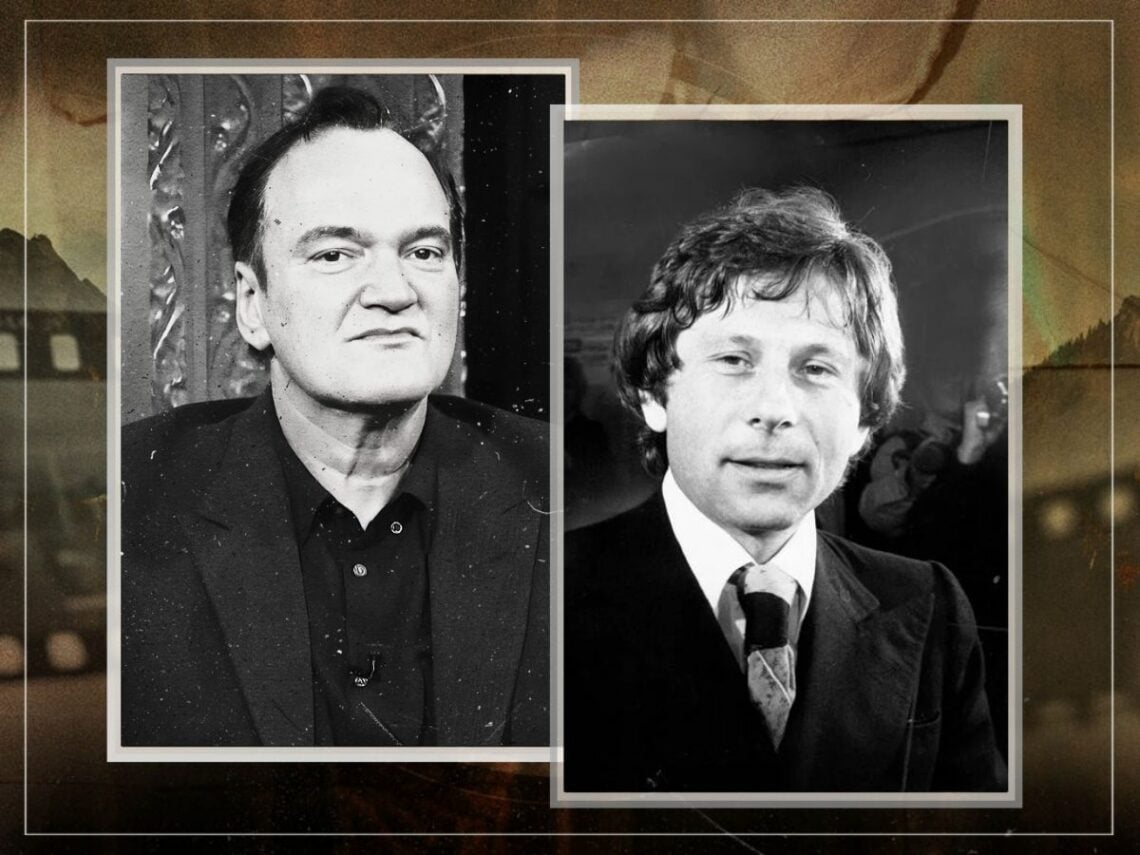
Quentin Tarantino’s problematic comments on Roman Polanski: “He had sex with a minor, all right. That’s not rape”

On February 1st, 1978, Roman Polanski fled the United States after 42 days in jail while he awaited final sentencing after pleading guilty to raping a child. It’s a startling fact that makes the support he has received since unreconcilable. Ultimately, the only way you can fathom the blind defence of the child rapist is to see it as a broader symptom of society’s ignorance regarding the widespread sexual abuse of women. Quentin Tarantino’s own condemnable comments reflect this unfortunate societal disparity.
This case is not one that should be caveated with any degree of justification: By Polanski’s own admission, in March 1977, the then-43-year-old director drove a 13-year-old girl to Jack Nicholson’s house while the Chinatown actor was out of town. Polanski claimed he was going to take photos of the girl for French Vogue magazine while he was a guest editor. When he arrived at the property, he gave the 13-year-old champagne and a quaalude. He then proceeded to rape her repeatedly and then drove her home.
The next day, he was arrested. Polanski spent 42 days in jail awaiting further sentencing. On the day he was released and informed that he was due to receive a lengthy sentence, he fled the US, boarded a plane to London, and crossed the border to France, where he has dual citizenship. French law has prohibited his US expedition charge ever since.
As a fugitive, Polanski has gone on to direct 15 projects. During that time, he has worked with huge Hollywood names such as Johnny Depp, Kate Winslet, Natalie Portman and many more. He has also been nominated for several awards. All while maintaining that he did rape a child and offering up the following explanation for his villainy in 1979: “If I had killed somebody, it wouldn’t have had so much appeal to the press, you see?” he said. “But… fucking, you see, and the young girls. Judges want to fuck young girls. Juries want to fuck young girls. Everyone wants to fuck you girls!”
In this regard, we are dealing with a child rapist who not only escaped justice but has also escaped rehabilitation and the just reconciliation of his own crimes. Largely, his blasé attitude regarding his abuse has also carried through to Hollywood. In 2009, an astonishingly large number of leading figures in the film industry signed a petition calling for his release, including David Lynch, Martin Scorsese, Wim Wenders, Wong Kar-wai and Woody Allen.
The argument is that his initial sentence would have been three years in state prison, and by that logic, he would have served his time by now. They see the fact that his international movement has been restricted to a few select countries and the condemnation of the press as punishment enough. However, if he had committed the same crime today, the sentence would have been severely harsher, but his defenders insist that he should be judged on previous, antiquated legal standards, despite the fact that he never actually served a sentence, to begin with.
Tarantino’s defence of Polanski and Hollywood’s accountability problem
Perhaps the most alarming public defence came in 2003 when Quentin Tarantino told Howard Stern: “He didn’t rape a 13-year-old. It was statutory rape. That’s not quite the same thing… He had sex with a minor, all right. That’s not rape. To me, when you use the word rape, you’re talking about violent, throwing them down.” It took Tarantino 15 years to apologise to Polanski’s rape victim for his evident ignorant and reproachable comments. Even then he caveated his recourse by saying that he “played devil’s advocate in the debate for the sake of being provocative”.
Tarantino’s defence of Polanski wasn’t just tone-deaf, it was symptomatic of a film culture that too often excuses genius at the expense of accountability. To dismiss child rape as a technicality of statutory law is not just legally inaccurate, it’s morally bankrupt. And when that dismissal comes from a filmmaker whose work thrives on shock, blood, and exploitation, it begins to sound less like provocation and more like projection – an uncomfortable proximity to the very structures of power and denial his films claim to subvert.

What’s more damning is that his apology came not in the moment, but after a 15-year delay and prompted not by personal reckoning, but by public pressure. That’s not growth; that’s damage control. And in a cultural landscape where survivors are still fighting to be heard, the silence of powerful men, followed by defensive half-apologies, has become a genre of its own. Tarantino, for all his cinematic brilliance, inserted himself into that canon, and no amount of retrospective clarification erases the ease with which he dismissed a 13-year-old girl’s rape as “not quite the same thing”.
Why would you play devil’s advocate in the case of a child rape? This alone is indicative of society’s continued ignorance on the matter. Is the violence continually perpetrated against women in Tarantino’s films merely to provoke the audience without much due forethought regarding the message that it sends? And is that a worthy justification in a world where the UN claims that one in three women worldwide have experienced physical or sexual violence, and in the US, every nine minutes, child protective services substantiates or finds evidence for a claim of child sexual abuse?
These facts are shocking, just as the details of Polanski’s case that opened this piece also prove unsettling. Anything glossing over these, defending them, or simply failing to address them clearly shows that, as a society, we have not come to terms with the problem. When you deconstruct Tarantino’s comments, the same can also be said of his own films, where violence against women fails to address the wider picture. He is not alone in this regard, but there is no way that you can say his films show violence gratuitously as opposed to exposing the ugliness of it.
While this has been a normalised entertainment choice that escapes Tarantino’s oeuvre alone, his comments and the same insensitive approach in the construction of his films show that we must be more cognizant of the issue in order to help solve it. In the past, Tarantino has even admitted this himself, stating regarding his allegiance with Harvey Weinstein: “I knew enough to do more than I did.”
While this is a saddening statement, it should serve as the tagline for how we actively address the problem moving forward. That also includes no longer using violence, whether sexual or otherwise, in films as a provocative tool. Because, above all, the Polanski case proves that culture can perpetuate society’s dark undercurrents in a troubling manner, such as constant sexualisation, blind hero-worship, and sustaining patriarchal paradigms even if it is subconscious. In order to address that, we must confront the blunt reality of the problem and be more mindful about our actions and art because, in all of this debate, the traumatic and tragic ramifications for a 13-year-old child are all too often widely overlooked.

Never Miss A Take
The Far Out Quentin Tarantino Newsletter
All the latest Quentin Tarantino content from the independent voice of culture.
Straight to your inbox.