


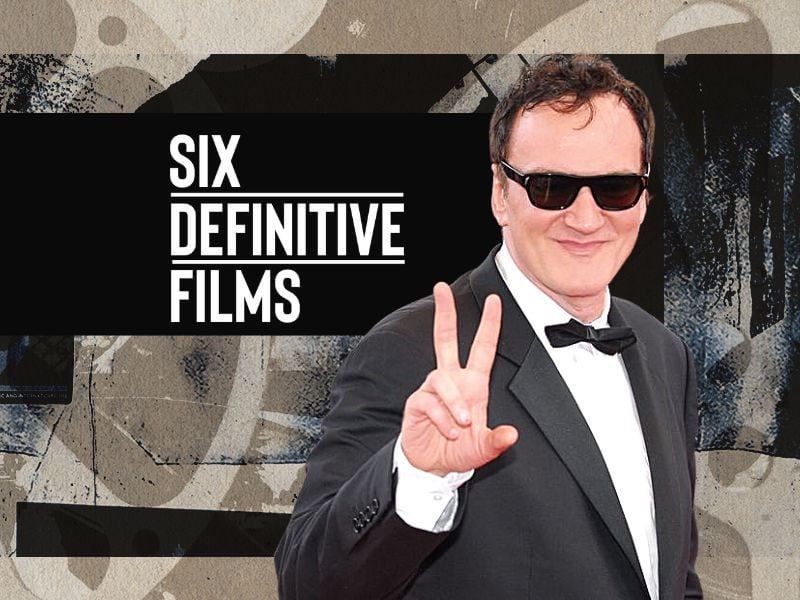
Six Definitive Films: The ultimate beginner’s guide to Quentin Tarantino

Whether you love or hate Quentin Tarantino, his influence on cinema is undeniable. Since the early 1990s, Tarantino has made a name for himself due to his distinctive visual style, on-screen violence, witty dialogue, and homage to classic cinema.
A self-proclaimed movie buff since childhood, Tarantino began writing films as a teenager. However, he ended up taking acting classes with the ambition of starring in front of the camera. That said, during this time, the filmmaker learnt how to write: “I actually realised I had a bit of talent at it [by] going to acting class,” he once famously said.
During the 1980s, Tarantino kept writing films, one of these being My Best Friend’s Birthday, which was never completed, although some of its dialogue made its way into 1993’s True Romance, a project directed by Tony Scott. Tarantino also wrote the screenplay for From Dusk Til Dawn for Robert Rodriquez in the early 1990s, which was his first paid writing assignment.
However, Tarantino received critical acclaim and recognition for his debut feature, Reservoir Dogs, a debut which was released in 1992. The heist thriller was hugely successful, setting the tone for Tarantino’s future work.
Famously, his next project was Pulp Fiction, for which the filmmaker won an Academy Award. By the mid-1990s, Tarantino was one of the hottest names in Hollywood, despite his independent roots. Everyone was talking about Tarantino, and the filmmaker continued his success into the next decade.
As of 2022, Tarantino has nine feature films to his name (Kill Bill: Volume. 1 and 2 are considered to be one movie), and he has claimed that he plans on making no more than ten films in his career to maintain a high quality of work. This has seemingly worked in his favour – every single movie of his has been met with critical praise; even Death Proof, widely considered his weakest and worst film, was still met with plenty of praise from many prominent publications.
With Tarantino’s latest feature, Once Upon a Time in Hollywood, the director received his highest amount of nominations to date, securing ten Oscar nominations and ten BAFTA nods in what is a supremely impressive feat. Tarantino’s legacy will forever be remembered in cinema, even if much of this is comprised of scandal. From his obsession with feet (which he inserts into his films at an alarming rate), to his questionable glorification of violence, Tarantino is far from a flawless director.
Still, Tarantino’s catalogue of films has greatly influenced aspiring and established filmmakers since the 1990s, thus, we have compiled a list of the most important and defining films of the director’s oeuvre.
Quentin Tarantino’s six definitive films:
Reservoir Dogs (1992)
Quentin Tarantino’s debut feature brought him into the mainstream, with critics labelling the film as a monumental achievement of independent cinema. Starring a stacked cast, which includes Harvey Keitel, Tim Roth, Steve Buscemi, Michael Madsen, and Tarantino himself, the film follows a group of thieves whose heist takes a turn for the worst. Keitel was so impressed with the script that he decided to co-produce the film, also paying for casting sessions in New York.
The film, which was originally intended to be shot with friends on a shoestring budget using black and white 16mm, ended up being a huge success for Tarantino. Reservoir Dogs was praised for its comical dialogue, non-linearity, and unapologetic intensity. Simultaneously, the film was criticised for its strong use of stylised violence, which caused many audience members to walk out of screenings, including the horror genius Wes Craven. Nevertheless, Reservoir Dogs achieves what it set out to do – shock and disturb.
Pulp Fiction (1994)
Two years after Reservoir Dogs, Tarantino released Pulp Fiction, a black comedy crime drama featuring the likes of Samuel L. Jackson, John Travolta, Uma Thurman, Tim Roth, Harvey Keitel, and Bruce Willis. With heaps of quotable lines, intense violence, and memorable characters, Pulp Fiction is a masterclass in screenwriting, perfectly contrasting humour with brutality.
The film was co-written with Roger Avary, and crime novels inspired the pair. Tarantino said: “I got the idea of doing something that novelists get a chance to do but filmmakers don’t: telling three separate stories, having characters float in and out with different weights depending on the story. […] Part of the trick is to take these movie characters, these genre characters and these genre situations and actually apply them to some of real life’s rules and see how they unravel”.
Pulp Fiction is also renowned for its spectacular soundtrack, which blends surf rock, pop, soul, and rock ‘n’ roll. From Dick Dale’s ‘Misirlou’ to Dusty Springfield’s ‘Only Son of a Preacher Man’, the soundtrack takes the film to even greater heights.
Kill Bill: Volume. 1 (2003)
Heavily inspired by martial arts cinema, grindhouse, samurai films and spaghetti westerns, Kill Bill is a kung-fu revenge epic that follows Uma Thurman’s The Bride as she tracks down the assassins and their leader Bill, after they try to kill her and her unborn child. Defiant and determined, The Bride is one of Tarantino’s greatest characters, with Thurman giving a memorable performance as “the deadliest woman in the world”.
The film culminates in an astounding fight scene between the Bride and the Crazy 88s as well as the Tokyo Yakuza leader O-Ren Ishii, played by Lucy Liu, which is a highlight of Tarantino’s oeuvre. Featuring a striking technicolour palette and even an anime sequence, Kill Bill is a visual feast. The following year, Tarantino released the sequel, which depicts The Bride’s continuing quest to kill Bill.
Inglourious Basterds (2009)
Tarantino transports us to World War II for his 2009 film Inglourious Basterds, starring Brad Pitt, Christopher Waltz, Michael Fassbender, and Eli Roth. We follow two groups – one of the French cinephiles and the other Jewish soldiers – the Basterds, as they plan to assassinate the Nazi leadership. It took over a decade for Tarantino to finish his script, stating that he kept expanding it with the vision that he was creating a masterpiece.
Whether you think Inglourious Basterds is Tarantino’s masterpiece or not, it is definitely one of his best films. Featuring the Tarantino hallmark of genre-blending, extreme violence, and masterful performances, the film is a spectacle – one that is thoroughly entertaining. Inglourious Basterds was nominated for eight Academy Awards, with Christopher Waltz taking home the prize for Best Supporting Actor. Tarantino’s sixth film proves him to be more than capable of attempting historical period pieces, paving the way for his subsequent features.
Django Unchained (2012)
The first of two Westerns directed by Tarantino, Django Unchained is set in the Antebellum South and follows Django as a slave who, now freed, trains with a bounty hunter to rescue his wife from enslavement by the chillingly cruel plantation owner Calvin Candie. Tarantino’s revisionist Western plays tribute to Spaghetti Westerns, such as Django and the films of Sergio Leone.
Jamie Foxx gives one of his greatest performances as Django. In an interview with That Shelf, Tarantino described why he picked him for the role, saying: “He was also my cowboy – there was this cowboy quality to him. He’s from Texas […] he knows what it’s like to be a kid in the 70s and actually experience racism”. Tarantino’s epic dishes out equal helpings of sensationalism and stylistic violence along with social criticism.
Once Upon a Time in Hollywood (2019)
The most recent effort from Tarantino came in the form of the epic comedy-drama, Once Upon a Time in Hollywood. Starring frequent Tarantino collaborators Leonardo DiCaprio and Brad Pitt, the film immerses us in late-1960s Los Angeles, where the film industry is changing shape, all whilst the threat of the Manson family hangs in the air.
Mixing fictional characters, such as washed-up actor Rick Dalton (DiCaprio) and his stunt double Cliff Booth (Pitt), with real-life stars such as Sharon Tate (Margot Robbie), Bruce Lee, and Steve McQueen. Tarantino perfectly captures the essence of the simmering atmosphere looming over Hollywood in the late-60s. Acting as a love letter to a bygone era, Once Upon a Time in Hollywood is a thoroughly entertaining movie that brings Tarantino’s love for cinema to the forefront of its narrative and style.

Never Miss A Take
The Far Out Quentin Tarantino Newsletter
All the latest Quentin Tarantino content from the independent voice of culture.
Straight to your inbox.