


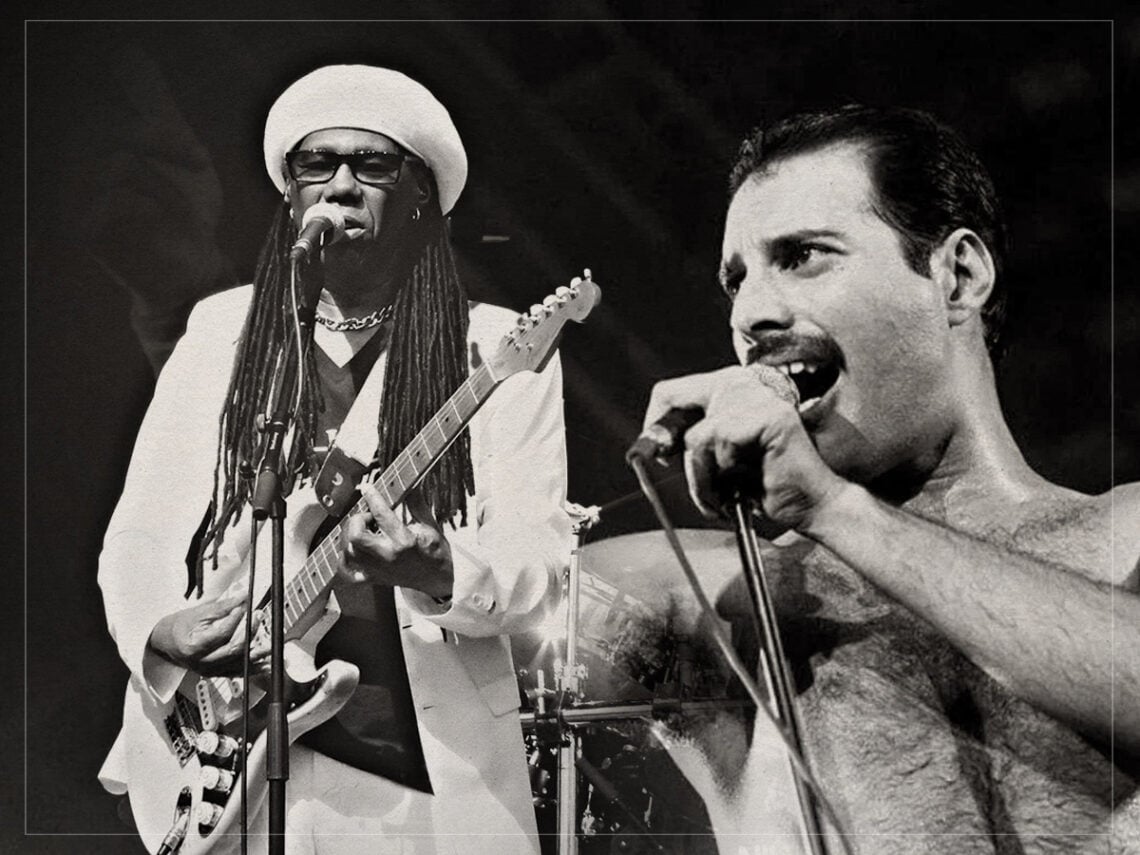
“I wrote the damn thing”: the Queen song Nile Rodgers claimed was stolen

Plagiarism is a hefty claim within the music industry, and one which has spurred on countless lengthy legal battles, royalty disputes, and vicious spats. For a songwriter as prolific as Nile Rodgers, though, having your work plagiarised, borrowed, or reinterpreted is something of an occupational hazard.
Whether it’s Diana Ross’ disco-era masterpieces, Daft Punk’s biggest hit, or his own extensive repertoire of timeless classics, Rodgers has attached his name to an unimaginable wealth of different projects over the decades. His multifaceted talents have seen him behind the production desk for countless hits, and his songwriting mastery rivals even the most successful of songwriters. Nevertheless, Rodgers has a rather nuanced take on the topic of plagiarism.
After all, there are only so many chords you can play with in the music realm; the idea that, at some point, your output will bear some crossover with another artist’s is somewhat inevitable. Some of the greatest songs of all time have been heavily influenced by other, seemingly unrelated songs. Famously, Lana Del Rey’s ‘Get Free’ bore some resemblance to The Hollies’ ‘The Air That I Breathe’, and Del Rey certainly doesn’t seem like the type of artist to sit around listening to early-1970s-era The Hollies in her free time.
Then again, some allegations of theft are harder to dispute. For instance, when John Deacon came up with the bassline for the Queen classic ‘Another One Bites The Dust’ back in 1980, Nile Rodgers immediately drew parallels to his own track, the Chic disco classic ‘Good Times’.
“One year to the day [after ‘Good Times’ reached number-one], the number one hit was ‘Another One Bites the Dust’ by Queen,” Rodgers recalled to The Guardian back in 2014. “And it sounded not like ‘My Sharona’ but like ‘Good Times’!” Listening to both tracks side by side, it is difficult to dispute the similarities between the two basslines, and yet it was only Deacon’s name that appeared in the songwriting credits of the Queen track.
“It was clearly an homage,” he continued. “Not to mention that John Deacon was with me in the studio when I wrote the damn thing!” Even still, Rodgers didn’t seem overly perturbed by this clear-cut account of musical theft: “But then, as Verdi said, ‘Good composers borrow, great composers steal.’”
After all, it wasn’t as though Chic and Queen were competing for the same section of the market back in those days, with one occupying the world of mainstream rock and the other disco – two worlds which were routinely pitted against each other. What’s more, Rodgers, with all his expertise and experience within the music industry, is more than likely aware of the fact that virtually all modern songs are in some way indebted to an external influence.
If you look at the early days of rock and roll, for instance, the hit singles credited to the likes of Elvis Presley or Jerry Lee Lewis were by and large reinterpretations of old American blues artists, who very rarely (if ever) benefited from their influence.
Rodgers is under no assumption that his writing for ‘Good Times’ was wholly original in itself, and perhaps that is why he never pursued Deacon and Queen for unpaid royalties. Plagiarism or not, that is simply how the music industry works, and aside from anything else, Rodgers has probably made enough from ‘Good Times’ anyway, without the added bonus of Queen.
