


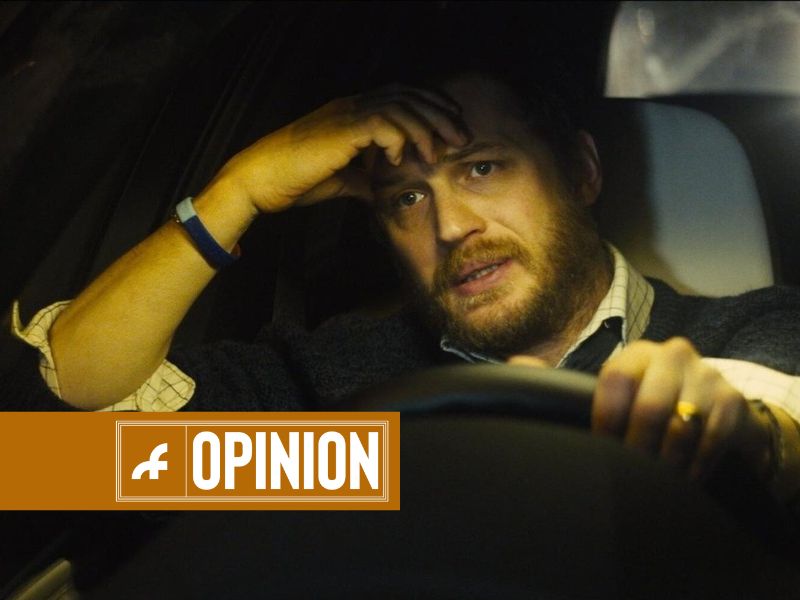
How the power of Tom Hardy makes ‘Locke’ captivating

Being a burgeoning Hollywood actor who had not yet reached contemporary popularity, it was a pretty brave move back in 2013 for writer and director Steven Knight to hold the English actor Tom Hardy within the confines of a BMW X5 and expect him to deliver a commanding performance. Looking back nine years later, Locke looks like the restrictive result of Covid-19 limitations, but the film should be considered far more than a mere experiment.
It certainly helped that Knight was a safe pair of hands behind the wheel, having earned screenwriting credits for David Cronenberg’s Eastern Promises and Stephen Frears’ Dirty Pretty Things years before the production of his basic independent drama. Championing cinematic minimalism, Knight places Hardy in the driver’s seat as Ivan Locke, a construction manager travelling on the M40 on the twilight of Friday night.
“This morning, I had a job, a wife and my children. Now all I have is this phone, and this car,” Hardy’s character mutters to himself as he conducts a series of phone calls over the BlueTooth speaker of his BMW that slowly constructs a web of regret, dismay and drama. Instead of travelling home to his wife and children and getting an early night before his important day at work the next morning, Locke instead is heading to London from Birmingham to be at the bedside of a woman who is about to give birth months after the pair had engaged in a one night stand.
A gruff Welshman with a calming demeanour, Hardy embodies the mind of the protagonist with tremendous command, making him feel like an everyday man caught in an extraordinarily prickly situation. Meticulous and driven, as the night goes on, Locke’s control of the situation begins to slowly slide, and with it goes Hardy’s slow descent into subtle insanity, well translating the fragile mindset of the breaking individual.
Unfolding with masterful pace from Knight, with every call Hardy’s character receives, his situation becomes increasingly more grave, his sons lose trust in him, his wife becomes more tearful, his co-workers more befuddled, and his pregnant one-time lover more relieved. It’s like seeing a man’s life being physically pulled apart in all directions, inevitably, some pieces are going to fracture and snap.
Whilst Hardy would be expected to carry such a drama in modern-day cinema, it’s easy to forget that back in 2013, Hardy was still something of an up-and-comer, having only recently fought Batman as Bane in Christopher Nolan’s The Dark Knight Rises. No doubt a promising talent, Locke would demonstrate the true dynamism of an actor who had only previously shown off his muscular physique and proficiency for action roles.
A humble role that purposefully rejects the allure of the Hollywood limelight, despite having voice work from an invisible yet impressive supporting cast that includes Tom Holland, Ruth Wilson and Andrew Scott, Locke explores the vulnerabilities of Hardy as an actor as well as his nuanced power for drama. Indeed, Hardy does not drive on a fury road of swirling fire and apocalyptic mania, with all the chaos of the film being contained within the leather seats of the BMW X5.
By the end of this wondrously economic piece of cinema Hardy is deservingly exhausted, having put, what seems like genuine sweat and tears into his emotionally wrought performance. Capturing a very specific stress that is both exasperated and calmed by the pace of the motorway and the silence of the car’s interior, Locke is a film that will make you look differently at your fellow drivers next time you’re travelling along the twilight of the motorway.
