


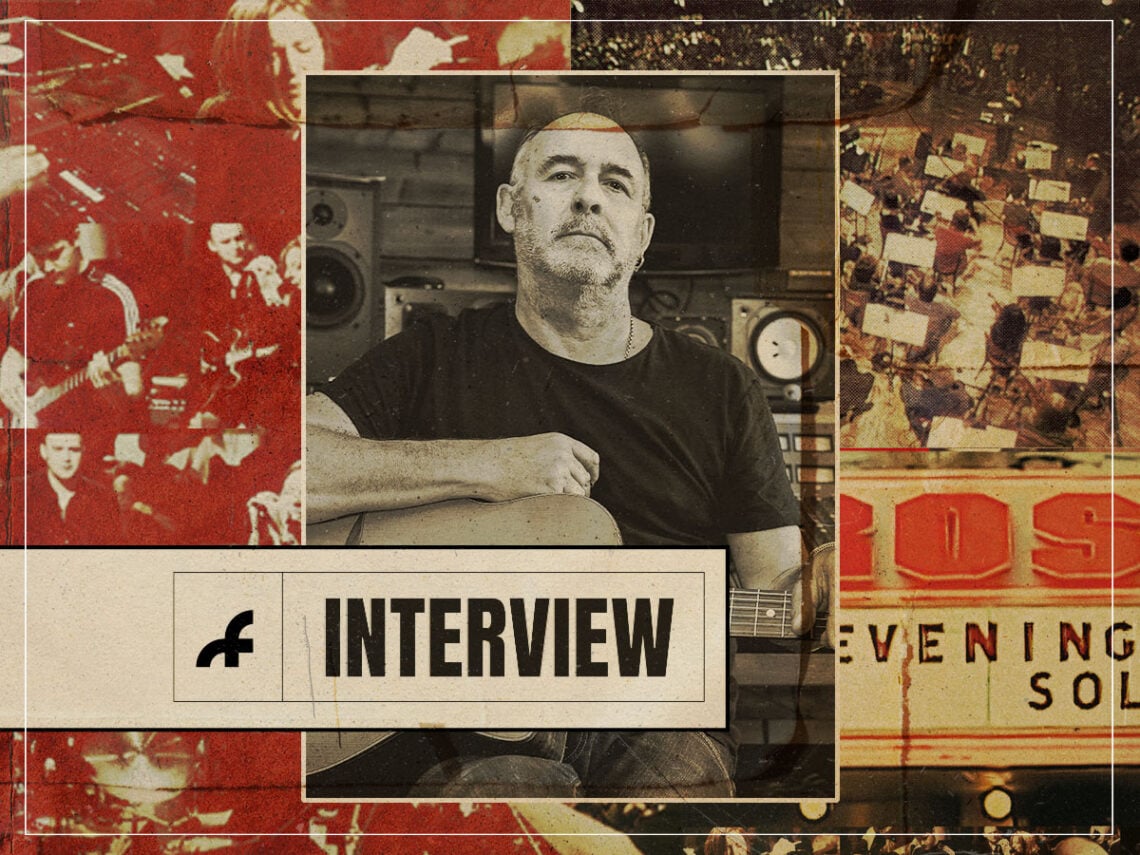
Portishead: Adrian Utley talks future prospects, artificial intelligence and more

Adrian Utley is best known as the guitarist of Portishead, the innovative, genre-defying band he brought to global prominence alongside vocalist Beth Gibbons and multi-instrumentalist Geoff Barrow in the 1990s. Utley is indeed the band’s guitarist, but this job title sells the man short. His full remit encompasses bass guitar contributions, composition, co-production, and even the theremin, as heard in the classic Dummy opener ‘Mysterons’.
On an April Wednesday, which brought weather about as indecisive as my Wi-Fi signal, Utley and I sat down for a half-hour video call. The primary focus of our conversation was Portishead’s recent Roseland NYC Live album reissue, but we also delved into the void that punctuates the band’s sparse oeuvre and cast our eyes toward an uncertain future.
There is a certain pleasure in seeing a craftsman in his natural habitat. In Utley’s case, it is undoubtedly his studio in Bristol, and he seems perfectly at ease foregrounding a barrage of dials, keys, and wires as we start our conversation with some customary small talk. “I think a balance in life is really important,” he tells me on the topic of musical biomes. “I like both the studio and the stage.”
Portishead released Roseland NYC Live in 1998 as a one-off concert film and a companion piece to the previous year’s self-titled album. The film and live album received warm critical receptions, but behind the curtain was a band on its knees. “I didn’t like what we did that day,” Barrow reflected in a 2008 conversation with the New York Times. He continued, describing the endeavour as “overblown” and “pompous.”
While Utley may not venture such peaks of self-criticism, he remembered the show as “intense” and “nerve-wracking”. Utley had the idea of creating a concert film inspired by The Sound of Miles Davis, a 1959 concert film starring Miles Davis and Gil Evans. “The whole thing was massively intense, and obviously, it’s very expensive to have an orchestra,” Utley reflected. “So we had to be very quick. We only had like two days of rehearsal with them, possibly even less.”
Touring through the mid-1990s in the run-up to the Roseland Ballroom concert helped to raise Portishead’s global stature but left the trio yearning for respite. “I was constantly on the road playing music, and I was sick of it… I was sick of travelling,” Utley continued. “I really wanted to just be grounded in a studio and learn about production. It’s a whole different world.”
When Portishead formed in 1991, Barrow was a spritely 20-year-old fascinated by hip-hop and electro. He met Gibbons during a coffee break at an Enterprise Allowance course, whereupon they discovered mutual aspirations. Utley, an established jazz guitarist, stumbled upon the duo at Coach House Studios, where they recorded their first single, ‘It Could Be Sweet’.
Utley, nearly 15 years Barrow’s senior, stood in stark musical contrast to the youngster, but where their Venn circles overlapped lay the nuanced beauty of Portishead’s sound. After the success of the Mercury Prize-winning debut album, Dummy, Utley became increasingly fascinated by Barrow’s production skills and hip-hop sensibilities. “I was interested in hip-hop and was listening to A Tribe Called Quest and Public Enemy,” Utley remembered. “Geoff was already there doing that in the studio as a young guy and knew more about it, so I wanted some of that. That, for me, was important.”
With just three albums in as many decades, only the insane would deem Portishead a prolific act. Utley’s mention of “intensity” and external passions pointed in the direction of reasoning. Still, the question of album scarcity begged.

Fundamentally, the wild success of Dummy set a lofty bar by which all subsequent releases were measured. “Although there wasn’t massive pressure from a record company – nobody’s ever interfered with us really – I think it was personal pressure within us, going, ‘Christ, we can’t do that again. We can’t repeat what we’ve just done!'”
While recording Dummy, the trio had plenty of ideas, but Utley felt they had “used up so much inspiration and stuff in one go.” Although the band was jubilant to eventually “find a way” with 1997’s eponymous follow-up, it took its toll and three long years. After Roseland, Portishead entered a hiatus, the three corners dispersing into separate projects.
Throughout their first chapter, Portishead stood at odds with genre classifiction. Hip-hop persuasions not dissimilar to those exhibited by fellow Bristolians Massive Attack had the group bundled under the trip-hop umbrella. With vinyl scratches, samples and trippy theremin sequences, one can understand the comparisons. Still, Portishead was a lone wolf, and they made it quite clear where they stood on such classification in 2008 with the arrival of Third.
Third defies convention and monotony at almost every turn, beckoning fans into the violent obscurity of ‘Machine Gun’ and the melancholic, burgeoning bliss of ‘The Rip’. Utley seemed to concur with my argument that Third is an underappreciated gem of the 21st century that deftly chartered new sonic territory while maintaining the accessibility of prior releases.
Extending his praise for Third, Utley pointed out that ‘Threads’ is his favourite Portishead song to perform live. “It’s one that Beth had written the guitar part for; it wasn’t me that did it,” he recalled, placing credit where due. “I really enjoyed playing that because it’s really weird. She recorded a load of stuff and then chopped it all up. It’s fucking weird, and there’s another aspect to it live that’s really intense.”
After six years of inactivity, Portishead regrouped for a short performance at Bristol’s O2 Academy in support of War Child UK, which provides aid to those affected by the ongoing war in Ukraine. I was lucky enough to attend the concert, where we saw a brilliant set from Portishead, followed by an energetic headline performance by IDLES.
Portishead limited their set to just five songs due to the sheer volume of artists performing that evening. “I wish we had done more, actually,” Utley commented. “We were offered to do the Albert Hall two days later, where we could’ve made a considerable amount of money for Ukraine, but for some reason, we didn’t do it.”
After receiving the expected answer, “I wish I could say, but I don’t know,” when I asked when fans could expect another Portishead tour, I took a different approach to the prospect of a fourth album. Evidently, the band has no plans to record a follow-up to Third just yet, but I was intrigued to understand Utley’s thoughts regarding a return to the studio with Barrow and Gibbons.
Utley explained that, while there are no “against” arguments, “It just isn’t happening.” Gibbons has her solo album, Lives Outgrown, arriving shortly and will be held up in touring commitments for some time thereafter. Likewise, Barrow is busy with his more prolific project, Beak. “It doesn’t seem a priority,” Utley pursued. “Although, I know there’s a lot of people wanting it.”
Despite doubts that Portishead would return to the studio any time soon, he offered one ray of hope. “We’re out of our record deal as well now, so we would own [the new album], which is good news,” Utley revealed. “I’m sick and tired of major labels; I think they’re just utterly shite… useless. Not all of them, of course, but quite a lot of them.”

Returning to the matter of Fourth, Utley concluded, “If you think about how many bands put out records quite quickly, we never did that. I’ve never been involved with any band or anything that would take so long to do anything. I’d love it if we had a new record, but I can’t say that there will be one.”
On the topic of music’s future, the conversation spiralled towards the lurking spectre of artificial intelligence. As a member of such a progressive, tech-savvy band, I wondered whether Utley might regard AI with tentative optimism. “I’m an old fella now, and it does worry the shit out of me,” Utley revealed solemnly. “I worry that we’re diluting our creativity by many things, not just AI. It’s not for my generation. I’ll be gone by the time it’s really happening, but it worries me for my kids.”
Utley conceded that humankind has always regarded technological revolutions with apprehension. “It’s like the telephone when they first came along, or steam technology – ‘We’re going to lose the plough because tractors have been invented. It’s going to ruin the fucking world’ – It probably has to be honest. So, I think I’d definitely be nervous about it, but something amazing might come out of it. Who knows? I’d rather have the plough.”
With four decades of experience behind him, Utley sees major label monopoly as riding side-by-side with AI as budding horsemen of the artistic apocalypse. “I don’t really listen to Taylor Swift, but I do like the fact that she re-recorded her records to stop her label doing exactly what they wanted with her music,” he praised. Besides not letting “AI do it for you,” Utley urges young musicians among readers to “take control of your career”.
“I’ve had the luck of having a successful band to be involved with where people want stuff from you,” Utley observed, understanding how difficult it is to be recognised in the modern industry. “I think it’s important to be honest with your music and do exactly what you want to do. I’ve seen people over the years we’ve been working, and the ones who last are the ones who don’t copy other people and make music from the heart, from themselves.”
“Don’t get shoved around by other people,” he added, addressing the camera.
As we wound down to goodbye, Utley revealed that he is currently working on a project in Dolby Atmos. “I’m really excited about the things I can do with that,” he said. “I’ve been involved in finding new ways of using the guitar to create orchestral textures or their own textures that aren’t like strings. I’m enjoying playing with new people that I haven’t met before – doing sessions, discussing and making music together – all these things massively interest me in the same way as when I’m doing a Portishead record with Geoff and Beth.”
So, while the future of Portishead is about as unclear as that of the music industry under the dawning light of artificial intelligence, Utley is happy as long as he has a studio, an idea and a couple of like-minded companions. “Making music with other humans has always been the most happy thing I can do,” he told me. “The whole process for me: live, in the studio, practising, writing. All of it is an absolute joy. I couldn’t think that I’d want to be doing anything else. I never have done since I was 18.”
The Roseland Live NYC 25th anniversary reissue is available now and can be purchased from the Portishead website. Listen to the album below.
