


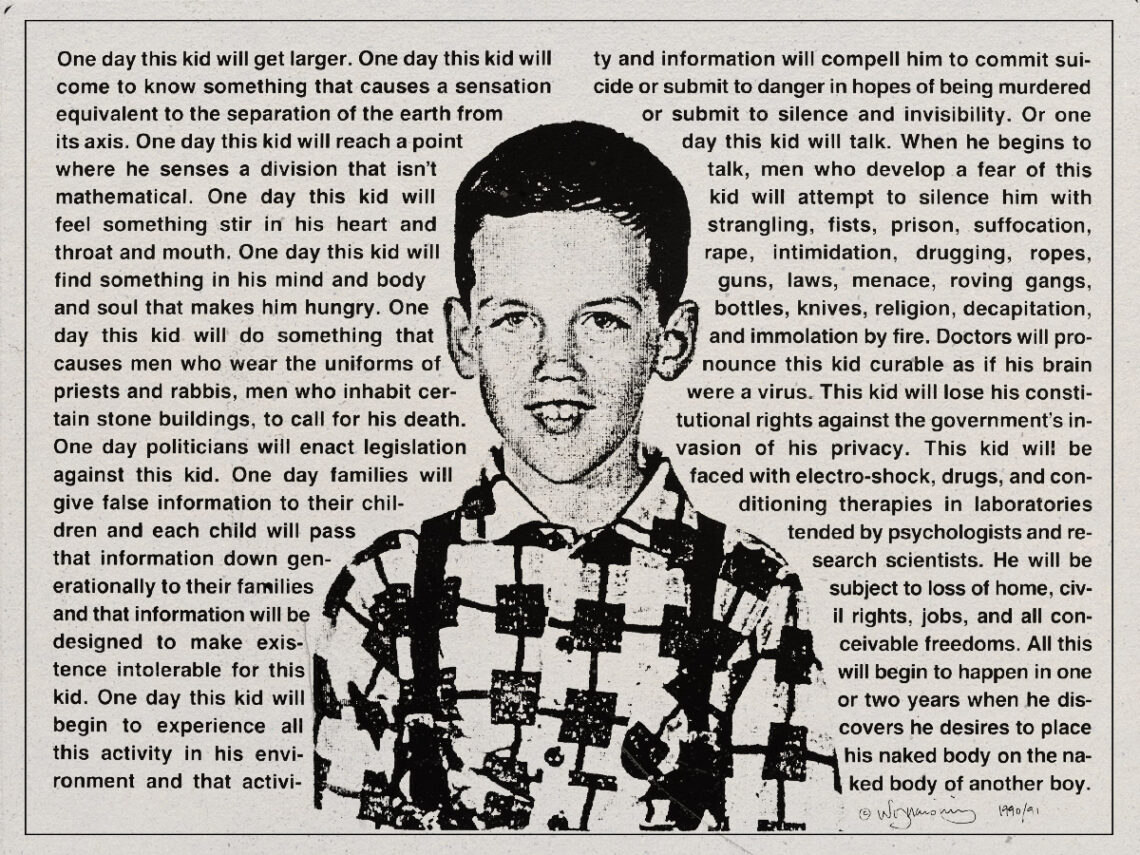
The political power of David Wojnarowicz’s ‘Untitled (One Day This Kid)’

“One day, this kid will do something that causes men who wear the uniforms of priests and rabbis, men who inhabit certain stone buildings, to call for his death.” David Wojnarowicz made this dark declaration in Untitled (One Day This Kid) two years before he died from an AIDS-related illness in 1992. It remains one of the rawest, most poignant testaments to homophobia in contemporary art.
The piece painstakingly moves viewers through his own experiences, condensing a lifetime of persecution and abuse into brutal text. But the words, no matter the horrific details they cover, aren’t what you look at first. Instead, it’s the young boy positioned in the middle of them. He nervously smiles, almost like it’s his first school picture. It’s a prepubescent Wojnarowicz, which makes the words surrounding him somehow even more devastating.
It’s a personal piece as much as it is a broad commentary on homophobia, and using this image, which is such a generic vision of boyhood it could be anyone, allows viewers to find humanity. It makes the lack of it that Wojnarowicz, as well as other gay men at the time, faced all the more deplorable.
As an artist, Wojnarowicz was unflinching when it came to advocating for gay rights. In his 1991 memoir, Close to the Knives, he wondered what would happen if the government were confronted with the human cost of their silence on the HIV/AIDS crisis.
“What it would be like,” he wrote, “If, each time a lover, friend or stranger died of this disease, their friends, lovers or neighbours would take the dead body and drive with it in a car a hundred miles an hour to Washington DC and blast through the gates of the White House and come to a screeching halt before the entrance and dump their lifeless form on the front steps.”
Wojnarowicz’s ashes were scattered on the White House in 1996, and his words continue to inspire activists years after his passing. (One Day, This Kid) is one of many pieces throughout his career that refused to shy away from the hatred gay men faced. This young child, he writes in the photo-text collage, will grow up to suffer electro-shock, drugs, and conditioning therapies, as well as “loss of home, civil rights, jobs, and all conceivable freedoms”.
He writes with certainty and generality – without knowing it’s a picture of Wojnarowicz, it could be about any American boy, and the empty title reinforces that. One of the only things we know for certain is that this child will suffer at the hands of others. The only other certainty is that all of that abuse is just because this boy “desires to place his naked body on the naked body of another boy”.
