


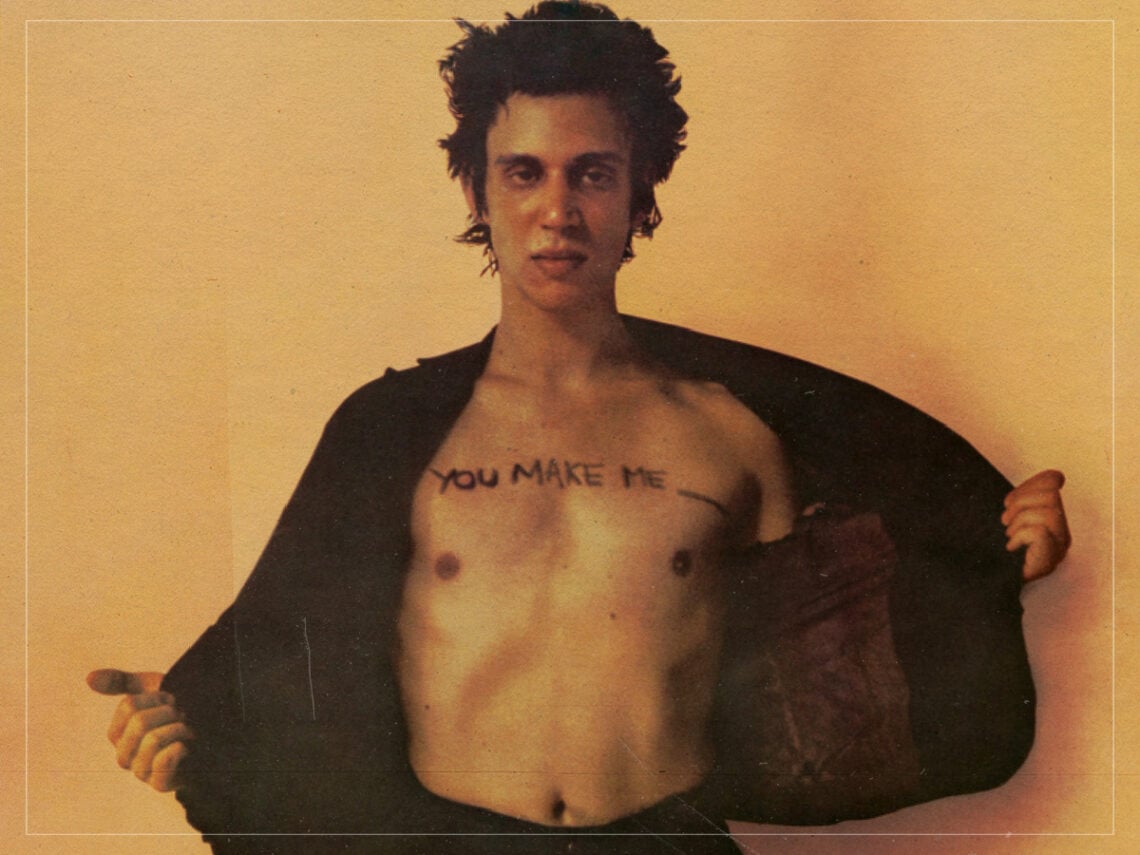
The poets that inspire Richard Hell: “They definitely give me heart”

Without Richard Hell as its central figure, punk lacked its true edge.
From the moment he left his home in Kentucky and arrived in New York City at just 17 years old, he moved within his own world, actively at the centre of punk’s burgeoning scene but as an unconscious influence, giving himself up to rock ‘n’ roll as a conduit for the poetry that formed in his mind.
Before he convinced his comrade, Tom Verlaine, to set their poetry to song in the most nascent days of Television, Hell, born Richard Lester Meyers, was a writer, picking up his pen not out of necessity, but out of sheer will. He wrote out of a fascination with words and the ability to weave a surrealist tale. Poems flowed out of him seamlessly, published in a range of periodicals, and he took up editorial work himself, founding various imprints, including Dot Books, where he published the character that he and Verlaine invented called Theresa Stern, literally superimposing photographs of the two together to create a female alter-ego.
“I thought that my sensibility was subtle and complex,” Hell writes in his memoir, I Dreamed I Was A Very Clean Tramp, “that it was interesting, and that what excited me in the things I loved existed inside me and that I could find ways to translate that into works that would be as beautiful and thrilling as I wanted.”
New York crossed Hell’s path with like-minded writers who experimented with a spoken-word interpretation of poetry set to music, like Patti Smith; the two shared a knack for writing electrifying works that sprang to life when read aloud, accompanied by a guitar. For Hell, rock ‘n’ roll and poetry became intertwined, a common language of revolution.
“There was an inherent contradiction in rock and roll for me,” he writes in Clean Tramp. “On one hand, I wanted to do it because it was physical and unhinged; on the other, I wanted to use my brain to make the songs say as much as possible… I was not any kind of intellectual snob, I was a high school dropout for a reason, but at the same time I wasn’t ashamed of my interest in books and in thinking.”
After the tension between Hell and Verlaine in Television became too intense to bear, Hell raged on his own with the Heartbreakers and later, Richard Hell and the Voidoids, spearheading a sound of perfectly mangled guitar rock with brutal lyricism that blended rebellion with sincerity. Songs such as the ballad-like cry of ‘Betrayal Takes Two’, and the cynical drawl of ‘Love Comes in Spurts‘ blazed with passion, while the anthemic ‘Blank Generation’ came to define Hell’s environs in New York.
But music became less of a resourceful language for Hell, who retired from it completely in the late 1980s. Now, he devotes himself to writing, publishing a series of novels, poetry, memoirs and arts criticism, endlessly brilliant in his wit and analytical eye.
Poetry has remained unwaveringly central to Hell’s output, revealing some of his favourites to Perfect Sound Forever in 1997, upon publication of his novel, Go Now. “Nobody’ll know these people I mention, because nobody reads poetry,” he remarks, before listing some of his then-current fixations. Bill Knott’s humorous, self-deprecating flair resonated with Hell, as did the work of Ron Padgett, who worked on An Anthology of New York Poets (1970) with a future collaborator and dual inspiration of Hell’s, poet Dave Shapiro.
Hell cites another peer of Padgett’s, Ted Berrigan, as a source, both being spirited figures of the second generation of the informal New York School group of poets. James Schuyler is another icon of Hell’s, who was central to pioneering the New York School, among the ranks of John Ashbery and Frank O’Hara. Schuyler wrote with an artistic sensibility, bringing life to the mundane. “Those are some I’m reading, and they definitely give me heart,” Hell asserts.
He names one final figure, of whom his list would be remiss without: Charles Baudelaire. “I realised that this was the prettiest word in the English language, and it isn’t even English: Baudelaire,” Hell remarks. The French poet and essayist was a master of communing with the Romantics before him, inspiring generations of poets (Hell’s included, seen in the works of Verlaine and Smith, too) with his modernist lyricism.
When asked for the reasoning behind his choices, Hell responds with a laugh, explaining that if he knew their secrets, he would channel them himself. “Poetry has always been my… magnetic pole,” he concludes. “It’s the direction I know that tells me where I am.”
