


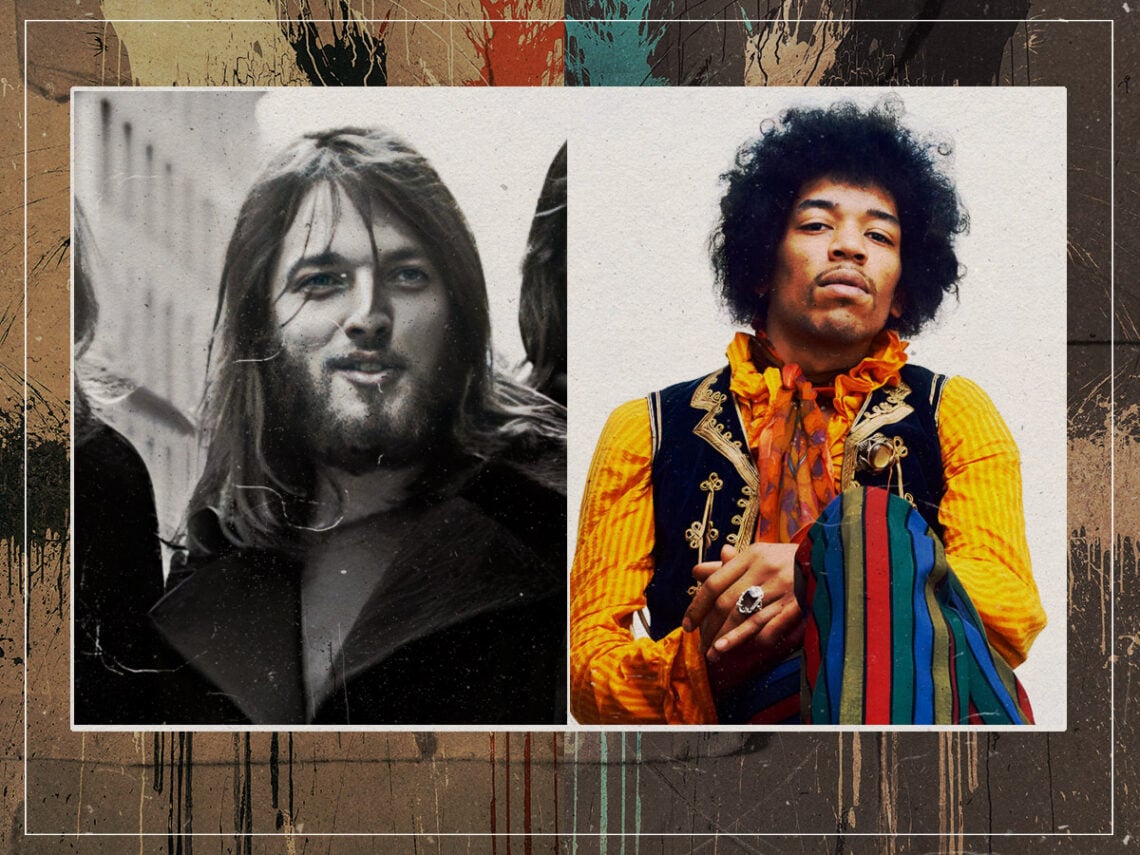
How David Gilmour became Jimi Hendrix’s sound man for his most iconic performance

The two worlds of David Gilmour and Jimi Hendrix are not simply connected by their instrument of choice. Perhaps two of the greatest Fender players of all time, the two men operated on somewhat different ends of the rock spectrum. Gilmour is a methodical and meticulous player, preferring the welcome comfort of the studio to create some of his finest work. Meanwhile, Hendrix was perhaps as close as rock and roll has ever got to a genuine genius. However, there is a bonafide link between the two stars.
The impressive career of Pink Floyd’s David Gilmour is one of the most highly esteemed in rock and roll. The singer and guitarist became one of the most vital members of the music scene when he replaced Syd Barrett as the face of Floyd in the late 1960s. Prior to that, Gilmour was a well-regarded guitarist, and after the prog-rock giants split, he has continued to make expansive and artistically sound music. One thing you can also add to his CV is, it would turn out, his brief stint as Hendrix’s sound man.
During the golden age of rock and roll in the late ‘60s and early ‘70s, there was only one man with a six-string weapon in his hand worth caring about: Jimi Hendrix. The guitarist had quickly become a poster boy for the counterculture movement, and with every virtuoso performance, he seemed more and more intent on becoming the de facto saviour of the flower power generation.
While being one of the more naturally gifted performers of his time, Hendrix operated as bastion of a new generation of thinking off stage, too. He promoted peace, championed creativity, and did it all with fearsome fretwork and ginormous guitar solos. One place where he truly left a mark was the Isle of Wight Festival in 1970.
In a recent interview, Pink Floyd’s own guitar hero shared that he wasn’t only in attendance for the landmark show at “Britain’s Woodstock” but also, inexplicably, ended up as Hendrix’s sound man for the performance. The crowd swelled to around 600,000 attendees, and despite performances from Leonard Cohen, The Doors, Joni Mitchell and The Who, we’d bet that 99% of them were there to see Jimi Hendrix play. It just so happens Pink Floyd’s Gilmour was one of them.
“I went down [to the festival] to go to it, and I was camping in a tent, just being a punter,” Gilmour told Prog Magazine. “I went backstage where our main roadie guy, Peter Watts, was trying to deal with all the mayhem, with Charlie Watkins of [amplifier company] WEM. They were very nervous; they were going to have to mix Hendrix’s sound. I did some mixing stuff in those days, and they said, ‘Help! Help!’ So I did.”

The performance is remembered for two troubling reasons. Firstly, the actual show was largely blighted by technical errors, including but not restricted to security radio being played out across Hendrix’s amplifiers. Secondly, and far more tragically, the performance alongside Mitch Mitchell and Billy Cox that took place in the early hours of August 31st, would be Hendrix’s last on UK soil. Gilmour may well have been in one of the brightest up-and-coming bands of the moment in Pink Floyd, but he knew when history was unfurling and wanted in on the act.
“I had met him previous to that, once,” he recalled to Prog when noting that he didn’t meet Hendrix that day. “I didn’t know him,” he added. That one moment had seen Gilmour witness the power of Hendrix first hand. “I saw him playing live at this club called Blaises in South Kensington. He jammed with the Brian Auger Trinity with Julie Driscoll singing,” he told Mojo’s Tom Doyle.
“This little place was packed with Beatles and Stones type of people, so you think, ‘Something’s going on.’ And this kid came in and strapped a right-handed guitar on the wrong way round. He was an absolute phenomenon from the beginning.”
Later, Gilmour would note of the performance: “Myself, and the whole place, were with their jaws hanging open.”
Their encounters wouldn’t end there, Gilmour and Hendrix again met over the other side of the channel as the guitarist arrived in the French capital. “Later, I was living in Paris and one of the jobs outside of just playing with my little pop group [Jokers Wild] there was that I was employed to take him round Paris for an evening, show him a good time,” he recalls. “And he seemed very nice. Likeable, shy.”
Sadly, the two powerhouse guitar players would never share the stage or even a tune. Instead, we will have to make do with what could have been and the small fragments of a relationship that never came to fruition.
