


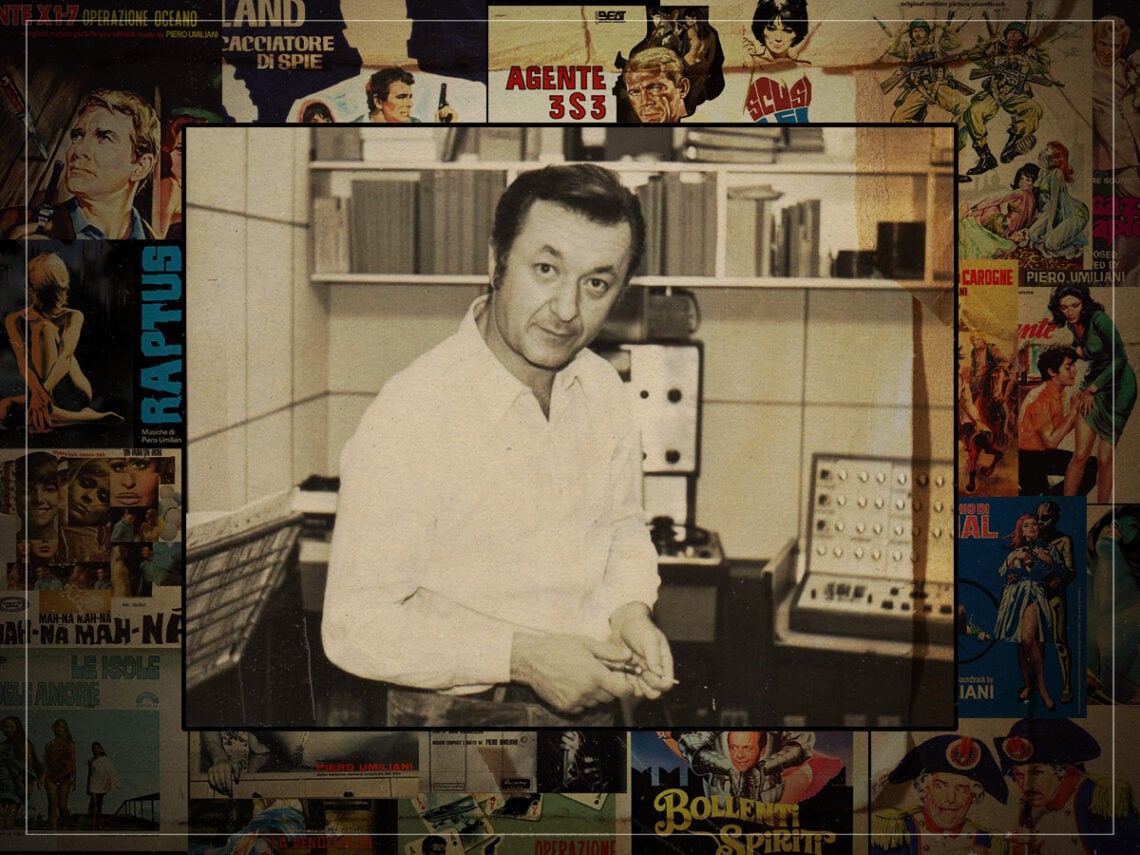
Piero Umiliani: The lasting legacy of Italy’s ultimate Giallo composer

For centuries, going back to the earliest origins of human expression, music has been an essential part of storytelling. In the modern age, this manifests itself in the rich vibrancy of film scores and soundtracks, created by a wealth of inventive composers and gifted storytellers. Film music spans the entire spectrum of sound and style, from the classic scores of John Williams to the experimental leanings of Zdeněk Liška. Within that expansive landscape, the prolific work of Italian composer Piero Umiliani exists in a league of its own.
A true pioneer in Italian music, Umiliani was among the first in the European nation to publicly praise the sounds of American jazz back in the 1940s, while working as a journalist for the Florence newspaper Nuovo Giornale di Firenze. Although this appreciation for the likes of Duke Ellington might have ostracised the young Umiliani from the core values of Italian society at that time, with the rampant rise of fascism becoming unavoidable, it also set him apart as one of Italy’s most unique and daring voices in composition.
By the late 1950s, the composer had already recorded and released the very first jazz records to be recorded in Italy, and had begun working in the field of film soundtracks. His first film composition was for the 1958 comedy flick Big Deal on Madonna Street, but he would go on to make a name for himself soundtracking Italian exploitation films. In particular, the composer typified the sounds of the Giallo movement, as well as dabbling in the Spaghetti Western, and even a few softcore pornos.
Right from the outset, Umiliani refused to play it safe with his soundtracks. Rooted in the defiant sounds of jazz, his work would often go to great lengths to push boundaries and establish bold new avenues of musical expression, in turn reflecting the revolutionary quality of Italy’s Giallo movement itself. He worked tirelessly for multiple decades, soundtracking a plethora of films, many of which would now have been forgotten were it not for the captivating quality of his compositions.
By the end of the 1960s, Umiliani was among the most respected and sought-after composers in all of mainland Europe, and his work had only become more pioneering and otherworldly as he progressed. He was not without his mainstream successes either, with the most notable example being the 1968 composition ‘Mah Nà Mah Nà’, which was used in the film Sweden: Heaven and Hell, but you have probably heard rendered in felt, as a version by The Muppets exposed the song to more widespread audiences.
Throughout the 1970s, Umiliani continued his musical experiments, crafting a range of library LPs which have since gained a dedicated cult following for their otherworldly quality and enduring sound. The composer’s work slowed during the early 1980s, and Umiliani ultimately passed away in 2001, on Valentine’s Day. However, his infallible reputation and endless penchant for inventiveness have never been forgotten, and his work inspired multiple future generations of musicians and composers.
The lasting legacy of Umiliani is probably best felt within the world of film, as select tracks from across his extensive discography are still reused in modern blockbusters – one such example being his work ‘Crepuscolo Sul Mare’, which was used to great effect in 2004’s Ocean’s Twelve.
Umiliani’s torch is also carried on by outfits like Milanese funk collective Calibro 35, whose recently released album, Exploration, is dripping in the influences laid out by the composer all those decades ago. Not only do the band include multiple covers of Umiliani’s work on the album, including a particularly brilliant reinterpretation of ‘Discomania’, but the record was largely recorded on vintage equipment in Umiliani’s old recording studio, which is still kept going decades after his passing.
The world of film composition and the landscape of Italian music in general would be virtually unrecognisable without the trailblazing influence of Piero Umiliani – a man who always stuck to his artistic principles and never stopped trying to find new ways to express himself or tell stories through inventive and ethereal soundtracks.
