


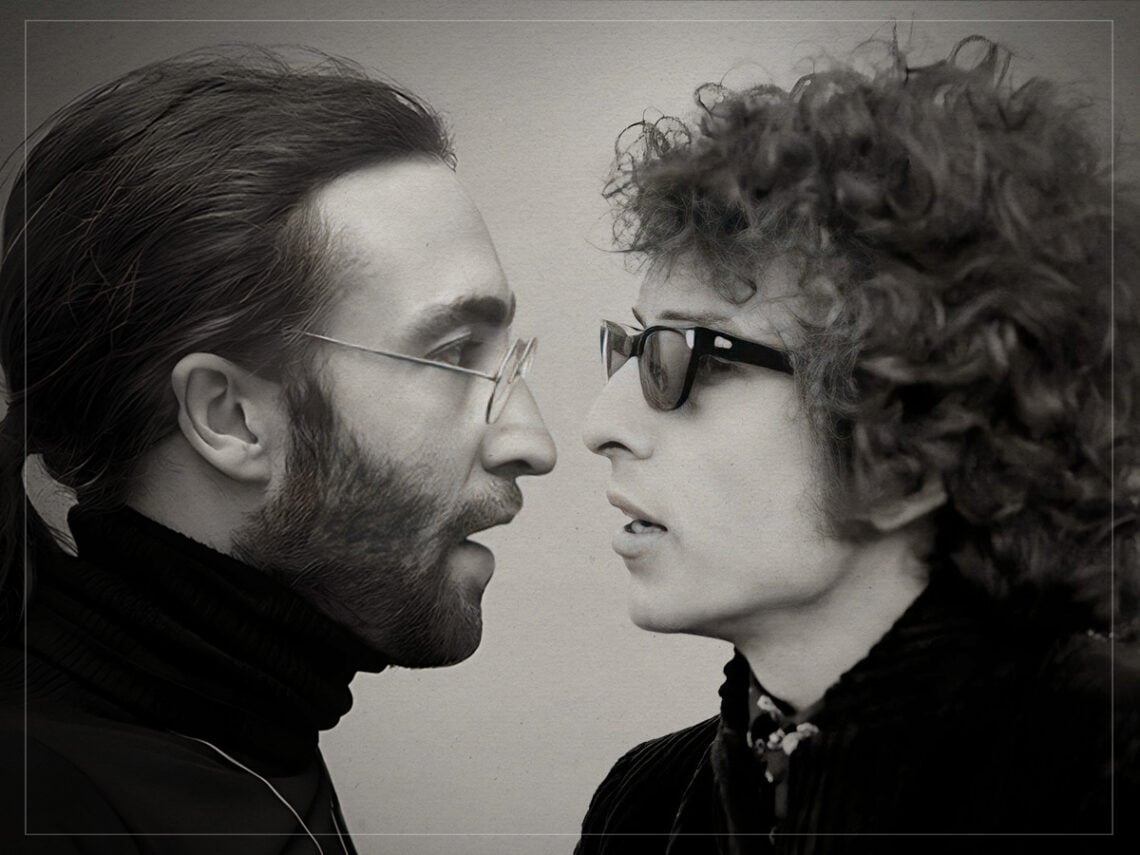
The one John Lennon song Bob Dylan never understood: “I can’t imagine that”

Nothing that Bob Dylan ever wrote has been known for being the simplest thing in the world.
When he went electric for the first time, Dylan wanted to challenge the perception of what rock and roll lyricism could be, and after spending his time as a folk artist, his verbiage was unlike anything that you would have heard out of the traditional bluesmen. He was looking to open up people’s minds, but even he had a few friends who wrote songs that he could never truly understand.
Then again, Dylan’s entire mentality was about not being perfectly understood. There were certainly moments where he peeled back the layers of himself on albums like Blood on the Tracks, but during his prime, it was easy for him to talk out of both sides of his mouth within the span of the same song. He was always looking at both sides of the world’s issues, but rock and roll was about more than simple mind games.
It was about finding the right melodies, and there was hardly any way for Dylan to compete with The Beatles when they arrived in America. The Fab Four may have been avid fans of Dylan’s all the way back to The Freewheelin’ Bob Dylan, but when listening to the way each of them wrote, John Lennon seemed to be interested in more than the simple wordplay that he used on every single song.
He wanted to get to the heart of what Dylan was about, and there would be a few times when they would lob songs in each other’s direction. ‘Norwegian Wood’ was clearly inspired by Dylan’s brand of writing, but when Dylan returned the favour on ‘Fourth Time Around’, Lennon was certainly paying attention to where his idol was heading. But after years in the spotlight, Lennon needed some time to think for himself once The Beatles ended.
There was a lot of emotional baggage that came with leaving his best friends behind, and Plastic Ono Band was the type of honesty that Dylan could have never imagined. All of the songs may have been as basic as possible, but listening to Lennon’s weary voice on ‘Working Class Hero’ and ‘Isolation’, you would have sworn that he had gone through the roughest pain anyone had ever seen.
And while Dylan could appreciate the wordplay on the record, he felt that ‘Mother’ was one step too far over the edge for him, saying, “A lot of people have trouble with their parents up until they’re 50, 60, 70 years old. They can’t get off their parents. I never had that kind of problem with my parents. Like John Lennon, ‘Mother’: ‘Mother, I had you but you never had me’. I can’t imagine that. I know a lot of people have. There are a lot of orphans in the world, for sure. But that’s not been my experience.”
Just because Dylan didn’t understand what he was going through doesn’t mean that he couldn’t marvel at what Lennon created. The pain of a kid growing up without parents is practically unimaginable, but even decades on from his mother dying, Lennon took every ounce of pain he ever struggled with and made the kind of song that stands as an emotional mirror into his soul throughout its runtime.
It’s not the most radio-friendly song in the world and it’s rarely a pick-me-up tune, but the fact that it mystified Dylan wasn’t about Lennon trying to outsmart his colleague. He was only quoting his own heart, and as long as you keep true to yourself, no other songwriter can touch you.

Never Miss A Tale
The Far Out Bob Dylan Newsletter
All the latest stories about Bob Dylan from the independent voice of culture.
Straight to your inbox.