


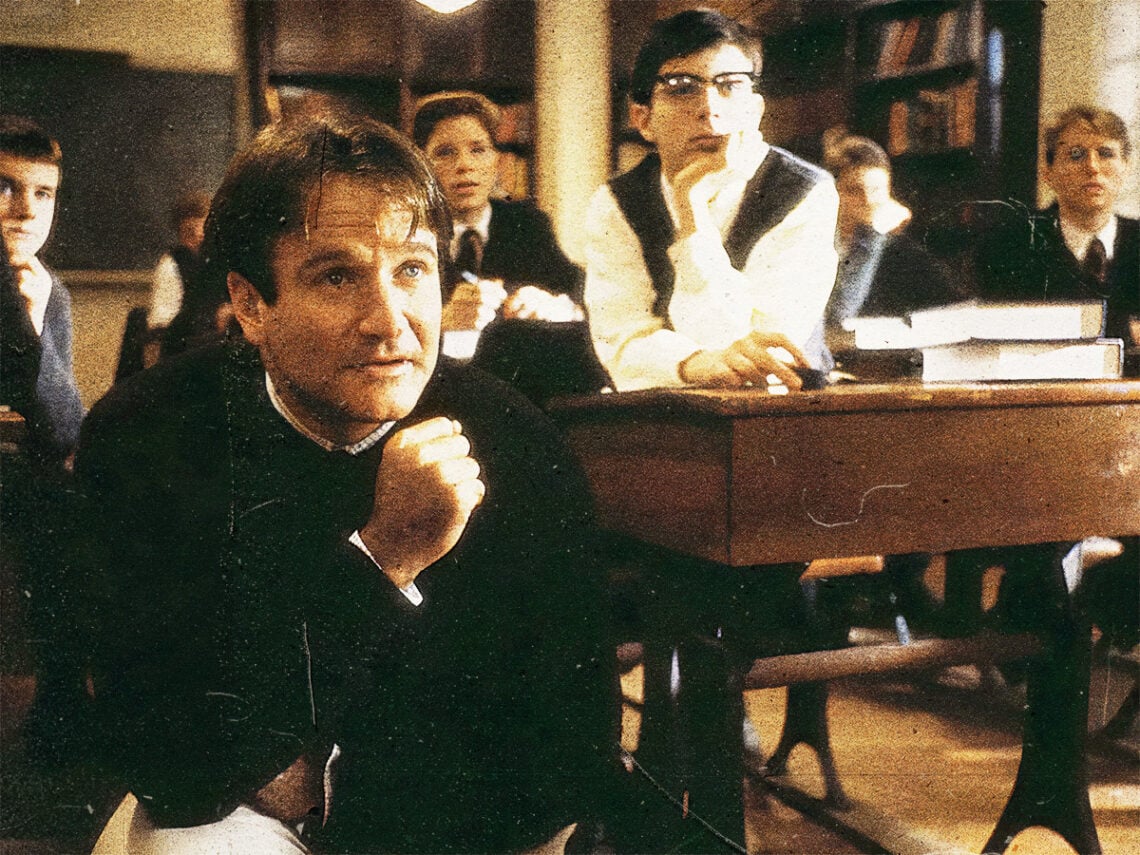
Peter Weir – ‘Dead Poets Society’

Peter Weir’s 1989 drama Dead Poets Society tells of John Keating, a new English teacher at the fictional all-male elite preparatory boarding school, Welton Academy. Keating is expertly portrayed by Robin Williams in one of his most nuanced roles, while a young Ethan Hawke plays one of his students, Todd Anderson.
The film begins with Todd starting his junior year at Welton, and he and his classmates quickly discover that Keating, a Welton alum, has joined the English department. However, Keating is no stuffy professor; rather, he is an enthusiastic orator with profound knowledge, not only of the class syllabus but its actual real-life meaning too.
His peculiar teaching methods see the class head out of the classroom to find the literary in the every day while arousing the attention of the school headmaster. At one point, Keating orders the young boys to rip out the introduction to their poetry books and to learn to think for themselves, or as he puts it, to “seize the day” and “make their lives extraordinary”.
It’s not all about Keating himself in Dead Poets Society, though, but rather the effect that he has on his students and their respective lives. One develops the courage to pursue his love interest, while another stands up to his father after discovering his love of acting. Todd, meanwhile, becomes a poet himself, once a shy and quiet boy, suddenly with the confidence to recite his own lyrics in front of his peers. Quite simply, Dead Poets Society is championing the moving power of literature.
However, the undoubted main draw of Dead Poets Society is Williams himself. There’s rarely a moment of comic temptation, as one might suspect given his prior career efforts, and he delivers one of his greatest performances with care, attention and the appearance of a genuine love for education and literature.
Williams’ Keating delivers Shakespeare as though he had been his entire life, and he undoubtedly possesses the excellence to be a great teacher. There’s no doubt that Williams is allowed to improvise on set, as a teacher might, but it’s always for the character and for the narrative rather than for his own inclusion in the film. He’s subtle and restrained, not allowing his undoubtedly genius as a comic to overshadow his dramatic qualities.
In another light, though, there’s also an unreality to Dead Poets Society and a certain melodrama that might not sit well with some audience members. After all, such a rousing occurrence of an English teacher turning the lives of young boys around is simply a rarity, to say the least, and young boys are simply not interested in literature.
Instead, they are taken by fighting and joking, fooling around and their early sexual endeavours. It’s not until later in life that one realises the healing and life-changing power of the written word, and it’s likely that outside of this cinematic fantasy, Keating would be ridiculed for his enthusiasm.
Of course, that’s not to take anything away from the narrative of the film. Perhaps Dead Poets Society serves as a flashback to the past, a moment of realisation at the power a brilliant teacher can possess, but to claim that it is anything short of a hope and dream in the face of reality is somewhat farfetched.
Still, Weir’s film is one of the best educational dramas of the 20th Century, even if its all-white middle-class environment is undoubtedly alienating: The power of literature ought to be available to all. Dead Poets Society can still arouse the senses and draw one to the greats of the English written word via one of Williams’ best-ever performances, but it might just grate at one’s intuitions at the same time.
