


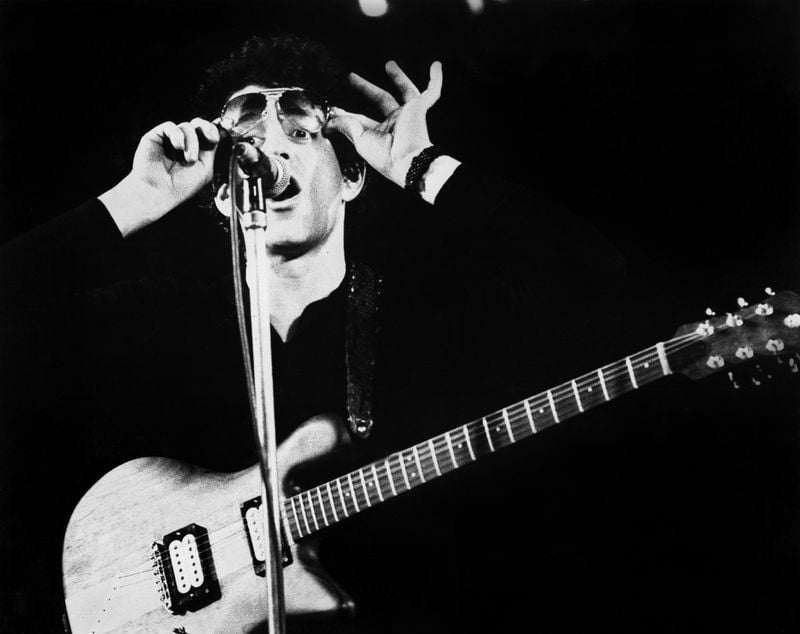
The real people referenced in Lou Reed song ‘Walk on the Wild Side’

After The Velvet Underground disintegrated in 1971, Lou Reed moved back home to live at his parent’s house. He became a typist for his father’s accounting firm, making a weekly income of $40. Reed was now living a wildly different life from the one back in New York, fronting a hugely influential avant-garde band. However, it was not long before he signed a deal with RCA Records and recorded his debut solo album in London.
Despite his self-titled debut being widely disregarded by critics, Reed found much greater success the following year with his second album, Transformer. Produced by David Bowie and Mick Ronson, the album contains hits such as ‘Perfect Day’, ‘Satellite of Love’ and, most recognisably, ‘Walk on the Wild Side’.
The track is regarded as Reed’s signature tune, becoming a counterculture anthem due to its discussion of taboo topics such as drugs, oral sex, male prostitution and transgender women. Reed provided a voice to figures outcasted from mainstream society and immortalised them forever in song. But who were the five people referenced by name in ‘Walk on the Wild Side?’
Firstly, Reed sings about “Holly”, who “Plucked her eyebrows on the way/ Shaved her legs and then he was a she.” This verse refers to transgender actor Holly Woodlawn, who featured in Paul Morrissey’s (an associate of Andy Warhol) film Trash. Woodlawn’s debut acting performance amazed director George Cukor, who tried to get her an Academy Award nomination for the role, which never materialised. Reed’s verse dedicated to Woodlawn depicts her journey from Florida to New York to start a new life away from discrimination. In her memoir, she wrote: “At the age of 16, when most kids were cramming for trigonometry exams, I was turning tricks, living off the streets and wondering when my next meal was coming.”
Next up is Candy Darling, who has been the subject of many popular songs, such as Reed’s ‘Candy Says’ by The Velvet Underground, ‘Lola’ by The Kinks and The Rolling Stones’ ‘Citadel’. The transgender actor starred alongside Woodlawn in Warhol’s Women in Revolt and became known as an icon and muse of the period. Reed’s lyrics, “In the back room she was everybody’s darling/ But she never lost her head/ Even when she was giving head”, refer to Darling’s regular appearances in the backroom of Max’s Kansas City. She tragically died in 1974 of lymphoma.
“Little Joe never once gave it away” refers to Joe D’Allesandro, an icon of gay subculture and a male sex symbol of underground cinema. The line refers to his character in Morrissey’s film Flesh as a teenage hustler, with D’Allesandro claiming that he had never actually met Reed when the song was written. The recognisable image of a man’s crotch on the cover of The Rolling Stones’ album Sticky Fingers belongs to D’Allesandro, and the chest on the front of The Smiths’ self-titled debut album is his too.
Another member of Warhol’s circle, Joe Campbell, is referred to as a “Sugar Plum Fairy”, a reference to his role in Warhol’s film My Hustler. Before joining the Factory crowd, Campbell was in a relationship with Harvey Milk, who he lived with for seven years. Milk became the first openly gay man elected to public office in California.
Finally, the last person mentioned in the song is Jackie Curtis, another Warhol superstar. She also starred in Flesh and Women in Revolt and harnessed a deep obsession with James Dean, hence the lines, “Thought she was James Dean for a day.” The words “speeding” and “crash” not only allude to Dean’s fatal car accident but also act as drug references, although Curtis ended up dying in 1985 of a heroin overdose. Curtis was an important figure in the LGBTQ+ community and even helped to pioneer the glam rock aesthetic. She described herself as “not a boy, not a girl, not a f*ggot, not a drag queen, not a transsexual — I’m just me, Jackie.”
‘Walk on the Wild Side’ remains one of Reed’s best works, acting as a tribute to some of the most iconic faces from Warhol’s Factory. When asked to describe the song, Reed put it simply, “I thought it would be fun to introduce people you see at parties but don’t dare approach.”
