


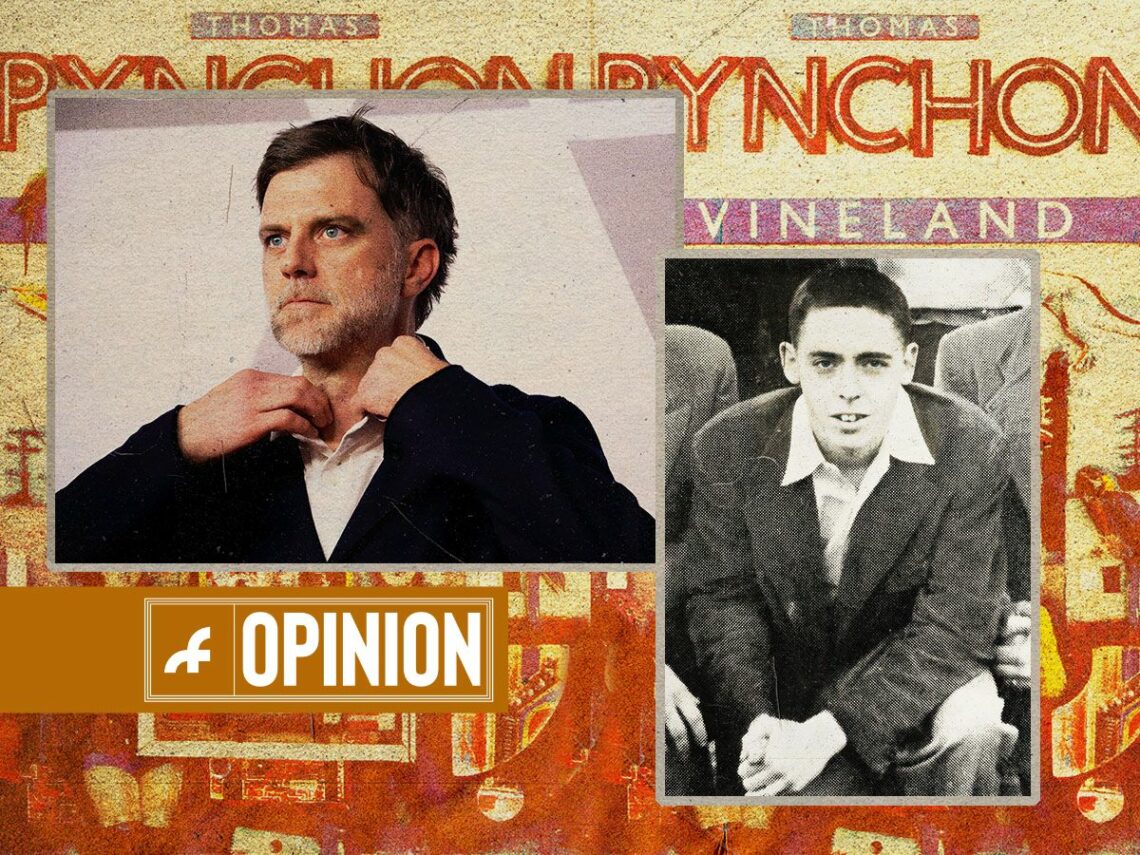
Hear Me Out: Paul Thomas Anderson should adapt ‘Vineland’ next

When director Paul Thomas Anderson gave us Inherent Vice, he didn’t just give us the ultimate stoner-noir and one of the most enjoyable and funny Joaquin Phoenix performances to date, he also made history, marking the first and only adaptation of a Thomas Pynchon novel.
Pynchon, one of a handful of major American novelists, including the likes of Cormac McCarthy, Don DeLillo and David Foster Wallace, who broke through in the mid-20th century, is probably most well known for his outright bonkers approach to writing prose. Usually spanning multiple decades and flitting between different geographies as often he uses punctuation, Pynchon’s novels are harebrained, hilarious, and often scary stories that reflect aspects of American culture, vividly rendered by rich ensemble casts with absurdly imaginative names like Slothrop or Pirate Prentice.
Like many of the great bastions of literature, it was thought that his novels could not or should not be adapted. Certainly, with entries like the hefty and hallucinogenic Gravity’s Rainbow, which broadly covered the construction of the German V2 rocket during World War II, or with Mason & Dixon and its liberally fabricated account of Charles Mason and Jeremiah Dixon on their surveying endeavours across America, it’s hard not to agree. To transport the contents of a Pynchon novel onto celluloid would do the work a greater disservice than most, capturing only a rudimentary essence of a much greater and more complex piece of art.
Then, in 2009, the author unleashed Inherent Vice on the world. Taking obvious cues, both aesthetically and thematically, from Robert Altman’s The Long Goodbye and the Coen brothers’ The Big Lebowski, Pynchon took the private eye/noir trope and transported it to the hazy and paranoid transition from the 1960s to the 1970s. Altman’s adaptation of the Raymond Chandler story made the archetypal detective laid-back and hippie-adjacent; the Coen brothers took this idea even further by making their sleuthing protagonist an outright pothead. By the time Pynchon published Inherent Vice roughly a decade late, a new genre was firmly established; a specific new strain of noir fiction. Altman had dug the well, from which now the Coen brothers and Pynchon were drawing.
In contrast to the majority of his bibliography, Inherent Vice was Pynchon’s most accessible book yet. Despite featuring his trademark interrogation of the sociopolitical climate, his wanton disregard for clarity and his general playfulness with regard to the English language, the story reared its head from the very beginning. Doc Sportello, freelance detective and marijuana aficionado, receives a surprise visit and a specific request from an old flame which sets him on a journey through the dark underbelly of 1970 California.
Whilst the immediate reaction might not have been, “This is ripe for adapting”, it nonetheless made a whole lot of sense that if any title in the Pynchon canon was going to be turned into a movie, it would be this one. Again, we had the Coens and Altman to thank for giving us an image of what it could look like, and so who better to buckle their britches and get on with it than Coens-contemporary and self-proclaimed “little Bobby Altman”, Paul Thomas Anderson?
The result was a wonderfully murky, beautifully grainy and unusually haunting comedy that signified the second collaboration between Pheonix and Anderson and generally made clear that the duo make for one of the greatest director/actor relationships in the history of modern cinema. What was all the more impressive was the fact that Anderson had even secured the rights for the damn thing, what with Pynchon being notoriously reclusive, almost supernaturally evasive and overall a complete enigma. Only a few pictures of the author exist, all of which date back to the early 1960s, and the number of interviews he’s given totals up to an absolute zero.
Anderson remained tight-lipped during the press tour for the film, prompted at every opportunity by podcast hosts, talk-show presenters and journalists on the nature of the relationship. Had the author and director spoken? Had they met? Were they friends, did they write the film together, and what thoughts did the ‘Invisible Man’ have on the final picture? Anderson, wriggling and squirming in discomfort, alluded to a very brief and initial conversation with Pynchon, emphasising the lack of involvement the author had with the adaptation of his work but clarifying that he “liked the movie”.
So why Vineland?
Having followed Inherent Vice with Phantom Thread, Anderson catapulted himself far in a different direction, ending up in the world of haute couture dress-making. He swapped Phoenix for Daniel Day-Lewis, the West Coast for London, and retreated two decades further back in time to the 1950s. His next picture was Licorice Pizza, which saw the director return to familiar territory: it told the tale of a blossoming yet awkward romance between a teenage boy and a young woman in 1973 California.
Meanwhile, a second Pynchon novel lies untouched, and yet – enabled by the success of Anderson’s adaptation and confirmation that the director’s unique sensibilities perfectly matched that of the mysterious author – a vision of the book as a film is perfectly clear. Flitting alternately back between 1980s Regan-era America and the 1960s, Vineland is not just another perfect book for Anderson to adapt; it should be the next film he makes.
In classic Pynchon tradition, the book follows a whole array of zany characters (one of whom is called Zoyd Wheeler) and paints a sprawling picture of inter-lapping and overcrossing relationships that are impossible to properly sum up, but loosely it presents us with a tale about a radical female filmmaker, an ageing hippie lamenting the loss of a culture war and a family drama set against the backdrop of the United States undergoing a swift and catastrophic metamorphosis.
Why is this perfect for Anderson? Besides already proving himself to be the perfect tonal and aesthetic counterpart to Pynchon, the director has flirted with filmmaking and the media in Boogie Nights and Magnolia, hippies young and old with Inherent Vice and Liquorice Pizza, family dynamics with Punch-Drunk Love and The Master, and crucial milestones in American history and culture with There Will Be Blood. When combined with the fact that he’s pretty much covered every decade now except for the 1980s, it truly seems like Vineland would make for a source material that is exquisitely suited to the director’s style yet would offer enough new territory to yield something fresh, original and challenging.
