


Producers and directors, keep your filthy hands off Cormac McCarthy’s ‘Blood Meridian’

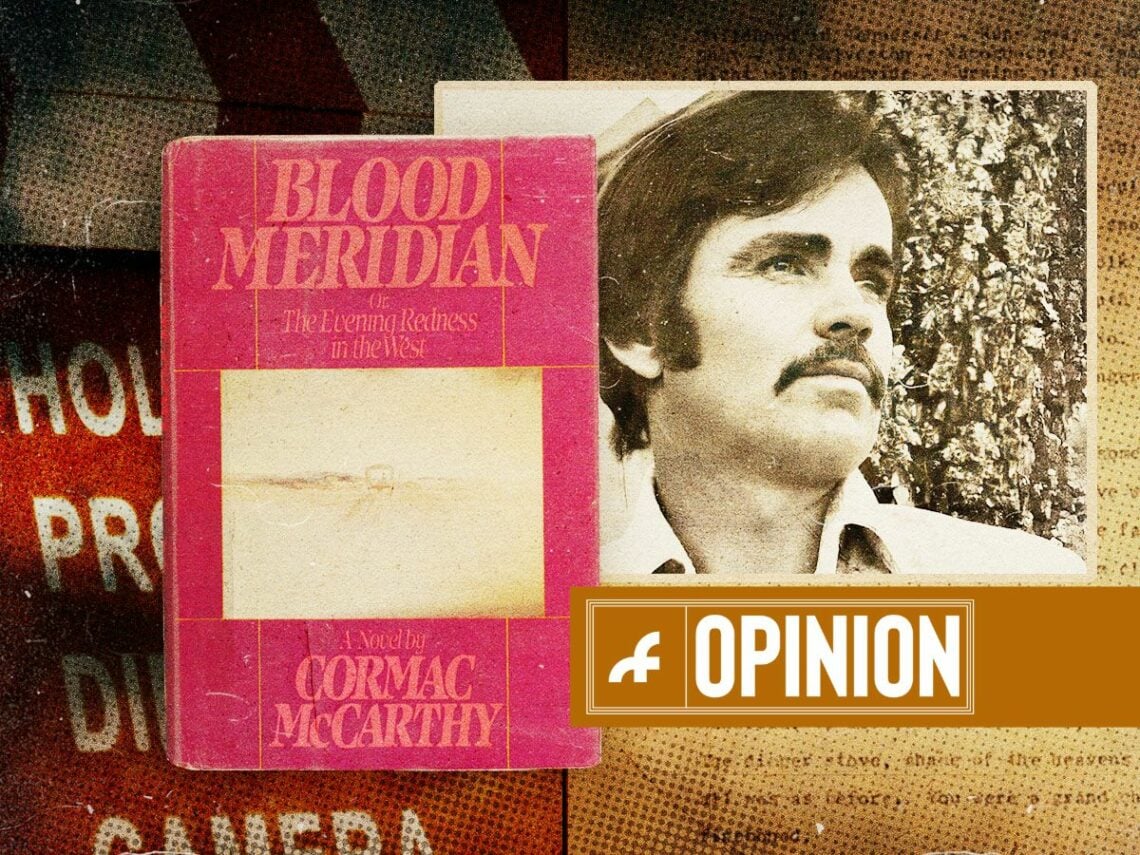
It’s undoubted that Cormac McCarthy‘s masterpiece is the 1985 anti-Western novel Blood Meridian, beautifully subtitled The Evening Redness in the West. The novel followed up on the critical success of McCarthy’s previous effort, 1979’s Suttree, and has remained his most significant work since its release, although some 21st Century texts have admittedly come somewhat close to taking the mantle.
The acclaimed yet pretentious literary critic Harold Bloom once sang the praises of Blood Meridian, calling it one of the greatest novels of the 20th Century, comparing it to Herman Melville’s Moby Dick in the process. Several other prominent literary figures have also sung vehemently for McCarthy’s masterwork, including fellow writer David Foster Wallace, to name but one of many.
Blood Meridian is set in 1849 at the Texas-Mexico border and focuses on a young teenager merely referred to as “the kid” who falls in with a gang of scalp hunters led by John Joel Glanton, a violent soldier in the Mexican-American War of the 19th Century. Glanton and his crew are paid by the American government for every Native American scalp they can claim.
However, the gang eventually descend into acts of mindless violence and begins scalping pretty much anyone they come across – not only the “savage Indian” tribesmen but innocent Mexican citizens and even fellow Americans too. They are joined by one of the greatest literary characters of all time, Judge Holden, a monolithic, wildly-intelligent creature who justifies the gang’s actions with lengthy, alluring philosophical monologues.
Over the years, since Blood Meridian’s release in the mid-1980s, there have been several attempts to make a film adaptation, but all have faltered during the development or pre-production stages. Screenwriter Steve Tesich tried in the mid-1990s before Tommy Lee Jones got his hands on the film rights and rewrote Tesich’s initial attempt.
In the 2000s, Ridley Scott and screenwriter William Monohan had another go, as did James Franco in 2011. It was Franco that got the furthest into development, shooting 25 minutes of test footage with actors Scott Glenn, Mark Pellegrino, Luke Perry and Dave Franco. Yet pretty much all those previous attempts failed either because they could not portray the novel’s excessive violence in a way that appeased the expectations of a production studio or because it was simply not good enough.
The allure of Meridian for the screen is more than understandable. McCarthy adaptations are more often than not commercial and critical success stories, so reaching for the author’s undoubted masterpiece seems like an easy grab, with an HBO ten-parter seeming like an especially attractive prospect. However, those toying with the idea of bringing the novel to either the silver or the home screen are missing the text’s point in sum.
The first issue, as mentioned above, is the violence of the novel. There are several instances of sheer barbarity committed by the Glanton gang, and just one springing to mind now sees the Judge pick two infants up by their feet and smash their heads off the floor, bone and brain spattering the dusty border floor. And that’s just on a slow day.
The question arises of how this might translate on screen. Would it be toned down for the sake of a wider audience? If so, then there is quite honestly no point in making a film version. At the very centre of Blood Meridian is that self-same violence, and McCarthy suggests that it is inherent in every man, in every being.
What’s more intense about McCarthy’s novel, though, is the language; indeed, the bread and butter of any literary masterpiece worth its salt. He employs a truly complex, luxurious style of prose that is ultimately Biblical in its protestations, and there’s a richness in the author’s words that cannot be translated to the screen, even if cinema admittedly possesses its very own kind of language.
To attempt to bring the Glanton gang’s deeds to a visual narrative would be to forego the very essence of the source text; to experience the Blood Meridian tale is to live and breathe it through McCarthy’s choice of words, prophetic in their terror, prescient in their barbaric glory.
Then there is, of course, the issue of casting, and nowhere else ought this be more important than in the character Judge Holden. The Judge – whatever he is a “judge” of exactly – is described as a seven-foot juggernaut, bald from head to toe; undoubtedly one of the most fearsome persons to ever find themselves on a written page.
But to cast an actor as Holden is to take away his very mystery. I believe that the Judge is the reincarnation of the Devil; omnipotent, alluring in tongue, barbarous in deed and seemingly immortal. The gang are said to have found him naked in the middle of the desert with no possessions, no food, no water. To have a visual, definitive representation of the Judge would be to set him in concrete. He would no longer be everywhere always, a mysterious phantom Djinn, but a real actor with a real face, unwantedly burned into our retina.
Interestingly, McCarthy himself seems to believe that the novel might just be suitable for a cinematic version, once telling the Wall Street Journal that any potential adaptation would be “very difficult to do and would require someone with a bountiful imagination and a lot of balls. But the payoff could be extraordinary.” Extraordinary indeed, but wholly unnecessary.
Perhaps McCarthy’s most recent offering, the twin novels The Passenger and Stella Maris, might provide a more suitable avenue for those desperate for more cinematic visions from the novelist. The language is still as glorious as ever but toned down from the biblical reckonings of Blood Meridian somewhat, and it boasts a fascinating, almost incestuous, brother-sister relationship and a harrowing story to boot.
The news recently arrived that John Hillcoat, who previously directed another McCarthy adaptation, The Road, is set to direct a Blood Meridian film that those at New Regency are currently writing. McCarthy himself, as well as his son, serves as an executive producer, so clearly, the film will have an air of authenticity about it. However, for the reasons stated above, one can only hope that the production falters once again and the glory of McCarthy’s novel is left to breathe in its own right.
Novels, especially the good ones, are ripe for plucking by the ever-reaching hand of cinema, but it’s a rarity that adaptations are even close in quality to their source material. John Huston’s 1956 Moby Dick, for example, offers a fine narrative with quality acting from Gregory Peck, as does John Ford’s The Grapes of Wrath, released in 1940 with Henry Fonda as Tom Joad.
But are they remotely as memorable as the genuine articles by Melville and Steinbeck? Simply, no. They are fine films, but just that, lacking the richness, the texture, the sweat and the toil of every painstaking word crafted by their authors. Hundreds of thousands of words are starkly missing, and the knowledge that language is at the very centre of the narrative looms unwittingly in the air.
So heed this language well, prospective producers and writers of Hollywood, McCarthy’s works “never sleep. He says that [they] never die. He dances in light and in shadow, and he is a great favourite [of mine].” Or, in other words, keep your grubby mitts off our beloved texts, please, just this once, for the love of God.
