


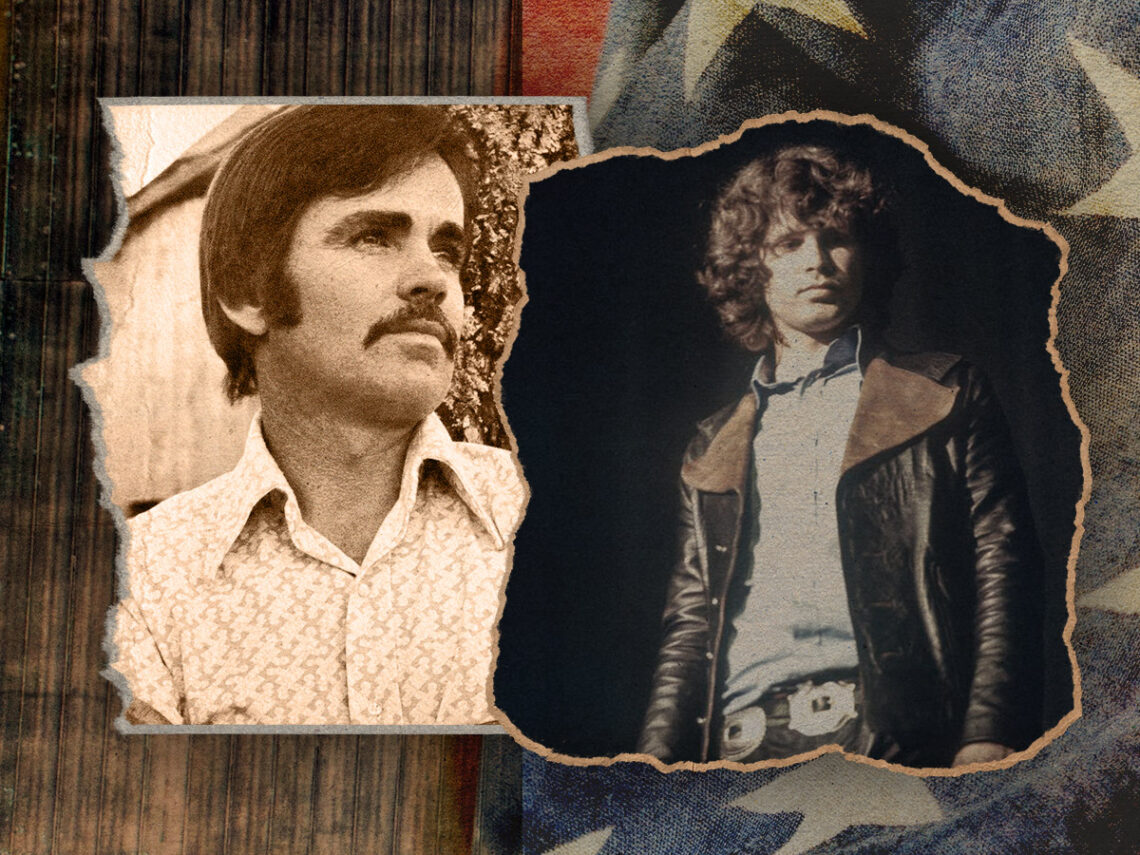
Cultural Connections: Cormac McCarthy, Jim Morrison and the shamanic reckonings of America’s past

Human knowledge and understanding have their limitations, often informed by our lived experience and the kind of things we read, listen to and generally consume. Today, in the first iteration of our ‘Cultural Connections’ column, we’re taking a closer look at two artists who scrutinise the epistemological reasoning of humankind in their works through a treatment of the history of America with a shamanic, beyond-human reckoning.
There are two specific figures whose works have examined the very conception and the limitations of human knowledge in an American historical manner. One is the acclaimed writer Cormac McCarthy, often considered the greatest living writer in the English language. The other is Jim Morrison, the poet and singer of one of the most influential bands of the 20th century, The Doors.
The best example of McCarthy’s treatment of the American past is in his widely-considered masterful work Blood Meridian. The 1985 novel is sometimes considered anti-Western in that the lines between good and evil are indistinct and, therefore, abandons the traditional means of Western narrative as defining human morality as set and immovable.
Narratively, the novel follows a young teenager simply known as “the kid”, who falls in with a gang of scalp-hunters led by John Joel Glanton hell-bent on massacring Indigenous Americans around the contested Texas-Mexico border smack bang in the middle of the 20th century. Glanton’s gang are searching for “Injin” or Mexican or any other kind of scalps as they fetch a hefty price from the United States Army, who have been struggling with the barbaric tribes’ violence against them.
Another significant character who joins the gang is Judge Holden, a man seven feet in height who is barbarically violent and immoral and possesses a near-supernatural intelligence. It is primarily through the wildly eloquent Holden that McCarthy can issue his treatment of what lies beyond the normal reckonings of humankind, for The Judge is an avid recorder of events, flora, fauna and moral understanding of every kind.
In many ways, Holden is something of a supernatural being; he is either the devil incarnate, a lost djinn, or the sum of all human (and beyond) understanding. After all, each member of Glanton’s gang claims to have come into contact with him before falling in with the scalpers, and Holden joined the group when they found him alone in the middle of the desert, naked, without water or food.
In that sense, the Judge is far beyond human, yet he is representative of all of human history simultaneously. Holden’s primary belief is that war and violence are inherent to humankind’s nature, hence his willingness no, desire, to kill, maim and rape his way through the indigenous tribes and the Mexican forces, regardless of their political or moral stance. McCarthy explains through his novel that the history of America was founded on violence and bloodshed. According to the Judge, that is how it has been, should be, and always will be. And yet, we find ourselves feeling at odds with this mode of address, even despite war persisting ever since the dawn of humankind. That reality of violence and the human necessity for war is counterposed with the strength of our human morality. The fact that the Judge – whom we understand to own all knowledge – is a proponent of such violence suggests that its vindication lies beyond the capabilities of human reckoning.
Another critical cultural figure who has toyed with that notion of shamanic beyond-human understanding is the lead singer of The Doors, Jim Morrison. After all, Morrison had named the band after he was inspired by a quote from the English poet William Blake: “If the doors of perception were cleansed every thing would appear to man as it is, Infinite. For man has closed himself up, till he sees all things thro’ narrow chinks of his cavern.” Aldous Huxley’s 1954 autobiographical book The Door of Perception also took its title from Blake’s words, and Morrison was also a keen reader of the English author. That quote suggests that our everyday human understanding blurs the infinite reality of the world. Morrison’s poetry seeks to reiterate that fact whilst drawing on the shamanic teachings of America’s history, similar to McCarthy’s novel and the didactic nature of Judge Holden.
There is the acknowledgement in ‘Awake’ that the proper understanding of the universe lies beyond the mundanity of what we believe to be accurate. Morrison urges us to “shake [our] dreams from [our] hair” to become more aligned with the epistemologically verified nature of the “Ancient Ones”. Through that kinship and the acceptance that something lies beyond what we only think we truly know, we – as Blake suggests – “cleanse the doors of perception” and can truly live according to whatever lies beyond humankind would urge. In ‘Power’, Morrison shows us that by living through that decree, he can “can become gigantic and reach the farthest things”, “can change the course of nature”, and “can place [himself] anywhere in space or time”.
Within some of Morrison’s most moving lyrics for The Doors, we find his kinship with the teachings of the Native American shamans of yore. In ‘Dawn’s Highway‘, Morrison claims, “the souls of the ghosts of those dead Indians… maybe one or two of ’em… were just running around freaking out, and just leaped into my soul. And they’re still in there.” This suggests that Morrison accrued the knowledge of those Ancients, which is most likely why he decided to live according to his own moral code rather than the one prescribed to us through the Judeo-Christian religion and the education system.
Morrison likely saw whatever knowledge was possessed by Judge Holden in Blood Meridian by means of an excessive lifestyle fuelled by psychedelic drugs and an insistence on forming his own hierarchy of beliefs. In that sense, Morrison transcended the limitations of everyday human understanding, creating his own mythological teachings that have inspired many of us ever since.
The two great artists approached the subject of knowledge with methods varying in style. Still, they ultimately had the same target: to highlight the imperative of believing in something beyond one’s usual human rationality. Something else exists out there beyond the capabilities or “reckonings” of humankind. But perhaps we will never come face to face with it until the very end, as both Morrison and McCarthy’s “the kid” undoubtedly discovered.
