


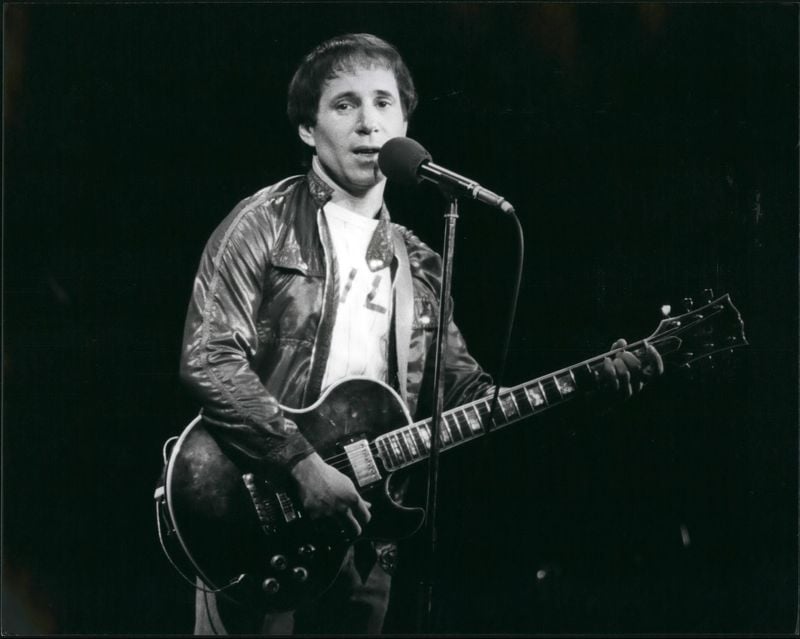
The icons who make up Paul Simon’s pantheon of songwriters

Tracing the lineage of admiration is often the best way to discover art. Understanding the artists admired by your favourite artists opens the door into a genre world where you can understand how every thread of commonality has been woven into different soundscapes. Where songwriting is concerned, most roads lead to Paul Simon.
Songwriter Jack Savoretti even told Far Out: “Well, for me, Elvis is the king of rock, Sam Cooke is the king of soul, James Brown is the king of funk, but when it comes to songwriting, I think Paul Simon is the king.”
Be it in the form of delicate introspection with early Simon and Garfunkel hits, or expansive tales of American imagery on his solo magnum opus Graceland, Simon has painted an intricate picture that covers most experiences of modern life.
While his music’s blueprint illuminates a sense of authenticity, beneath the surface is a level of vulnerability that verges on the insecure and a dogged determination to improve every facet of his creative approach. While we associate the creative process of most greats as an effortless pursuit that sees them simply plucking songs out of thin air, for Simon, his self-doubt has developed a craftsmanlike approach to songwriting.
In George Martin’s 1983 book, Making Music, Simon explained the methodology that sits behind one of music’s finest back-catalogues: “I work with my guitar and a legal pad and use about 50 pages to develop a song,” Simon wrote. “I get going fairly early in the morning, because my mind is sharp, and start by dating the pad and putting down personal comments, such as how I am feeling that day, so that it becomes a diary of sorts. Slowly, a song will begin to emerge although sometimes it will stagger along, day after day, making no progress at all. The first page might have all sorts of lines that will never be used, but as I turn the pages, a little thought might come forward and suggest potential for development.”
Such is the breadth of Simon’s work and the intricate composition that exists within it that the idea of a meticulous methodology shouldn’t seem surprising. But often, in analysing music’s otherworldly talents, a sense of effortlessness is uncovered. Paul McCartney, for example, has built a legacy on the sort of songwriting that feels innately melodic, penning songs that feel as though they have existed within the depths of our memory long before he uttered their first notes. Which, in itself, brings with it dangers of simplicity but it’s not a threat that Macca tempers with quite the same level of tinkering as Simon.
“I have to be careful that something just doesn’t come out too bland,” McCartney said of his songwriting process during a conversation with Rolling Stone, “Paul Simon works his music much more than I do, with a first draft, a second draft, third draft. I do that as well, but not as much as he does. It’s different kinds of music.”
So perhaps it’s no surprise that when pressed on who makes up his pantheon of great songwriters by Mojo, McCartney made the list. For his obvious point of methodical difference is something Simon would admire. In answer to the question, Simon listed his complete alumni: “I’d put it at [George] Gershwin, [Irving] Berlin, and Hank Williams. I’d probably put Paul McCartney in there, too. Then I’d have Richard Rodgers and Lorenz Hart.”
As composers, Gershwin, Rodgers, and Berlin highlight Simon’s intrigue for minute compositional detail, while McCartney is the only artist who acts as his contemporary. Interestingly, when elaborating on his list, Simon included John Lennon and Bob Dylan within his “second tier” of greats, nodding to perhaps a more optimistic tendency in his style influence. For Dylan and Lennon weren’t afraid to delve deeper into the darkness of humanity, McCartney’s work had a sunnier disposition to it and arguably a more realistic north star for the work of Simon.

Never Miss A Tale
The Far Out Bob Dylan Newsletter
All the latest stories about Bob Dylan from the independent voice of culture.
Straight to your inbox.