

How George Harrison’s sister helped The Beatles crack America
Read More


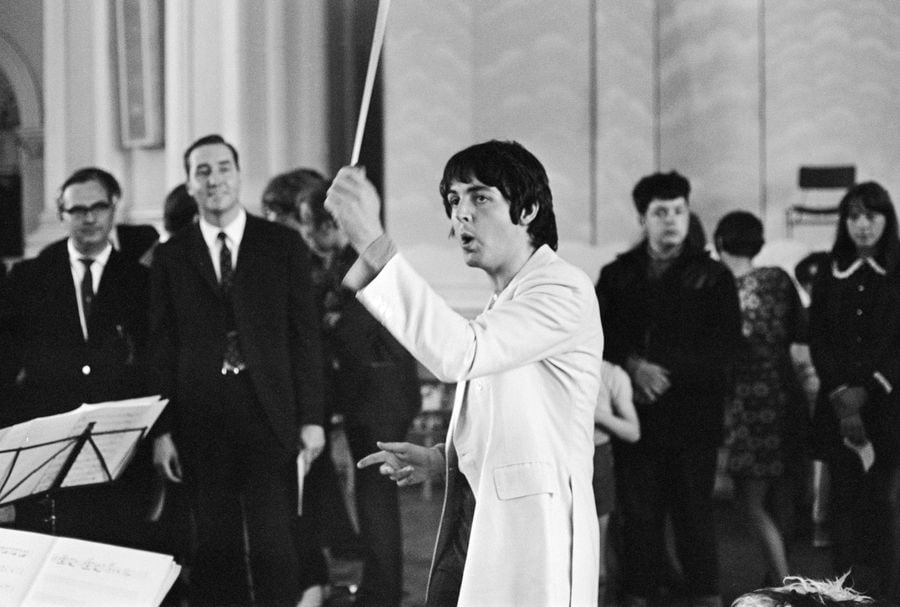
The Paul McCartney classic ‘Eleanor Rigby’ was released in 1966 with ‘Yellow Submarine’ as a double single and the only single released from The Beatles’ seminal album Revolver. Despite being released some three years and six albums into the Fab Four’s mainstream success, the idea for the song had been conceived before The Beatles had even formed.
Amongst George Martin’s beautiful double string quartet arrangement, the song tells the mystical story of the elusive characters, Eleanor Rigby and Father McKenzie. The characters are portrayed in a desperate world of loneliness with the imagery of a bleak churchyard painted into the lyrics and framed by the mournful atmosphere of the instrumentals.
The lyrics were often believed to have been inspired by a name McCartney once read on a headstone at St. Peter’s Church in Woolton, where, incidentally, he met John Lennon at a church fete in 1957. The wonderment as to what sort of life she might have led sparked his imagination and inspired the lyrics. However, McCartney has since discounted this origin, recalling that Rigby was actually inspired by an old lady whom he used to help with menial house chores in his youth. He said, “I found out that she lived on her own, so I would go around there and just chat, which is sort of crazy if you think about me being some young Liverpool guy.”
In the early 1960s, McCartney was dating Jane Asher, and her mother had arranged for McCartney to take piano lessons. In an article he wrote for The New Yorker, McCartney revealed that it was during these lessons that he had come up with the instrumental structure for ‘Eleanor Rigby’.
“When I was in my early twenties, Jane’s mum, Margaret, organised lessons for me with someone from the Guildhall School of Music and Drama, where she worked,” Paul recalled. “I even played ‘Eleanor Rigby’ on piano for the teacher, but this was before I had the words. At the time, I was just blocking out the lyrics and singing ‘Ola Na Tungee’ over vamped E-minor chords. I don’t remember the teacher being all that impressed. The teacher just wanted to hear me play even more scales, so that put an end to the lessons.”
When McCartney finally got around to arranging the lyrics over the instrumentals of the song, they weren’t quite how we now know them. “Initially, the priest was called ‘Father McCartney’ because it had the right number of syllables,” Paul wrote. “I took the song to John [Lennon] at around that point, and I remember playing it to him, and he said, ‘That’s great, Father McCartney.’ He loved it. I wasn’t really comfortable with it, because it’s my dad — my father McCartney — so I literally got out the phone book and went on from ‘McCartney’ to ‘McKenzie.’”
The song was a lyrical breakthrough for the group as one of the earliest examples of the Beatles moving toward the avant-garde with darker and more complex themes. The song was a far cry from the group’s early formula of whimsy love songs. The track became an instant hit for The Beatles and was a critical and commercial success globally. At the time, the track’s more upbeat and tacky sister ‘Yellow Submarine’ performed better on the charts, but ‘Eleanor Rigby’ appears to have rightfully faired better in the test of time as one of the Beatles’ greatest singles.
All the latest stories about The Beatles from the independent voice of culture.
Straight to your inbox.
