


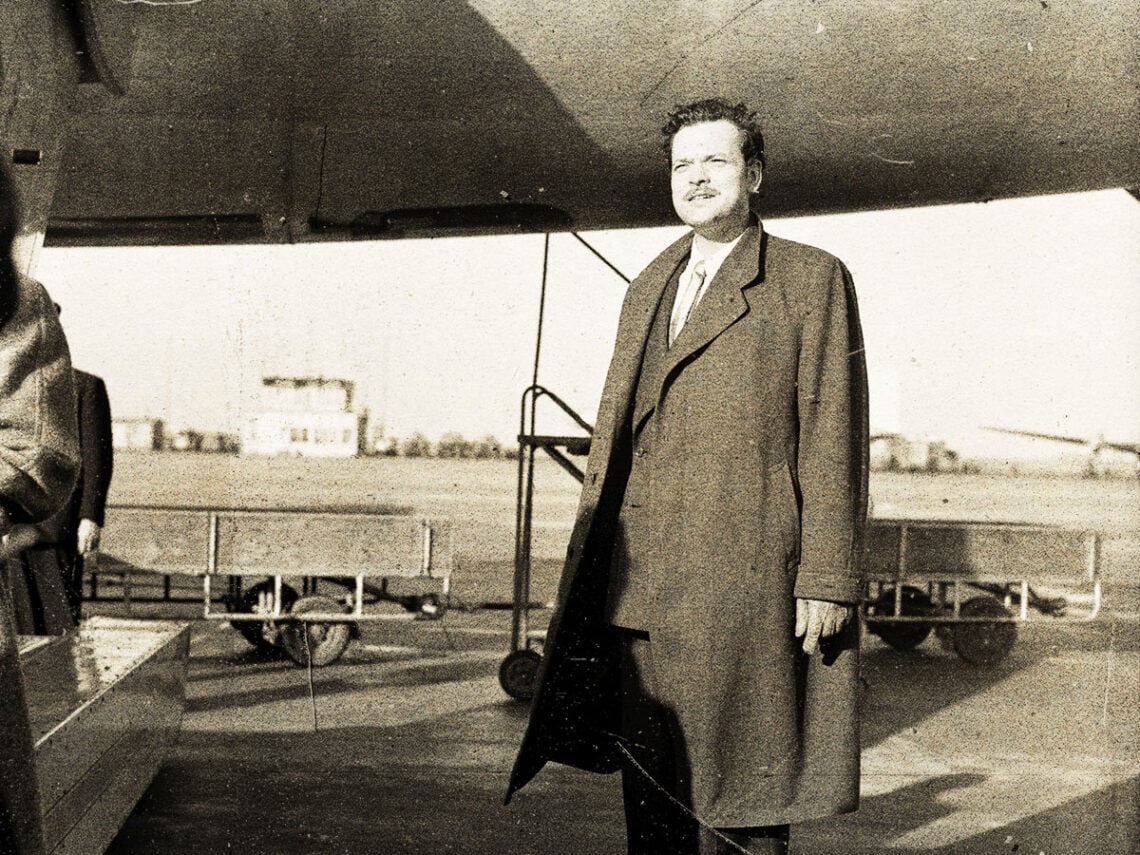
How Orson Welles’ favourite American directors taught him the art of timelessness

Only the most confident filmmakers would harbour dreams and ambitions of making timeless motion pictures, so if anything, it was entirely on-brand for Orson Welles to accomplish just that with his debut.
By the age of 21, he was already gaining plenty of attention as a theatre director, with his legendary radio adaptation of HG Wells’ The War of the Worlds further increasing his fame and notoriety. It was only a matter of time before he made the jump to the silver screen, and he did so in iconic style.
Welles was only 25 years old when Citizen Kane released, which continues to boggle the mind. He wrote, directed, produced, and played the lead role in an inarguable masterpiece of cinema, which continues being spoken of in hushed tones as one of the greatest movies ever made.
Being involved in one timeless film is a distinction not many creatives on either side of the camera can lay claim to, but Welles wasn’t even done there. He may have been an on-camera performer only, but the reveal of his Harry Lime in Carol Reed’s The Third Man remains one of the greatest character introductions ever captured on celluloid.
The year after Citizen Kane hit cinemas, The Magnificent Ambersons underlined Welles’ status as Hollywood’s newest wunderkind, and it’s another classic to withstand the test of time to retain its power. The same can also be said of 1958’s Touch of Evil, making it patently clear the filmmaker had an almost preternatural gift to create works of cinema and embody characters who’d become enshrined in history.
On the surface, it’s not something that can be taught, especially to a talent as singular as Welles. However, it’s telling that in a 1967 interview with Playboy, he passed judgment on the current crop of contemporary American directors. The ones he specifically singled out for praise—or faint damnation—all knew a thing or two about timeless storytelling.
“Stanley Kubrick and Richard Lester are the only ones that appeal to me, except for the old masters,” Welles said. “By which I mean John Ford, John Ford, and John Ford.” No prizes for guessing which one he liked the most, then, but the three of them evidently taught him a thing or two about timelessness.

Kubrick’s 2001: A Space Odyssey, A Clockwork Orange, Barry Lyndon, and Full Metal Jacket, Lester’s Beatles movies A Hard Day’s Night and Help!, his sequel to Richard Donner’s Superman, and any number of Ford flicks covering Stagecoach, The Searchers, The Man Who Shot Liberty Valance, The Grapes of Wrath and more all tick those boxes of having multi-generation rewatch value and long-lasting appeal, which isn’t even naming every title that fits the bill.
On the other side of the coin, Welles wasn’t fully enthralled by a director who may not have been American, but became synonymous with many of Hollywood’s greatest-ever thrillers. “There’s always something anecdotal about his work,” he said of Alfred Hitchcock. “His contrivances remain contrivances, no matter how marvellously they’re conceived and executed.”
One of the reasons why Welles became the filmmaker he was stemmed from ironclad self-belief and a supreme confidence that bordered on arrogant, but he was wrong on occasion. For a noted example, his assessment of Hitchcock’s filmography continues to be rendered more and more irrelevant with each passing year.
“I don’t honestly believe that Hitchcock is a director whose pictures will be of any interest 100 years from now,” he mused, with the passage of time having proven him incredibly wrong. “With Ford at his best, you feel that the movie has lived and breathed in a real world, even though it may have been written by Mother Machree. With Hitchcock, it’s a world of spooks.”
Much like Kubrick, Lester, Ford, and Hitchcock, Welles was the mastermind behind several movies that achieved timeless status, regardless of how little credit he was willing to give the latter. It’s something that can’t be manufactured or aimed for ahead of time, but for anybody talented enough, it’s far from impossible.
