


The musician Bob Dylan tried to copy on stage: “My definition of cool”

If you tried to label Bob Dylan as anything under the moniker of singer-songwriter, then “lyricist” is probably your best bet.
You don’t get a Nobel Prize for Literature by not being handy with a rhyming couplet or two, and you also don’t get such an accolade for being unoriginal. And, in truth, that is wat has always set Dylan apart. Aside from the odd moment of wanting to be as popular as The Beatles or the unstoppably inspiration of Woody Guthrie, Dylan has never tried to copy anyone, and that’s a good thing.
Dylan operates in his own sphere, always has and always will. What he write and how he records is unlike anybody else. He has songs which can go on for tens of minutes but still have an audience singing along in their car. But the only time he has ever really thought to copy another performer was when he tried to take his songs to the stage.
Bob Dylan’s stage presence has always been fuss-free. Even in his early days, Dylan does nothing to distract from the power of his lyricism. But there was always one musician he looked up to, even if it was misguided.
Returning to early footage of a young Bob Dylan playing some of his earliest shows, his energy has remained consistent. Watching clips of his 1964 Newport Folk Festival slot or sweet moments shared on stage with Joan Baez and high-octane action is minimal. Maybe the singer smiled a little more than he does now, but it’s largely the same.
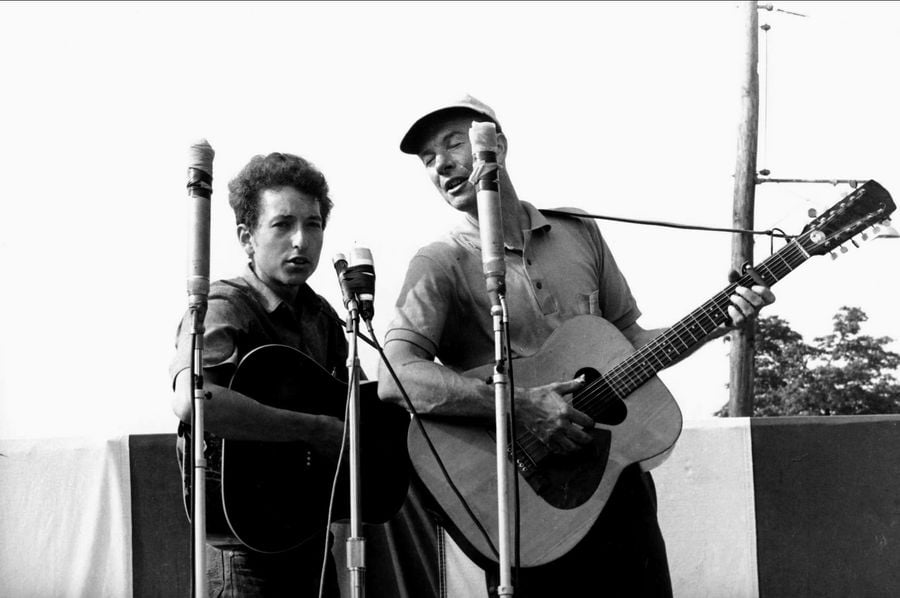
Dylan has always been there, less so to perform and more to make his audience hear him. Keeping to focus on the music, he has never seemed interested in drawing unnecessary attention to himself.
The song itself has always come first. Even when sharing his favourite artists or artists he admires, Dylan seems singularly interested in the music. “A great song is the sum of all things,” he told The Wall Street Journal. “It could be the turning point in your life. Louis Armstrong does it like a scat singer, Jimmie Rodgers can yodel it. It’s timeless and ageless. It’s a field holler, it’s blood and thunder, it’s on easy street and in the land of milk and honey.”
He continues the impassioned speech by saying, “It’s everywhere. It can be sung by a lead singer or a backup vocalist; it’s non-discriminating. A great song touches you in secret places, strikes your innermost being, and sinks in. Hoagy Carmichael wrote great songs, so did Irving Berlin and Johnny Mercer.”
An advocate for the way a great song can move a person, Dylan’s stage presence seems entirely focused on not distracting from that. In recent years, that even goes so far as the singer banning phones from his shows, demanding his audience stay seated and silent, ready to truly listen.
It’s hard to imagine a performer like Dylan looking up to any other artist or trying to emulate anyone else’s approach but his own. However, there was one artist that he really valued enough to want to emulate.
“Miles Davis is my definition of cool,” he told Spin in 1985. Recalling moments he saw the jazz legend playing smaller venues, it was Davis’ utter nonchalance that he loved.
“I loved to see him in the small clubs playing his solo, turn his back on the crowd, put down his horn and walk off the stage, let the band keep playing, and then come back and play a few notes at the end,” he continued.
To Dylan, that was peak coolness. It suggested having total power over your stage and crowd, as though the music had hypnotised the audience or frozen time for everyone but the artist themselves. It was a style that the folk star wanted to try, but it didn’t quite work for him. “I did that at a couple of shows,” he said. “The audience thought I was sick or something.”

Never Miss A Tale
The Far Out Bob Dylan Newsletter
All the latest stories about Bob Dylan from the independent voice of culture.
Straight to your inbox.