


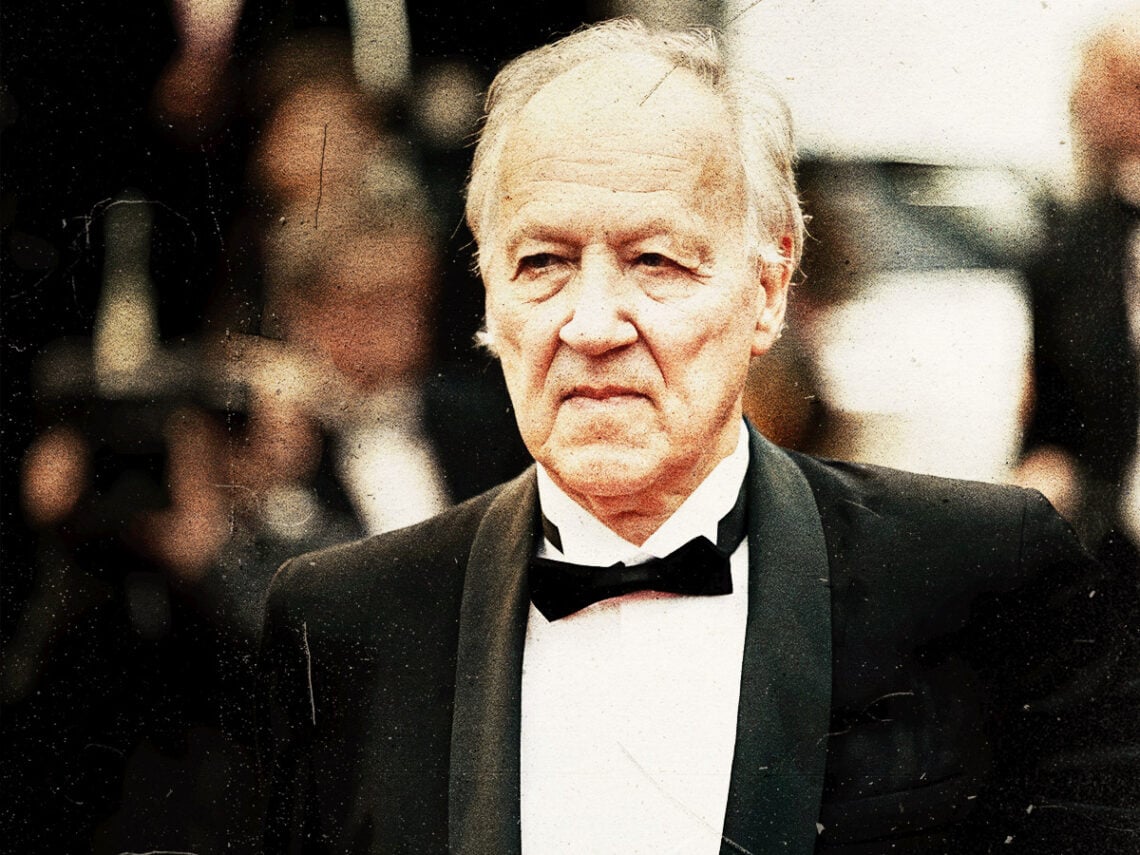
“That’s greatness”: Werner Herzog on the only movie that achieves perfect balance

If Werner Herzog doesn’t like something, he’s happy to let it be known in that distinctively loquacious way of his that makes everything sound at least a little bit foreboding, even if that’s not his intention. Chickens, for instance, are one gripe that have met with deathly wrath.
That comes with the territory when he’s long been established as one of cinema’s most prominent eccentrics, but he’s just as happy to praise something to the hilt when he believes it to be worthy of attention. Usually, that involves are that grabs the full thistle of humanity.
The dichotomy at the heart of the filmmaker was encapsulated by his legendary creative partnership with Klaus Kinski. They alternated between carrying a deep-seated love and mutual appreciation for each other and hurling expletives back and forth while fantasising about killing the other one and generally making each other’s lives a misery in the most vicious way possible.
Herzog’s outspoken and uncompromising nature means that he’ll very rarely be found falling over himself to celebrate a movie that barely has any imperfections from his point of view. That’s why it carries plenty of weight to hear him describe one stone-cold classic as “probably the only film that I’ve ever seen which has something like perfect balance, which does not occur in filmmaking very often”.
That might be surprising in and of itself, but it becomes less so when he’s talking about Akira Kurosawa’s Rashomon, one of the most influential and often-imitated films from one of the industry’s most influential and often-imitated auteurs.
“You sense it sometimes in great music, but I haven’t experienced it in cinema, and it’s mind-boggling,” he said to Rotten Tomatoes of the Japanese legend’s near-perfect masterpiece. “I don’t know how Kurosawa did it. It’s still a mystery to me. That’s greatness.”
Rashomon completely revolutionised cinematic storytelling forever, with Kurosawa using a single inciting event – in this case, the rape of a woman and the murder of her husband – to prevent conflicting versions of the exact same scenario. The various characters therein relay the events as they either remember them or want them to be recorded for posterity, with new questions constantly being posed.
In the 70+ years since the film’s initial release, the ‘Rashomon effect’ has become a staple structural conceit that’s been adopted across film, television, literature, video games, and virtually every other form of media. That’s not to say Kurosawa invented the technique, but he definitely brought it to mainstream prominence, and creatives have been leaning into it liberally ever since.
However, not many have done it anywhere near as well as the maestro, with Kurosawa’s Rashomon relying on that sense of balance to its multi-pronged plot that Herzog was so taken by. Much like vast swathes of his illustrious filmography itself, then, the structure has been regularly pilfered but never bettered.
