


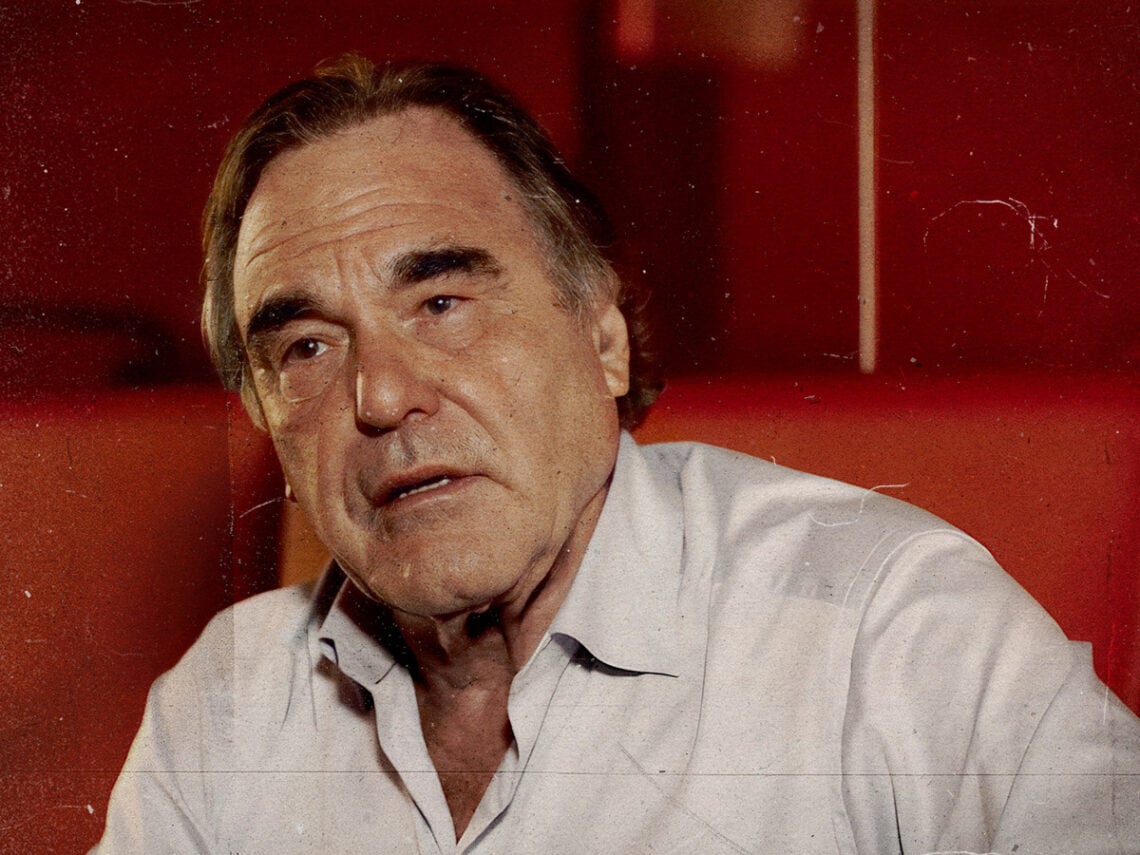
“Deny their existence”: How Oliver Stone has failed women throughout his career

As far as the films of Oliver Stone go, it’s fair to say that he’s often detailed the inner workings of male figures, whether in cultural, criminal or political areas. In whatever form, masculinity has frequently played the key role in defining Stone’s films ever since his screenwriting debut, Midnight Express, in 1978.
As a director, though, Stone cemented his position as an auteur of male-centric cinema, largely beginning with his Vietnam War drama Platoon and going on into the likes of Born of the Fourth of July, The Doors, JFK and Nixon. Stone didn’t truly consider a female main character in his films, at least until 1994’s Natural Born Killers, though even Mallory is inextricably tied to her husband, Mickey.
This raises the question of just how Stone perceives women given how he has represented them within his films. For all intents and purposes, it looks as though women have often played second fiddle to men in most of Stone’s films, and even the director admitted that when it came to his 1987 drama film Wall Street, he got his portrayal all wrong.
In an interview with David Breskin, Stone claimed to have recognised a “failure in the writing” of Wall Street, which starred Michael Douglas, Daryl Hannah and Martin Sheen and focuses on a young stockbroker who becomes embroiled in the workings of an affluent corporate raider.
Sean Young, who played the wife of Gordon Gekko in Wall Street, later called Stone “a bastard” for the way he reduced her role after she stuck up for co-star Daryl Hannah when the director made her wear a revealing dress that she wasn’t entirely comfortably with. Young also claimed that Charlie Sheen had stuck a note with the word “c-nt” while the production was going on creating a toxic set. Therefore, it’s clear that Stone’s movies have not always possessed a positive atmosphere for women to work on.
Responding to the overall dominance of men over women in his films in the interview with Breskin, Stone noted, “I’d say the boys have been the protagonists, but the movies have been about ideas in which men were primarily concerned,” meaning war, drugs and money. Still, Stone felt that he had tried to incorporate more women into his films as time went on so as not to “deny their existence”.
Breskin had been keen to point out that Stone had often portrayed women as merely being there to serve a purpose, or rather, to serve men as mere commodities, but Stone responded by saying that he had tried to make a film version of Evita with Meryl Streep, who would have served as his first female protagonist. However, it is perhaps telling that this never came to fruition.
According to Stone, he had more women working on The Doors than on any of his other films, so the director clearly believes he has made a concerted effort to be more inclusive. However, Stone followed up by saying, “I admire, I adore women. I’ve lived with many women in my life. I think women dispense grace.”
“Beauty is important on the screen,” he added. “I don’t want to belittle it. I realize that. When you see a beautiful face, you respond. It’s as old as the world. It behooves me to use beautiful faces.” Evidently, even in Stone’s personal life, he merely sees women as being possessors of beauty and grace rather than power and intelligence, as many of his films would suggest, most notably, Wall Street.
Stone made a final attempt to justify his treatment of women in his films by claiming that when a woman is intelligent, it makes her “very sexy” even though a woman “without a brain in her head” can be equally “exciting”. Once more, the take-home seems to be that the viewpoint is primarily physical even as he tried to rectify his remarks and filmmaking history.
Sadly, though, the damage has already been done by Stone, and even though he was desperate to stress that there are strong female characters in the likes of Born on the Fourth of July, The Doors and Salvador, it’s clear that his on-screen portrayal of women has fallen well short of the mark.
Stone’s movies are undoubtedly a male affair, concerned with violence, money and the historical periods where politics were dominated by men. In that light, and though the director, with a self-confessed “appetite” for women akin to an “African chief”, has made a shallow effort to include more women in his films, it’s clear that Stone has failed in whatever feeble attempts he has made to portray them in a positive light, beyond providing men with beauty, sex and something to gaze upon.
