


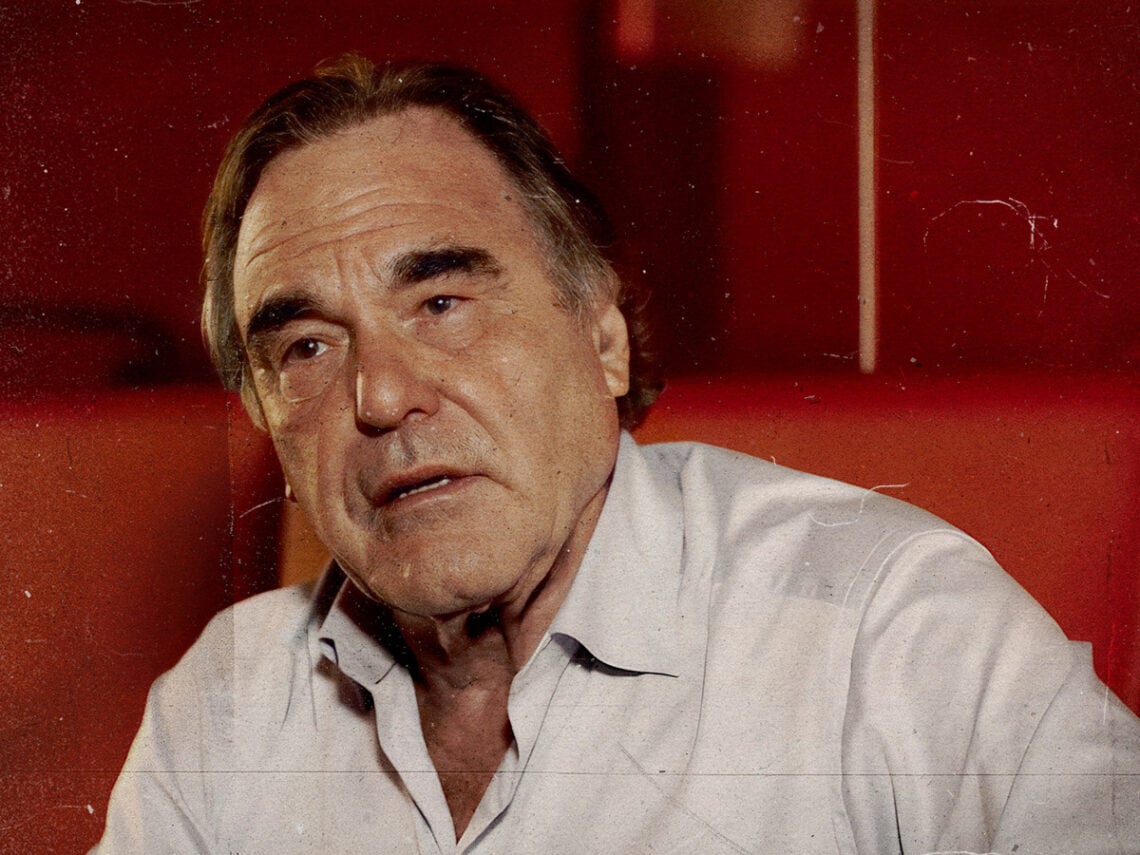
Oliver Stone explains why happy endings are “not possible” to make any more

Often, Hollywood can be criticised for creating what feels like a fodder of content, where directors and filmmakers aren’t allowed to freely create, instead being restricted by studio demands. Of course, many ardent creatives buck this trend, with the likes of Quentin Tarantino, Lynne Ramsay and Oliver Stone creating films that challenge the status quo and strive for innovative cinematic artistry.
Each of these aforementioned filmmakers still rears their heads every so often in the industry today, even if Stone is better known as an icon of the late 20th century. A heavily political director, Stone worked with several 20th-century icons, such as Tom Cruise, Willem Dafoe, Kevin Costner, Tommy Lee Jones, Val Kilmer and Keith David, whilst conjuring the Oscar-winning movies Platoon, JFK and Born on the Fourth of July.
Creating a Vietnam War trilogy in the 1980s and 1990s, Stone was known for his outspoken opinions and politically-driven movies, a sentiment that carried over into his contemporary releases, most appropriately, 2022’s Nuclear, a documentary about how the climate crisis can be solved with the innovation of nuclear power.
Speaking about the movie in relation to the attitudes of contemporary society, Stone told The Playlist, “There’s so much conventional illusion. It’s the nature of life…You have to accept it. Most people are deluded. Most people believe in Gods and all sorts of superstitious crap. Science is the best way to deal with life. Not to say it’s the only answer, but to me it’s the spiritual answer”.
His decision to take on the documentary came after Stone read Joshua S. Goldstein’s A Bright Future, the book on which the movie is set. “I read the review, and I bought the book,” he added, “This was after I had been made aware of how dangerous climate change is through the years from the Al Gore film [An Inconvenient Truth] in 2006, until now…Right away, I called him (Goldstein) up and said can I option the book? I asked him to write a dramatic film, but it was a mistake because it’s not possible to dramatize nuclear power. It’s not possible”.
The conversation later drifted onto the influx of disaster movies since the turn of the new millennium, including climate-centred fictional catastrophes as seen in The Day After Tomorrow, Geostorm, or Adam McKay’s ‘Best Picture’ nominee Don’t Look Up.
When pressed as to why we’ve seen so many of these movies, Stone explained: “So much has gone wrong. They say everything is going wrong. The world is fucked. We are very pessimistic now. There’s no possibility to have hope in movies. It’s seen as corny. If Frank Capra came along and made movies with a happy ending. I love that. We love that, but it’s not possible anymore. It doesn’t seem possible. There’s a deliberate type of self-imprisonment. Movies have always been made for horror and fear. It makes money”.
Stone is, indeed, correct, with such endings feeling too disingenuous for modern audiences who are not blind to the issues of the modern world. Take a look at the trailer for Stone’s documentary below.
